“I… I don’t like soccer,” confessed Park Chan-wook in a strange little essay published around the time of the 2002 World Cup, co-hosted between South Korea and Japan. “Football is the last sacred ritual of our time,” declared Pier Paolo Pasolini back in the ‘70s, as detailed in the book El fútbol según Pasolini. The relationship between football and filmmakers is rich, dating back to the origins of the artform itself when Alexandre Promio became the first person to film a football match back in 1897. But, more recently, it’s been another Alexandre who has popularized the sport for cinephiles worldwide. That would be Alexandre Koberidze, the Georgian filmmaker whose second feature, What Do We See When We Look at the Sky? (2021), takes place during the 2018 World Cup and his follow-up, the recently-released Dry Leaf (2025), follows a man and his invisible friend as they travel to football fields scattered across the nation’s rural villages. His films understand the role football plays in culture—especially outside the United States—as a link between people, a fountain of passion, and a source of occasional heartbreak. All matters that we can also apply to cinema: an art that unites, enthralls, and more often than not stings.
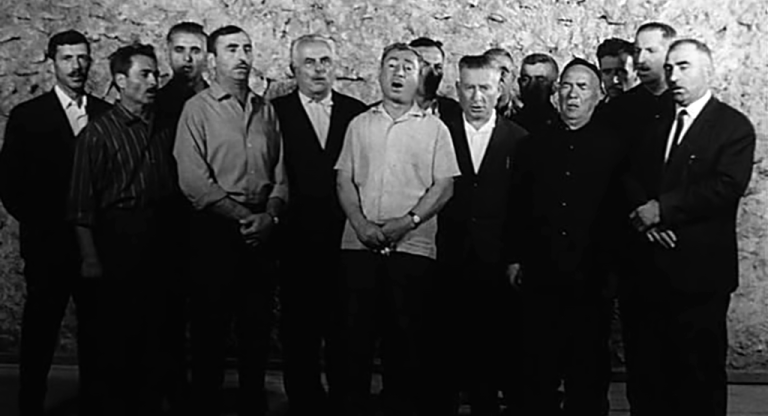
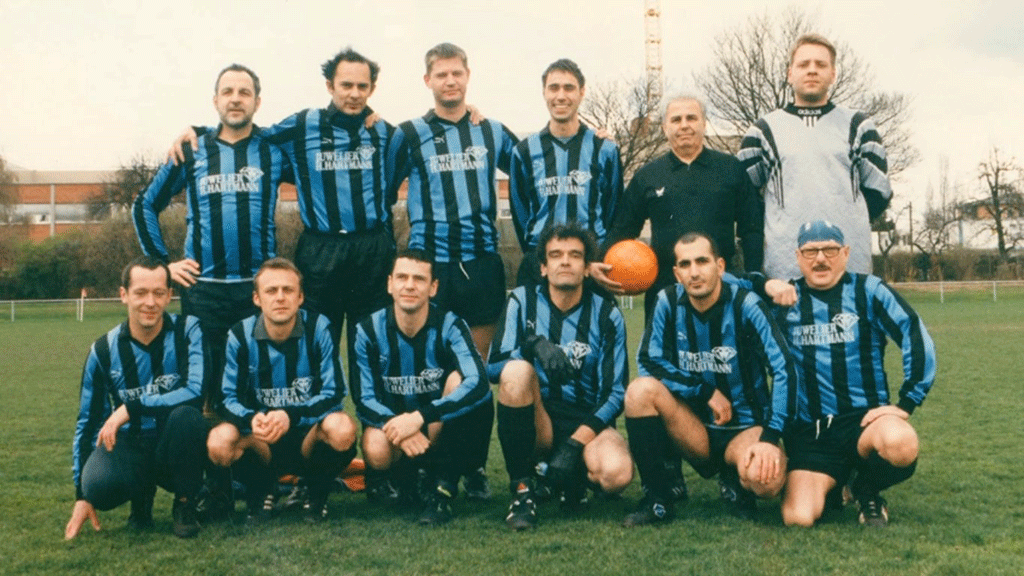
German director Christian Petzold’s relationship to football might not be so evident from his films. In fact, he once stated that “it’s not possible to make a good movie about soccer.” A point he more or less repeats in the conversation below. Nevertheless, Petzold is a man who is devoted to football, having played in the same team as Harun Farocki (as seen above) for two decades. And, as will become evident below, he identifies a similar high in good filmmaking and good football.
On the occasion of the first annual Cinema Showdown—a football match between Koberidze and Petzold, whose new films hit U.S. theaters this weekend—I spoke with both filmmakers about their relationship to the sport. What unfolds is a curious conversation about team loyalties, community bonding, and Petzold’s short-lived career as a quasi-professional football player.
Nicolas Pedrero-Setzer: I’ve spoken to you in separate contexts and I was pleased to find out that both of your favorite football clubs are tied to cities with strong working-class, leftist traditions. Alexandre, you informed me you were a Barcelona fan; Christian, you said Liverpool. What is the relationship between your love of these teams and politics?
Christian Petzold: Liverpool is not my first favorite team. That’s a German team: Borussia Mönchengladbach. They played fantastic football in the ‘70s. The village I’m from is a very ugly village and Mönchengladbach is also very, very ugly. That something so beautiful as the way in which Mönchengladbach played in the ‘70s could exist in such ugly circumstances gave me hope for my own life in the ‘70s, when I was playing football by myself; therefore, I think there is a correlation between Borussia Mönchengladbach and myself. Now they play ugly football. I don’t know what that means for me, but in the ‘70s, when I was younger, they played fantastic football.
Alexandre Koberidze: Generally speaking, football in the ‘70s was a more romantic sport than it is now. For me it started with a coincidence. Of course, I would love to be a fan of Dinamo Tbilisi or some other Georgian team, but I completely missed the interesting times of Georgian football. When I was growing up, there were some people who were really following the Georgian club football scene, and now I admire them because it’s a really small community. They go to games together, watch them, and know a lot, but for me and my friends this was never the subject.
For me, it started in ‘94. At my school, everyone was talking about the Champions League final where Barcelona was playing against Milan. Barcelona was the favorite, and at school all of the kids were talking about how Barcelona would destroy Milan. So, I became part of it. Then, at night, we watched the game and Barcelona lost 4-0. It was a shocking experience to see a giant, a favorite that everyone was in love with, destroyed in a moment. The next day, when I got to school, everyone was a Milan fan. I felt that Barcelona needed someone on their side. It’s part of childhood to choose the side of the weak. So, that’s where it all started. I’ve been following them since. Still, for me, it is completely unexplainable why I get nervous when I watch football, or when I watch Barcelona play. I’m less nervous now, but as a teenager it was a lot. Sometimes I couldn’t even watch because I was so nervous.
NP: As a kid in Mexico, I remember always feeling nervous around the time of the World Cup. There was hope, but an eventual relinquishment of that hope because we don’t have the best track record as a national team. It's important to experience that as a kid—such a big emotion.
Now for you, as filmmakers, I’m curious if you had a similar emotional pull to cinema as children. Did the love of the game or the art come first, and were they at all related?
CP: There is a big difference between playing football by yourself, being part of the fan culture, being in a stadium, and so on. I played football for 40 years until both of my knees broke. Throughout these 40 years, I felt this one fantastic emotion that I searched for every weekend when I played: this feeling that you are in a team and the structure of the game is unraveling by itself. You are losing your individuality. You are part of language. You know where to pass the ball. This feeling is very similar to that of the best moments when you are making movies. This is also something that you experience when you are at the cinema watching a movie and lose yourself. These are experiences that I can compare to playing football.
There is a quotation from Elias Canetti that goes something like this, “Everyone who is going into a stadium is sitting with his back to ordinary life.” This is something which is fantastic at football stadiums. But to watch football at a T.V. is something totally different. It’s a very lonely thing. In What Do We See When We Look at the Sky? [2021] Alexandre, what match are they watching?
AK: There are various games. We were shooting during the World Cup.
CP: Two years ago, Georgia’s football team in the Eurocup was fantastic. You could see, in the reaction of the players, that they were playing for something more than their nation. There was something very, very touching about the way they played.
AK: When we qualified for the Euros… I’ve never seen something like this happen in Tbilisi. People say that when Dinamo Tbilisi won the Winners Cup in 1981 it was a similar situation. The whole city was outside. Kids. Older people. Young people. Everyone was hugging. I’ve never hugged so many people I don’t know in my life. And, it might never happen again. I was hugging everyone and everyone was hugging me. You would go outside and it was pure happiness—with no thoughts about tomorrow.
CP: When I saw your movie [What Do We See When We Look at the Sky?] in Sevilla, I remember feeling that the melancholic, empty streets in it and the football matches on the T.V. sets signaled that the whole of Georgian society was waiting for this moment that you talk about. When people come out of their houses and there is community. When I saw the Georgian team play in the Euros later, I had the feeling that if the movie was shot then, it would be a completely different movie.
AK: Absolutely, because there was not even a dream that something like this could happen. That the streets could be full. No one ever imagined that. When it happened, I was happy that I was able to be part of it without having to think about how to show it on film. I just closed the door, went outside, bought the biggest bottle of beer, and ran.
NP: I’d like to go back to this notion of losing one’s self and whether you’ve identified other similarities between football and cinema. For example: the frame, the durational aspect, the 90-minute runtime, the collective organization. Are these similarities you’ve felt?
CP: The 90 minutes are deep in my body and my experience, but I think Alexandre is a fan of extra time.
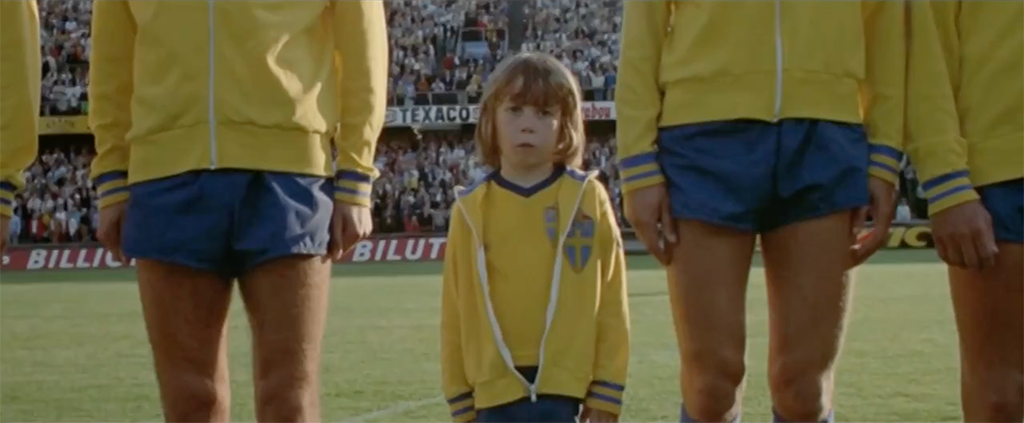
Anyhow, there’s one very interesting thing: football does not exist in cinema. There is only one movie that is quite okay and tries to make football its main subject. It’s a Swedish film called Flimpen [1974], but it’s about a seven-year-old boy who plays fantastic football. You cannot make a movie where the main subject is football because football has its own camera positions. It doesn’t need the cinema. It has the wide-shot. It has the close-ups. It has the steadicam view. It has the goal cameras. That’s enough. When cinema tries to film football, they want to do new things—subjective point-of-view, for example. It’s ridiculous; therefore, cinema and football do not work together. There are similarities, but they do not relate to the language of cinematography.
NP: Alexandre, do you agree?
AK: Yes. At some point, I understood why it was important for me to follow football. If you follow it for enough time, you follow stories. It is like an unending series. You know, This guy comes from this kind of family, he started very young, he was injured, and now he’s coming back… And you know the whole backstory of the other guy too—and they have to meet. And, The team is struggling and there is a coach who hasn’t coached for 20 years… You have so many destinies coming together and these layers create a dramaturgical story.
This is what happened with Leo Messi. At some point, the whole world knew that he had tried to win and was not able to. The whole world was watching this dramaturgy of someone losing, losing, losing and winning in the end. That could easily be the dramaturgy of a novel or a film where different characters collapse or help each other. There is this layer, besides many others. There is also this unspoken movement between people who are doing something. Or, who are part of a team and trying to create something. This is very similar to cinema.
CP: Football scenes themselves are not interesting, but the things around them are. For example, you can make a movie about when Barcelona killed the UNICEF logo on their jerseys because they wanted to make money. First, they didn’t want to be capitalistic. They wanted UNICEF on their shirts and to have a democratic structure. Now they have debts and they need money—something is happening there with the structure of football. You can make a movie about this.
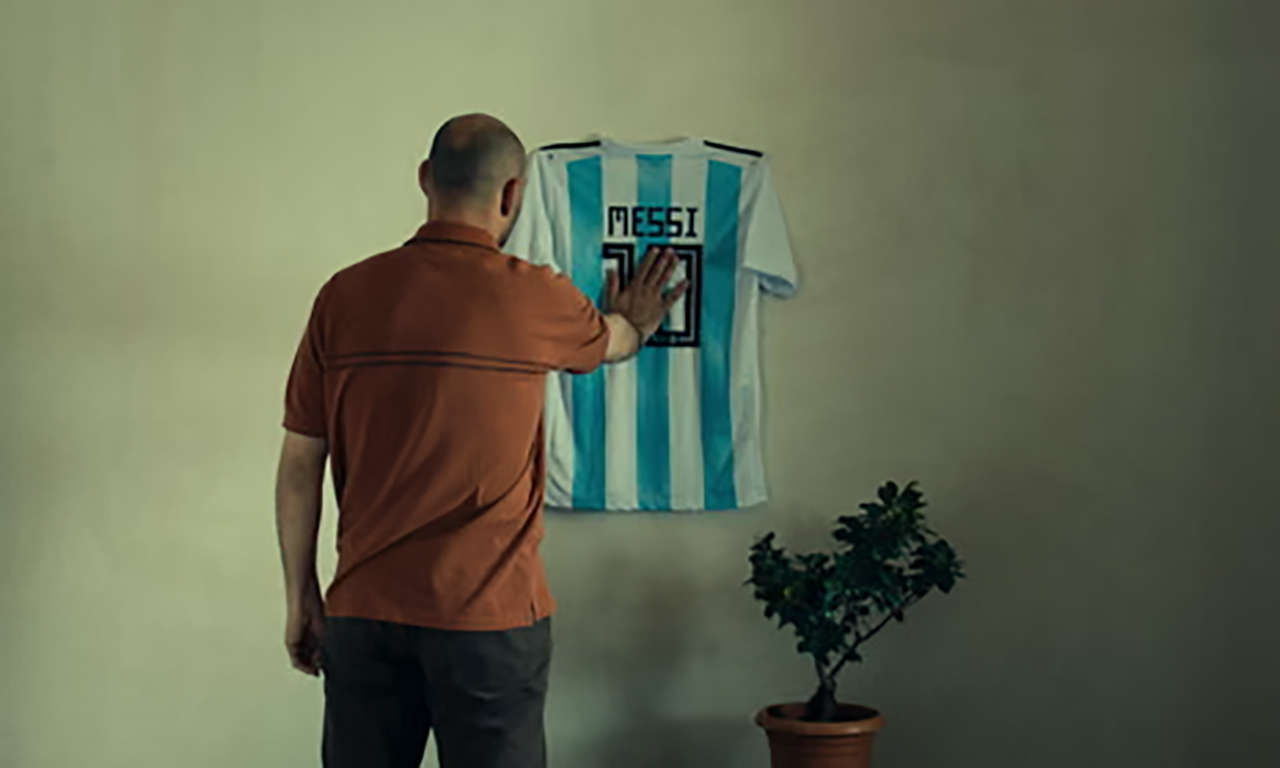
NP: Then football becomes a backdrop. Alexandre, this happens in your films. In your latest one, the football fields across rural Georgia push the narrative, and in the last one, the games happen in the background, on T.V. sets across bars. Must football be relegated to being backdrop in narrative cinema?
AP: Football is my biggest passion. So, looking for moments that I want to film, and that awaken my most passionate side, I integrate football into my films. They give me a lot of energy. When I make a film and I have to wake up early, I feel a slight laziness. It becomes hard to wake up. But when I go play football, I always wake up before the alarm clock. I wake up and I shower, and I am ready, waiting for others to join me. It gives me this push of energy, this happiness. So, I figured that if I integrated it into my films, then I could transport this energy into my work.
When we were looking for locations [on Dry Leaf], at one point we went to a really big football stadium and they took us on an excursion. We walked through this tunnel that football players walk through to start the game and I almost fainted from the feeling even though the stadium was empty. I imagined what it would be like to go through that tunnel if the stadium was full.
NP: That image reminds me of The Purple Rose of Cairo [1985], of what it would mean to step into a film or a football match. It’s as if you’re leaving yourself behind, losing yourself in the frame or the field.
CP: When you watch a John Ford movie, like My Darling Clementine [1946], you see this newly built village. The first thing that people build in it is always a church, because they need a center and a place where they can meet. The football fields in European towns are a little bit like the churches in John Ford movies. The first thing people build up in small villages is a little football field. You can drink beer. You can meet up there. The women are coming. The young people are playing football. And, really, the saddest thing for me is when I went through Eastern Europe, in Romania and Ukraine, many years ago and saw football fields like ruins. No one is playing there. You see two goats. You can see the death of these communities in these ruined football fields.
NP: You might like Alexandre’s new movie then, because, to a certain degree, that is its subject. He found all of these abandoned football fields across Georgia. Alexandre, can you talk about the impetus behind your decision to look for these fields?
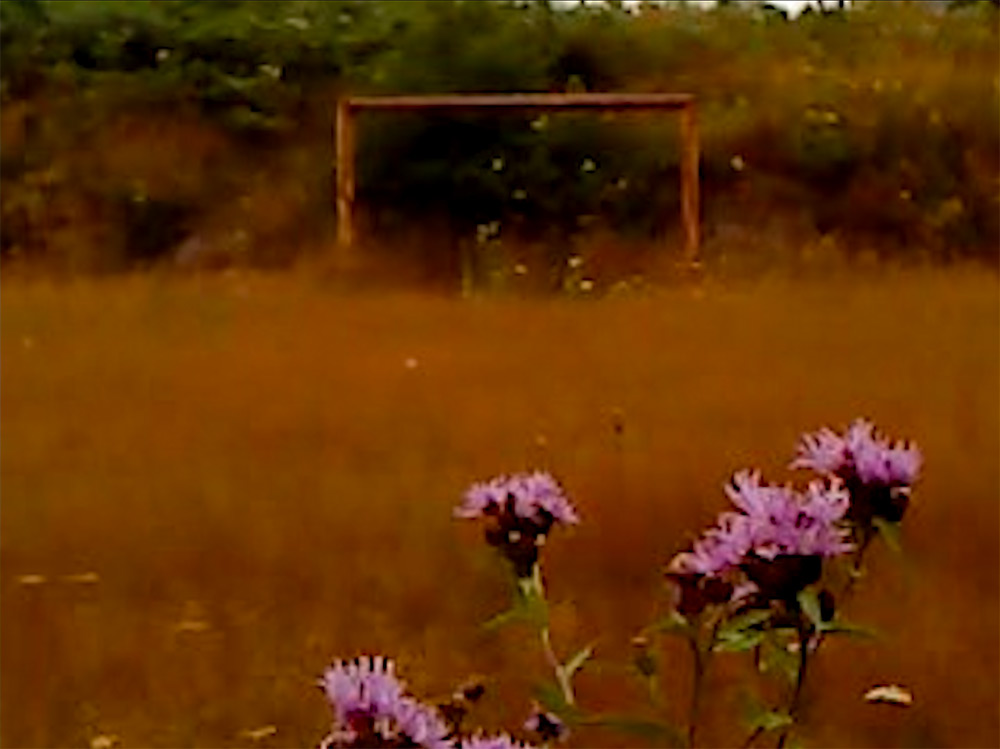
AK: I was not looking for abandoned places. I was just looking for places where people may or may not be playing football. It was never my intention to show that places are abandoned. If you go to many of the places that we filmed at in the evening, when the sun is gone and it’s not so hot anymore, you will find some people playing football. Only after a few screenings did I realize that I had filmed these football fields that looked abandoned. Different people approached me with this reaction, “That it seemed like I was looking for abandoned football fields.” Because I was working in a very intuitive way, maybe that’s the truth. But, that’s not how it started. I was more interested in seeing how I could film these places and how beautiful they are. But, of course, there is this layer because sometimes they are destroyed and sometimes they are empty. Then again, we’ll never know because in the film we have many invisible characters, so any time you see an empty field it might actually be full.
CP: Cinema always likes abandoned places. Abandoned places are talking about what happened and what is lost. There are so many movies about war that don’t show the war. They show the war fields after something happened. The cinema is a sentimental art. Cinema loves divorce more than the act of falling in love. I’m sure of that.
NP: I want to return to this question of passion. Alexandre, you’ve said that it’s easier to wake up for football than it is for cinema, and that you have to transplant this passion from one to the other. Christian, do you share this feeling?
CP: When I made my first film, I was playing in a football team with Harun Farocki. It’s called Tasmania Berlin. It’s one of the worst teams in the Bundesliga [the professional football league in Germany]. Every Saturday, they made bad jokes about us. But, we played there together.
Monday was the first day of shooting. Saturday, we had to play. Harun said to me, “You want to play on Saturday and on Monday we’re shooting? Can you concentrate?” I said, “Yes, it’s important for me to play.” But then we started playing and I was really bad. I saw myself, like a bad actor who is thinking about himself. At half-time, I went home. It was not possible for me to play. I lost my football innocence. But later, with the second movie, it came back. To direct a movie is to be like a coach. To be a player is a more innocent thing.
AK: You were playing in the Bundesliga?
CP: Yes, as part of Tasmania Berlin. One Berlin team can reach the Bundesliga, because Germany is a federal state. Tasmania came into the Bundesliga because Hertha BSC had something to do with corrupted money. So, Berlin has a really bad, bad team in the Bundesliga. I don’t think they have more than 7 points. Three goals shot in one season.
I was part of a special team with directors, artists, and so on. But we wore the same jerseys and had to stand for all of these bad jokes they made about us. But, I now know that I was not such a good player. I thought I was, but there was this one thing that happened to me. I was in Antalya [Turkey] with my wife and the Algiers National Team was also there because they have a training camp there. I went to their table and said, “I’m sorry about what happened in 1982”—when Germany knocked them out. It was a corrupt thing. So they took me with them to their training match and let me play with them. But, after one minute, they said, “Okay, you can sit there with the women.” There was a big, big gap between their professional football playing and my own.
Screen Slate, 1-2 Special & Cinema Guild Present The First Annual Cinema Showdown. Kick-off is at 11am at 71st Riverside Soccer Field.