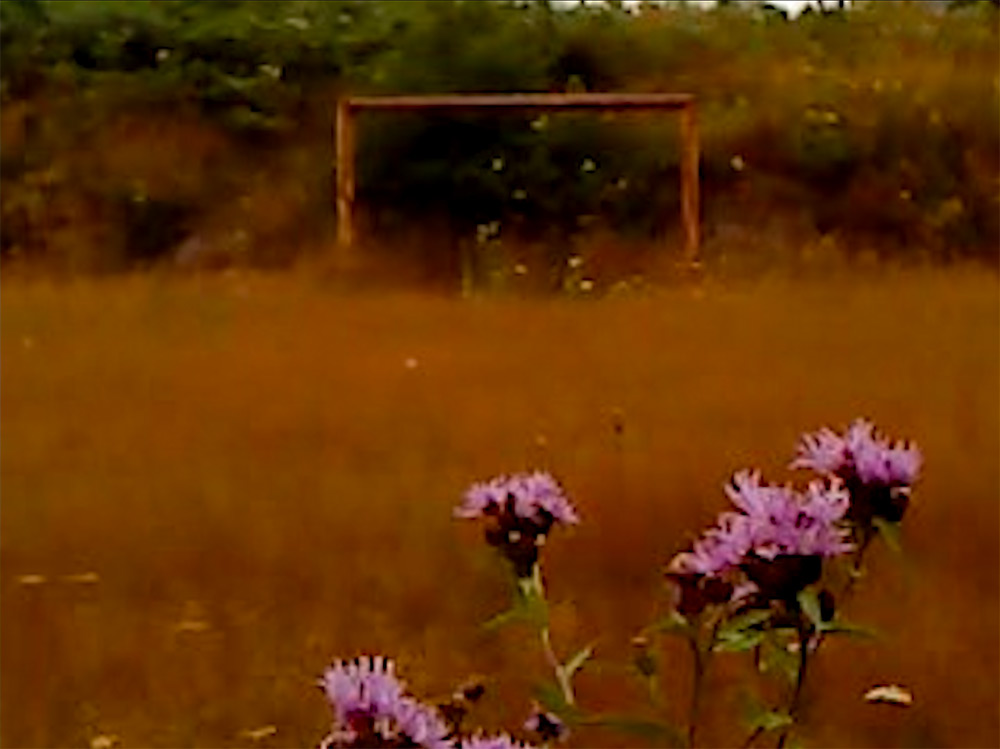
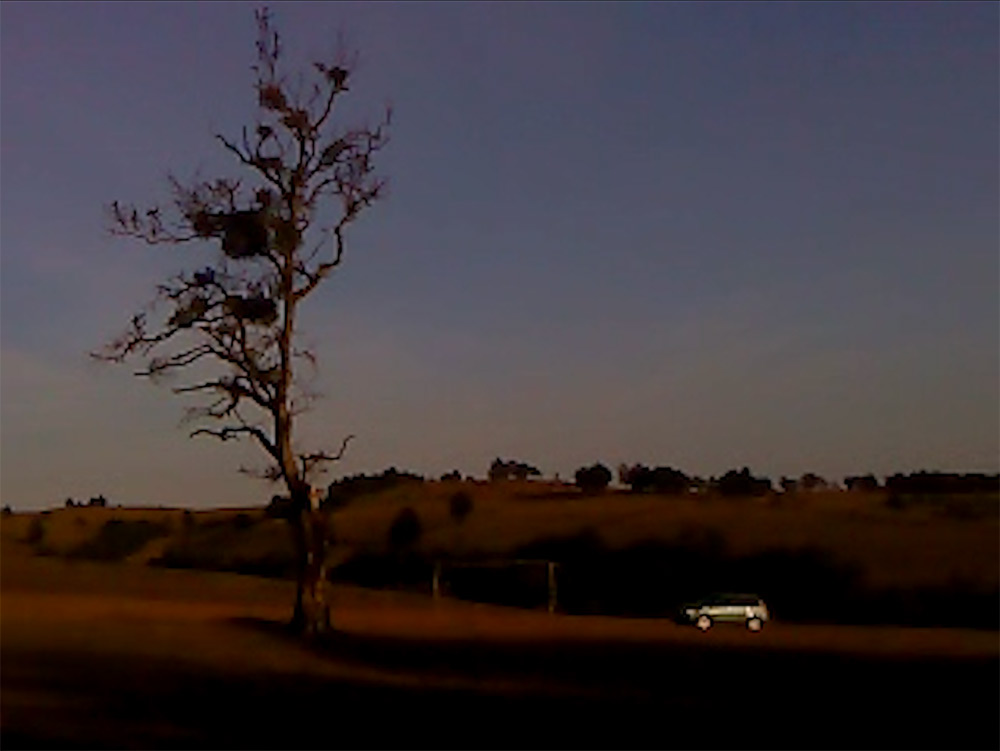
More than an emotion or intellectual idea, the greatest sensation one takes leaving Alexandre Koberidze’s Dry Leaf (2025) is a sense of freedom. Made with a crew of three across a largely improvised series of roadtrips, Dry Leaf is a bittersweet paean to the road and the beauty of the journey regardless of destination. Shot in the often inscrutable 144p resolution of a 2008 Sony Ericsson cell phone, a sense of endless discovery is baked into every hypnotizing, mysterious frame.
The images pulse at you as if rendering before your eyes, at first appearing merely as an odd conglomeration of pixelated dots before taking any semblance of form or meaning. Starting from a simple premise—a father, Irakli (David Koberidze), hits the road to search for his daughter who disappeared while taking photos of rural soccer fields—Koberidze spins the film into a lyrical assemblage of mundane images—flowers, dogs, donkeys, football fields at dusk—made ethereal and nearly fabulistic through the film’s undulating rhythms and Giorgi Koberidze’s looping, electro-acoustic score.
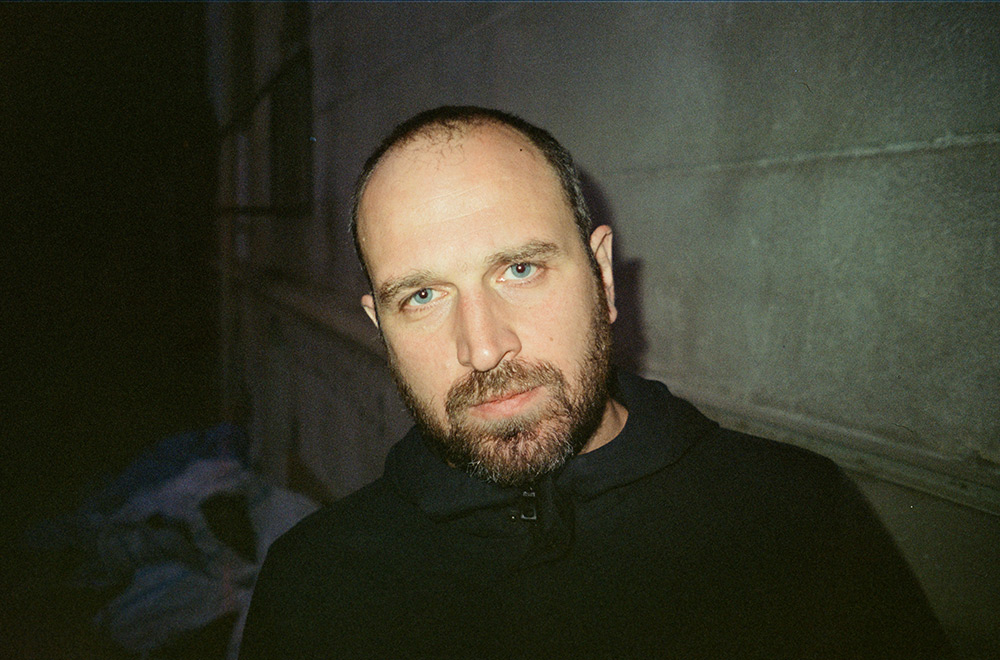
I was lucky enough to be able to sit down with Koberdize at the Black Nights Film Festival in Estonia to talk to him about the film’s lofi beauty.
Joshua Bogatin: What interests you about filming football?
Alexandre Koberidze: Filming something starts as a very intuitive thing, but later I discover different aspects that interest me. Football on TV captures a lot of emotion. I never have scenes where people really get emotional, like happy or sad. My actors mostly express something normal, in between. When filming people playing football I can have really emotional faces in a film without making it very dramatic. The expressions are just inside a game. That's what is generally amazing about sports. It’s so serious in the moment and inside this frame, but there's always still the limit of knowing that it's just a game. It's the same with art and filmmaking. When we were making What Do We See When We Look at the Sky? [2021], my cinematographer and I knew we would get stressed, so we said, “Let’s not forget that it’s just a game that we're playing.”
JB: Your films feel like some mixture of fairy tale and documentary. Are you conscious of those modes as two separate impulses in your work?
AK: It’s a way of trying to look for wonder, or a kind of miracle, in everyday life. And the other way around. I want to somehow connect them, but of course I can't connect them because in order to connect them I have to hold both. But, I don't feel that I'm in the position of holding. I'm more moving between those two spaces, trying to prove to myself that these worlds can coexist and that they exist as they are.
I think there are many things which are excluded from everyday life now, beliefs of what can happen and what cannot. I met a guy in the mountains and he very casually told me a story about an old woman who was going from one village to another a year earlier. She broke her leg and then a bear found her. The bear healed her leg and brought her home. This was told to me in the same manner as I would tell you, “I woke up this morning and had a coffee.” It’s your choice. You either say he's telling some folklore, some silly story, or you say, “Okay, that's how it is.” This guy told me the story, why would I doubt it? Sometimes it's a choice and sometimes it's just a feeling. I don’t know, I believed him. But when I told this to a friend, he was like, “It’s a silly story.”
JB: But is it that you simply believe him? Or that you both believe him and don’t believe him at the same time?
AK: I try to live with the principle that if someone is telling me something, I try not to question it. That's also how I try to read old stories or legends which are understood as completely made up today. I think there is always a layer of things which were happening and are just not happening anymore.
JB: Once we’re on the road in Dry Leaf, I feel like the documentary impulse is more foregrounded than the fabulist impulse. You’ve talked about your process before. How you started with a script and gradually let that go as you proceeded. With this film were you always interested in a more diaristic approach to filmmaking or did that organically emerge through the process?
AK: It was more the process. When I was writing, I wrote things I was interested in and I wanted to do it. I wrote things I wanted to stage to create these pictures. It's not that I wrote something just for funding.
Before going on the trip, I read this book by a Japanese gardener. He makes his garden without separating the different cultures and treating them in a different way. He has land and he lets everything grow together. He says he’s trusting the plants, because they know who has to grow where and when. In the end, he says he has more and better plants than his neighbors who follow the gardening rules. It’s a philosophy of trusting the land and trusting the things you are working with.
I became very curious to see if I could have the same approach with things I'm working with. I try to start something and then follow what it gives you. Also, in the book, he says it doesn't necessarily mean less work. It’s a different kind of work, but the work is more alive. You move and see what has to be done. You follow what the garden is telling you. That’s why I forgot about my plans and followed the road.
JB: Was there ever a moment when you considered dropping the frame narrative? The middle section is so loose and freewheeling—why was it important to have these narrative bookends where Irakli sets off and then ultimately returns?
AK: It's a big question. Why do we need stories for films and do we need them or not? We know there are films with no stories at all and they still work. It’s a bigger question for me than just this film and I’m trying to understand it. Somehow, at some point in my life, I understood that there is no precise answer for every film. Every filmmaker has to define this for themselves. What is their relationship with a story? How much of a story should be in the film? What do we call a film? What is the difference between a clip, a video, and a film? We could call any compilation of sounds and images a film in a way. So why yes or why no? It's a huge question.
For me, if I make something, to call it a film, maybe I need a little story there. It’s not a rule, at some point I will make a film differently, but for now it's just easier for me to have this frame. To think about football again, and the idea of a football field, or a game being only 90 minutes long—it’s the same idea. It's being able to know where it starts and when it ends. To have some rules. Without rules it's anarchy, which is not bad, but it’s a different thing.
JB: Are you very conscious of film tradition when you're making a film? Do you carry a lot of references around in your head?
AK: I generally make films because I've seen films that I loved and have thought, “Maybe I should make one as well.” Now, I always need to see something that I like to be reminded of why I do it. I can't get inspired by the things I make after they’re done. I always need to see a good film to be reminded how beautiful films can be. Sometimes, because of work or other reasons, there are weeks or even months when I don't see anything. I see the whole passion fading away. Then there are films that come to help, to remind me.
In the summer, I had a long run of not seeing anything that I liked and in Cologne, out of coincidence, I saw The Mastermind [2025]. I was very tired, because I didn’t sleep two nights before and I was not sure if I should see it in that condition. But after, I was completely sure in my love of cinema. It was completely regenerated.
JB: It’s a fantastic film. You’ve also talked about silent cinema before. Is that a big influence on your films?
AK: Yes, it’s an influence and it’s also what I try to do. People talk in my films, but not so much. I think Dry Leaf is my film with the most dialogue, but I try to approach all my films like they are silent films. Even though we have sound design, music, dialogue, I stage it and write it as if it were a silent film. Thinking about my next films, it's mostly this, silent films with sound.
JB: Your first two films also reminded me a lot of silent city symphonies. In Dry Leaf so much of the film is about a sense of place, about discovering what’s on the side of the road—be it flowers, donkeys, or invisible children.
AK: We traveled and saw things. It was clear that we would feel the start and end of the story with things we meet on the road. From the beginning, it was clear that the places, situations, and details we find will be the film.
JB: You're also capturing things that are going away. Did you feel a sense of obligation to capture something before it would disappear?
AK: Yes. In Georgia, I have this feeling that there are some buildings which will be gone in a year. It’s a constant process. Things and places disappear, or are no longer as they were. Capturing it or going to look at it—not just capturing it on camera but somehow trying to remember it—is also a way of trying to save yourself.
With nature it's very different because we are destroying it, but we are destroying ourselves first. We know that even after we completely destroy ourselves, life will go on. It's sad, but maybe okay. Still, we were seeing villages and this rural life where everything is working against its existence. The whole politics and economy in Georgia, but also around the world, tells people, you must move to the city. It was like this in communist times and it's like this now. Still, this tradition of living in the countryside is huge for some people, so it's not questionable. I think these people save the land.
JB: I’ve read that you're involved in a lot of the protests and the political struggle going on in Georgia. Do you see the film, or filmmaking in general, as being involved in a political struggle?
AK: I don't know. I'm involved in everyday protests in Georgia, as are most of the people I know. I follow, I don't invent how things should be done. It's a very open process. There are no leaders. But still, there are people who propose what to do and so on. In that sense, I have this simple role that I just go there every day and I do what the others do. But from day one, it was clear to me that I don't want to film them. I wanted to be calm and not mix the two. Also, this is maybe a moment I want to forget and not watch again.
In general, from my personal experience, I know that films I've seen have changed me and have changed my behavior. Before I saw Where is the Friend’s House? [1987], I was one person. After the film, I was a different one. It is a political change, because it really changed my responsibility in life. This is also how politics works: if I feel responsible for the person next to me or not. Small or big things. I’ve experienced it, so I know films work like this, but we never know who is touched and who is not, and in which section of our soul or brain.
JB: At the beginning of the film Irakli asks a classroom, “What is a line?”, and later, “What is a circle?” I thought it was a very funny and brilliant way to get the audience to think about what we might really know or not know about such fundamental things. Can you talk about where these moments came from?
AK: I don't remember exactly, but with these moments I wanted to indicate that what follows is something very simple. At first, a circle or a line seem like the most simple things, but then the film will give you a lot of time to think about how complex they are.
My friend was telling me a story about old Chinese master painters who would spend a lot of time with different shapes. When they were working on circles, they would watch the moon for one month. They would make circles that grow and then get smaller, and would spend the nights with these circles. This was the moment when I connected this simple shape with how much time you can spend with it, and how many ideas it can give you. I thought, this is exactly what interests me: to think about things that seem simple but are not.
JB: To me, the film moves like a dry leaf falling to earth. If you only think about where the leaf is headed, the ground, its journey is linear. But if you look at its actual movement, it constantly swirls in circles in a beautiful series of motions. Were you conscious of those two ideas—circularity and linearity—as you were constructing the film?
AK: Well, when we filmed those moments I really didn't know what kind of film we were making because we filmed them in the beginning. I think we did it because there was something going on, but I didn't know how the film would work. Of course, these shapes are connected to the storytelling we know from old times.
A circle is a circle, but as we know from old stories it's never a circle. You never go back where you started and it's never the same person who started the trip and so on. I also like that my father, his hands are shaking a bit, so when he drew the circle it wasn’t a perfect circle. He was worried about it, and I told him, “No, it's the circle we need because later, when you will be making this trip, it will not be a perfect circle.” You will go in different directions. You want to start it perfectly, but it's changing.
Dry Leaf screens Sunday, April 19, co-presented by SF Cinematheque at the 4 Star Theater.
Previously:
Dry Leaf runs March 20-26 at Film at Lincoln Center. Director Alexandre Koberidze will be in attendance for a series of Q&As. He has also been training for the first annual cinema showdown on March 21, where he will face Christian Petzold in a football (soccer) match.