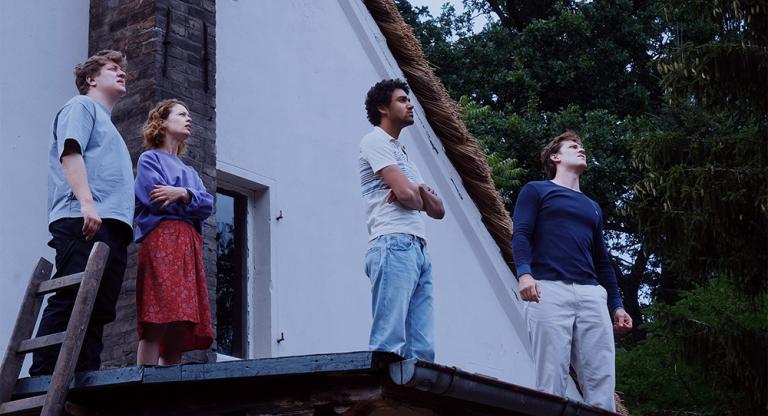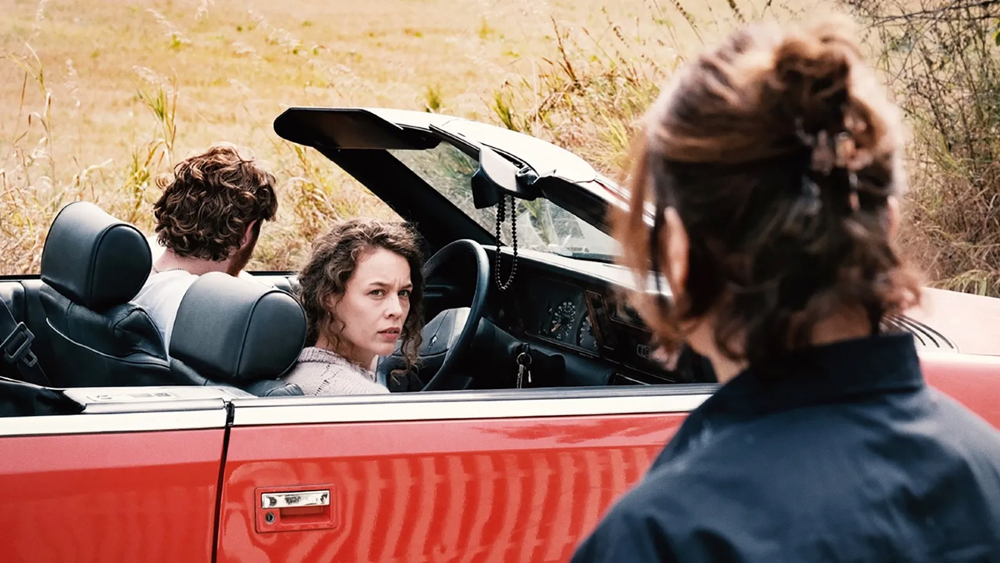
The German auteur Christian Petzold’s abiding commitment to remake Vertigo (1958) with each film is second only to his will to denaturalize our innermost desires and foibles onscreen. In his latest, Miroirs No. 3 (borrowing from Maurice Ravel’s piano suite), a young pianist (Paula Beer) inhabits the home of a strange older woman (Barbara Auer) in the wake of a near-fatal car accident. This fabulistic premise freshens up many of Petzold’s familiar themes: wanderers who appear alien in urban environments, the perpetual construction of identity, and music as a site of psychosomatic trauma.
The words “minor Petzold” have been tossed around as though the film depends on such a distinction, when really its unassuming exterior is not merely charming, but a vital part of how this film grieves its characters—quietly and incessantly, like a nervous tic. Whereas Petzold’s Ghosts (2005) moved with a kind of obscurity, Miroirs No. 3 is comparatively lucid, with its moral affectionately plucked from a children’s story.
Ahead of the film’s North American premiere at TIFF back in September, I spoke with Petzold about water, the cinema of survival, Babybel costuming, and morbid fairytales.
Saffron Maeve: You reference Arnold Böcklin’s painting, The Isle of the Dead, in an early shot in the film, when Laura sees a paddler on the river in a black shroud. Could you speak a little more about the influence of painting on your work?
Christian Petzold: When I start writing a script, I put together photos, music, graphic novels— like a little mood book. Arnold Böcklin’s Isle of the Dead is a very popular painting in Germany and when I was a child I feared seeing it. When I saw the painting again as an adult, I asked myself why there are no visible faces in it, as the young woman and the paddler are looking at the island. The German desire—the whole German world—is death. So, there is a fascistic mood. It’s as if when you’re on the island of death, you find your identity. Then, I saw the picture again and thought the island looked like the open thighs of a woman. There’s a very famous painting, The Origin of the World [Gustave Courbet, 1866], where we see a woman’s vagina and know our life comes out of this. Böcklin turns this around and says, “We want to go back in there to die.” This is the fascistic situation.
On page 10 or 11 of Moby Dick, the narrator notes that there is water in all paintings. When people have problems, they go to the water, to the shore—not in Toronto, they killed the shore with a shit highway, but to a lake or river or pond. In this scene, I said to Paula Beer, “When you are at the bridge on the canal and this Böcklin guy is coming, you realize all your problems are solved when you are dying.” She’s coming into a story where she’s playing a dead person.
SM: I’m also curious about your relationship to music, both broadly and with specific reference to Miroirs. Why “Une barque sur l’océan”?
CP: In making a movie about someone who is on the border of suicide and has learned to see, feel, taste, and smell the world again, I couldn’t use a score because I wanted to hear the birds, the wind, everything. My composer, Stefan Will, was totally depressed at my second movie in a row without a score. But with this Maurice Ravel suite, you can feel the energy and brutality of water. We want to go to the shore to seek the fantastic, but on the other hand, it could be our death. This is inside of the piano piece.
The subtitle [“Une barque sur l’océan”] was the main thing I was interested in because, for me, many movies are about a shipwreck: the parts of the ship are on the surface of the ocean and the survivors are swimming there, hoping to build a raft. Cinema is about surviving and nothing else.
SM: Do you remember the first time you heard the piece?
CP: Yes, when I was shooting Afire [2023]. I had a little Bose sound system in my hotel room and I would always get up at 6am, have a coffee, and listen to the same music each morning. I don’t want to be surprised when I’m working. For Afire, it was this Ravel. The actors would ask me what I’m listening to, so I told them about the cinema as this raft and also the metaphor of the mirror as something that isn’t esoteric. In really good movies, everything happens two times; someone tries to kiss someone twice and the difference between those two kisses is the story.
SM: I watched the film with my partner, who is a pianist and pointed out that Paula Beer was actually playing the pieces in the film. I later read she was coached by Adriana von Franqué. Was it your own suggestion that she learn the music?
CP: Sometimes I need a single thing to start to write a script. When I worked with Paula Beer for the first time on Transit [2018], she left a premiere in Paris two minutes before the screening to go to diving school. She said she was playing a role in a submarine movie [The Wolf’s Call, 2019] and wanted to know what it felt like to be underwater. I said, “That’s a good idea,” and wrote Undine [2020] because of her. Then, during Undine, my flat was close to hers and I could hear piano coming from her flat. “I’m playing,” she told me. Therefore, I came up with the idea for her to play a piano student. Paula had six weeks with that fantastic player, but we still had to do some tricks. Of all the pieces in the film, she can only play the first ten seconds.
SM: A friend told me that you love Gina Gershon’s “I heart gossip” t-shirt in Demonlover [2002]. Could you speak a bit about the costuming in Miroirs, particularly the graphic t-shirts Laura wears that belonged to Yelena? What were you hoping to communicate about Yelena through, for instance, the Babybel tee?
CP: Katharina Ost, the costume designer, is really intelligent. She said that graphic t-shirts in movies are sometimes a problem because people stop looking at the actor’s face and look instead at the graphic, which gives the scene its meaning and intention. We thought if Yelena committed suicide, it had something to do with her mother and the tentacles she kept around her. She gives her adult daughter t-shirts as if she were 11 years old—Babybel is a cheese for children, a baby cheese.
On the other hand, Laura wears a very expensive sweater in the summer, as if she’s chilly. Something is not right in her life. Like Yelena, she doesn’t want to be an adult. She wears this duck sweater because she wants to stay young and the world makes her anxious. There’s a Babybel and there’s a duck; there’s a dead woman and a living woman, and they are somehow in contact with each other.
SM: There’s also a strong fable quality to it: the disorienting beginning, the ominous maternal figure, the fateful ending… What is your relationship to fairytales?
CP: In Europe, all the blood, the traumata, the earth’s memories, are in myths and stories. The tales of the Brüder Grimm are European stories which come from France to Germany, so you have a collective memory very similar to cinema.
I don’t like movies that are based on good literature, but ones based on one song or one tale. When our kids were very young, my wife and I read the tales of the Brüder Grimm to them, and one of our favorites was about a young girl who died and whose mother prepares dinner for her each evening. The girl then has to come out of the grave, sit at the table in her shroud, and eat with her mother. But after a week, she tells her mother she must stop making the dinner, which is to say, stop suffering. If she doesn’t, the girl is stuck in this purgatory and cannot go to heaven. My kids didn’t sleep for days.
Miroirs No. 3 runs March 19-26 at Film at Lincoln Center. Director Christian Petzold will be in attendance for a series of Q&As. He will also be around for Film at Lincoln Center’s series “Christian Petzold in Person” and the upcoming first annual Cinema Showdown.
In San Francisco, Miroirs No. 3 runs March 27-April 2 at the Vogue Theatre.