In a 1983 article published in American Film, screenwriter Stephen Rebello summarized the findings of a panel of “industry insiders” tasked with selecting the finest unproduced screenplays. Among a list headlined by a number of future classics, including Paul Verhoeven’s Total Recall (1990) and Rob Reiner’s The Princess Bride (1987), the panel highlighted an unusual romantic comedy about nuclear conflict: Miracle Mile. Described as “a rude and flashy bit of comic business” defined by “the pretzel logic of a nightmare,” the screenplay hailed from writer Steve De Jarnatt, an AFI graduate with one short film under his belt at the time. Despite studio interest, Rebello notes that De Jarnatt was “digging his heels in against compromise” regarding the film’s apocalyptic ending, seeking “to land a shot at directing it himself.” While he waited, De Jarnatt co-wrote the Rick Moranis and Dave Thomas comedy Strange Brew in 1983, later making his directorial debut with the Melanie Griffith sci-fi vehicle Cherry 2000 (1987). In 1988, five years after Miracle Mile’s appearance on American Film’s list, De Jarnatt finally got the chance to direct his touted screenplay as his sophomore feature for the Hemdale Film Corporation.
Unexpectedly, what should have been the start of a promising directorial career instead turned out to be his final feature film. However, for a film that seeks to encompass everything from humanity’s origin to the quotidian nuances of its abrupt extinction, there is something fitting about Miracle Mile standing as De Jarnatt’s definitive statement as a filmmaker. Early in the film, De Jarnatt sets his sights on a television running a documentary about mankind’s emergence from the “primordial stew of Earth’s atmosphere” after countless millennia of evolution, slowly zooming out to reveal the setting: the La Brea Tar Pits Natural History Museum in Los Angeles. Here, humanity’s prehistoric past provides the backdrop for the romantic future of trombone player Harry Washello (Anthony Edwards) as he sets his sights on fellow museum-goer Julie (Mare Winningham), who is endeared by his goofy advances. Totally smitten by his new love, Harry is convinced they were fated to meet: “There must be a cosmic plan of some sort,” he insists.
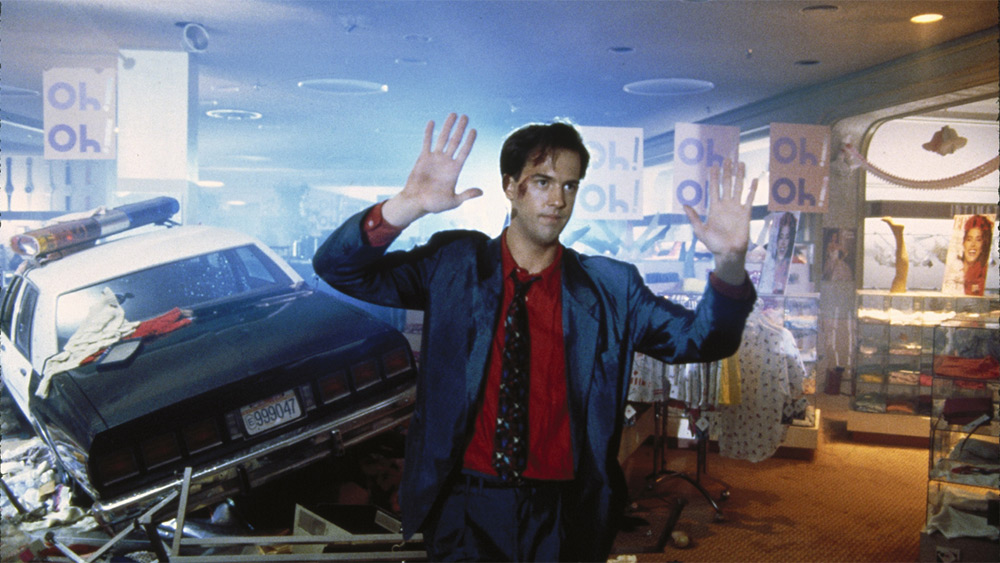
Miracle Mile’s initial ironic fascination with the beginning of the universe, with fateful encounters and cascading chains of causality, is only matched by its bracing confrontation with humanity’s own sudden, violent, and entirely self-imposed destruction through nuclear war. Horribly late for a nocturnal date with Julie, Harry fails to reach her from a phone booth, walking away dejected. Then the phone rings—only it’s not Julie on the other end of the line. A man claims to be calling from a missile silo in North Dakota, insisting that, as part of a newly commenced global conflict, nuclear weapons will hit LA in less than an hour. Here, De Jarnatt lingers on Edwards’s face in a discomfiting long take, as Harry goes from annoyed and dismissive to outright panicked. In a matter of moments, he is convinced that the stuff of nightmares is about to come to fruition.
If the film’s opening cheekily chronicles humanity’s centuries-long evolution, Miracle Mile’s race-against-time plot suggests that the species’ unraveling may be much speedier, with its third act demonstrating how the ultimate devolution could occur in a matter of minutes. For a film that revels in tonal inscrutability, indulging the odd eccentricities of its high-concept scenario and very specific LA milieu, Miracle Mile’s conclusion spirals into a litany of genuinely stomach-churning horrors. As word starts to spread, chaos breaks out in the streets, with throngs of cars and people colliding with nowhere to go. In this exploration of annihilation, De Jarnatt paints a fraught and disturbing portrait of a reversion to primal instincts and social tribalism.
Miracle Mile screens this evening, May 10, and on May 21, at BAM on 35mm as part of the series “Pynchonesque.”