During a panel shown in Peter Nestler’s homage to Straub-Huillét, Defense of Time (2007), the pair wax polemical about direct sound. Straub, at one point, knocks over a cup to drive the argument home: “The sounds one hears, and the people who produce these sounds, are inseparable.” This principle furnished a support beam for their dogmatic ethos, whereby the veracity of a sound (and image) hinges on our ability to see its origin. Likewise, there’s no mistaking the origin of what we hear in Otar Iosseliani’s Ancient Georgian Songs (1969) and Soso Chkhaidze’s Old Georgian Hymns (1970), two films that employ formal strategies other than visual confirmation to demonstrate the origin of their own sound: polyphonic song.
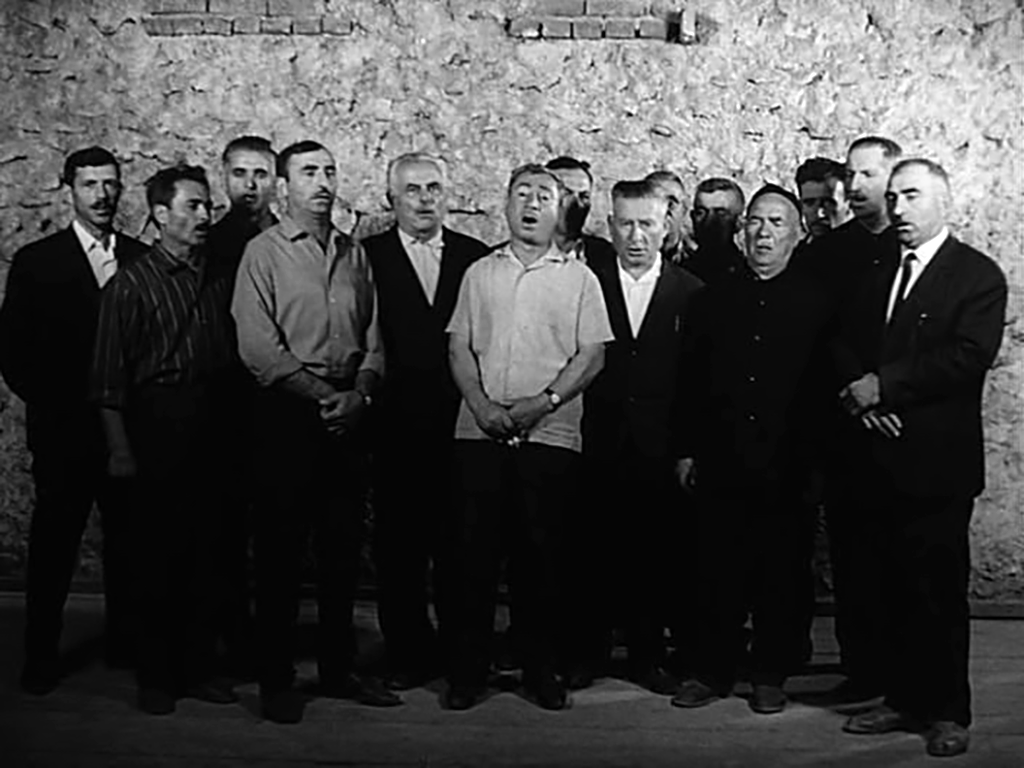
Iosseliani begins with a supra, a traditional Georgian feast at which choral hymns are sung, toasts made, and decanters of wine emptied. He proceeds to show us four of the 15 regional polyphonic dialects, with different ensembles of portly men chanting complex interlocking vocal parts. Dissonant three-part harmonies background pastoral images of the agrarian rhythms from which the musical compositions often derived, many of them taking chords from the cadence of peasantry: women sew, children brawl, and men reap to the metronome. The choir’s symbiotic cohesion is a generational inheritance, the songs and their context passed down from ancestors much like heirloom lockets.
Chkhaidze’s film features the disembodied voices of Anzor Erkomaishvili’s Rustavi choir, superimposed on a travelogue through the Caucasus mountains and its dotting of monasteries—a number of them abandoned soon after the Bolshevik invasion. Remnants of frescoes imbibed with light resound with liturgical tunes centuries removed from their genesis; art survives historical times chipped to the point of half-recognition.
These films undertake the task of historicizing Georgian polyphonic song, something Chkhaidze would later self-parody in his comedic docu-fiction about preserving the tradition, Shvidkatsa (1992), wherein a TV crew rides around the Gurian region to rally the geriatric troops of a village choir for a final recording session. The hermetic choir members, so battered by the years that they can hardly stand without cursing, are thrilled to dust off their pipes for posterity’s sake. Mind you, they can’t perform without Ivane, the 103 year-old conductor; Anania, the crotchety lead vocalist; or Esop, the 93 year-old yodeler, among others.
These films lament a bygone era of culture when polyphonic singers were treated as high-ranking members of society. Both directors revisited this deterioration time and again, but Chkhaidze’s films went by and large unseen. Iosseliani had the last word: “Culture is not something where one cellist performs, and the others, who don't know how to play, listen to him. Culture is when everyone knows how to do something.”
Ancient Georgian Songs + Old Georgian Hymns screen this afternoon, March 21, at e-flux screening room as part of the series “Georgian Polyphonics: Screening and Performance.”