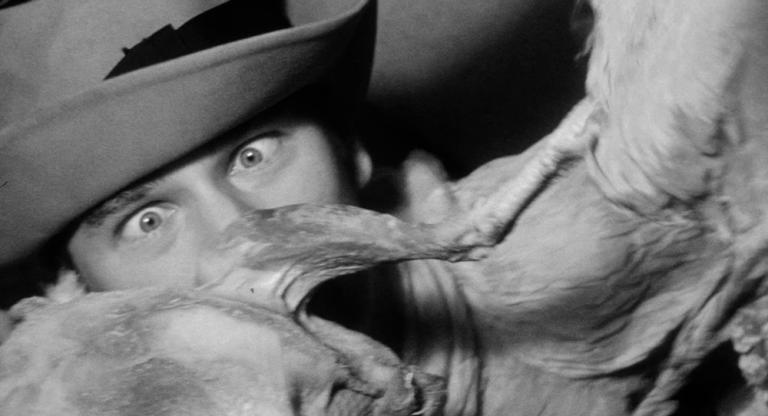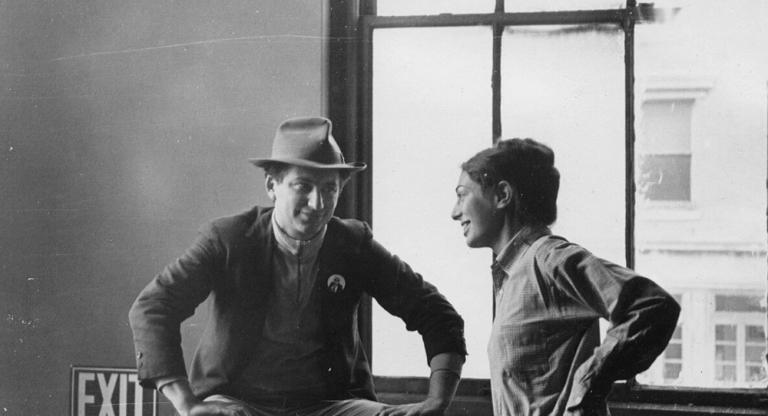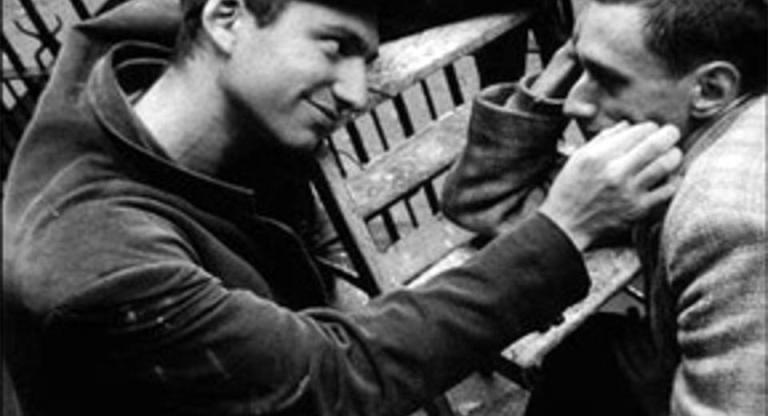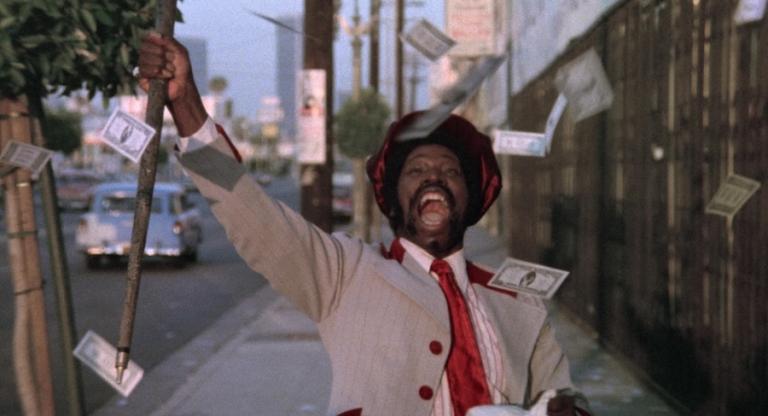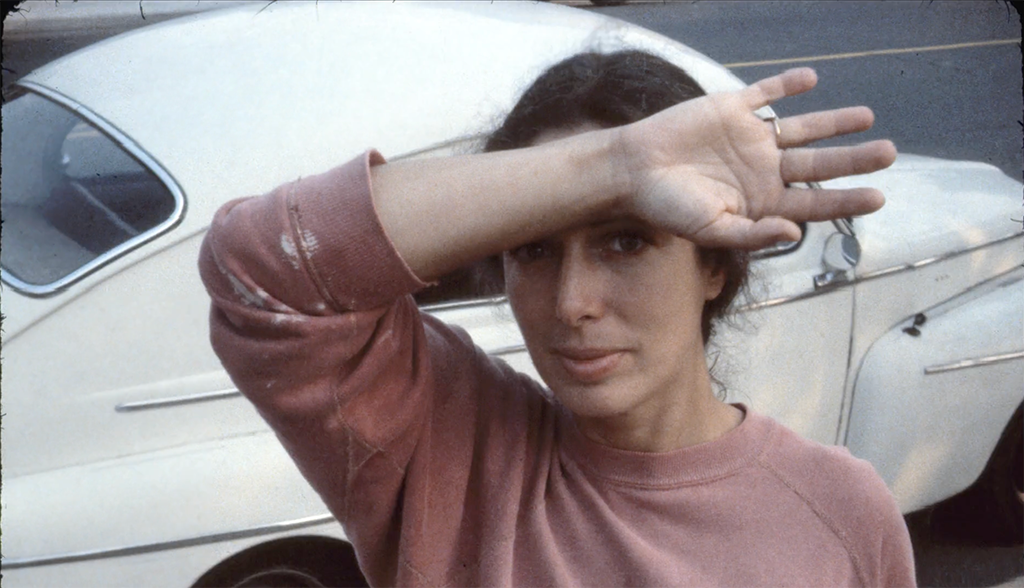
1961: A broke, starving artist hitchhikes from New York City to Provincetown, MA, and, by pure happenstance, meets the one person who sees something in both his work and himself that no one else ever has. Turns out she’s a painter too, naturally. They remain conjoined at the hip for the rest of their lives—until June of last year, when they aren’t. This is, broadly speaking, the story of Ken and Flo Jacobs, the most fortuitous romantic partnership in American experimental cinema this side of Stan Brakhage and Jane Wodening. Together, they formed a creative force that endured for over six decades across film, video, performance, and whatever else they turned their hands to.
Fast forward 38 years. June 1999: The Jacobs are in Taormina, a hilltop town on Sicily’s east coast, attending its annual film festival when Mount Etna—one of Europe’s tallest active volcanoes—erupts. Five months later, with the help of a computer assistant, they completed a film about the incident during a New Works residency at Harvestworks. What they fail to capture, though, is the discharge itself; instead, we’re told it occurred “nearby” at the start of Flo Rounds a Corner (1999), the first of what would become over a hundred digital “Eternalisms,” works ranging from 30 seconds to over two hours that transform two-dimensional images into three-dimensional ones. What unfolds over its six-minute runtime is its own kind of eruption: a surge of tectonic energy acting upon an ever-shifting landscape, generating a push-and-pull current that practically seesaws the images. A simple stroll down a nameless road becomes something closer to controlled entropy: motion breaking down into its component parts, then reassembling in real time. And, of course, there’s Flo, rounding the titular corner, bag of oranges in hand, strutting to her mark, unbothered, never once turning toward us.
But Flo doesn’t so much walk to her destination as stutter forward, her herky-jerky movement fractured into near-identical iterations pulled from different points along her path, flickering against one another. The background façades begin to slip, stretch, and drift, as though the ground beneath them has quietly given way. Space doesn’t extend here; through rapid alternation between similar frames of imagery, it instead oscillates, producing the illusion of depth. As the film progresses, that instability spreads: passing figures double, cross, and interfere, their paths veering as if pulled by competing vectors. When Flo reaches the corner she’s destined to round, the film hesitates, holding the turn in accelerated suspension as if it demands more energy than anything before it. For a brief moment, it seems like she won’t make it; she shuffles in place, as if barred from continuing, the action stretching to half the film’s length. This precarious moment eventually passes: Flo pushes through, as do we, the sun’s blinding rays caught in a nearby car window, and all that accumulated tension dissipates, even as the flickering continues. Flo Rounds a Corner transforms everyday walking, moving from one point to another, into something radical, even divine. Mark McElhatten, a curator’s curator if there ever was one, deemed it “as casual, momentous, and ‘on time’ as the Arrival of a Train at La Ciotat that rounded the corner of another century.”
Between that first encounter and that unassuming turn of the corner lie 13,879 days of shared life, mostly made up of commonplace episodes and interactions with friends and family, many of whom the Jacobs chose to immortalize in Cyclopean 3D: Life with a Beautiful Woman (2011). Composed almost entirely of still images spanning the ‘60s through the mid-to-late ‘70s and brought to life through Jacobs’s patented Eternalism technique, the film plays like an animated picture book—a living, breathing photo album that distills two decades of material into 47 minutes.
From a historical perspective, there’s no shortage of cameos from notable avant-garde film artists: Peter Kubelka, Ernie Gehr, Michael “Mike” Snow, Morgan Fisher, and the aforementioned Stan and Jane. And, from those who deserve wider recognition, like Colorado-based “weirdo art film luminary” (his words, not mine) James Otis, whose own found-footage re-edit On Your Own (1981) appears in full, smack dab in the middle of Ken’s 7-plus-hour manifesto Star Spangled to Death (2004); and, Fred Worden, who passed this past March, a maker of masterful abstract black-and-white films Ken claimed “loosens the brain good.” But the stars of the show are Flo and Ken, along with their two children, Nisi and Azazel, whose quotidian experiences take on a newfound vitality in the film—shaped not just by post-digital manipulation, but also by the love and dedication two intertwined souls shared for one another while inhabiting this mortal plane. It was a pact that began in the ‘60s, carried through the ‘90s, and, thankfully for us, has been rendered eternal.
Flo Rounds a Corner + Cyclopean 3D: Life with a Beautiful Woman screen tomorrow evening, April 15, at Anthology Film Archives as part of the series “The Whole Shebang: Celebrating Ken and Flo Jacobs.” Amy Taubin will introduce the screening.
See Also