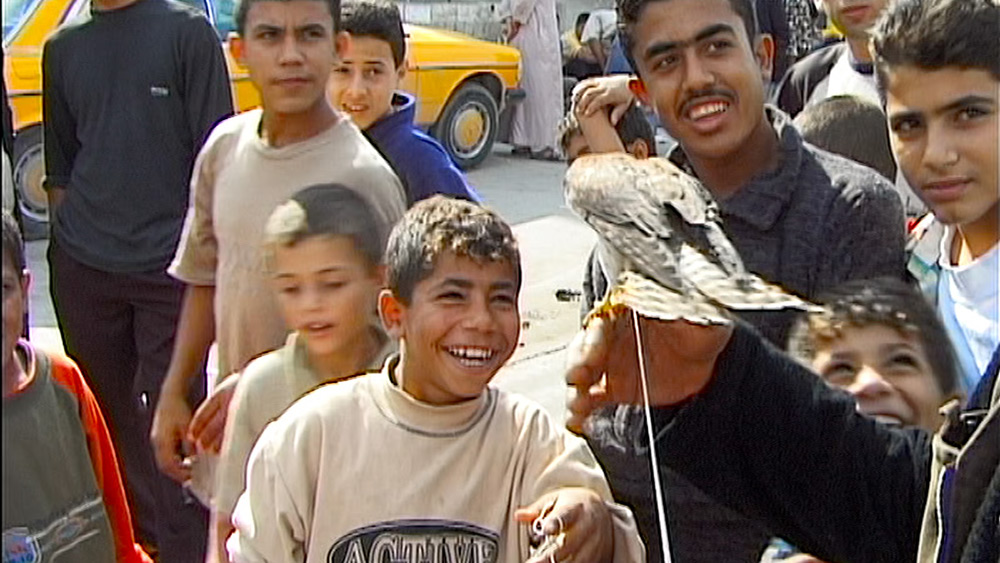
In November of 2001, during the Second Intifada, a guide named Hasan Elboubou accompanied director Kamal Aljafari in his search throughout Gaza for a man named Abderrahim Shamiyeh. Aljafari and Shamiyeh were incarcerated together in an Israeli juvenile prison in 1989. Equipped with a MiniDV camcorder, Aljafari and Elboubou set off in a yellow taxicab, beginning in Beit Lahia and Beit Hanoun in the north and traveling south, toward Khan Younis. Nearly a quarter of a century later, in August of 2024, Aljafari rediscovered the raw footage on three MiniDV tapes.
By way of the MiniDV, the boundary between viewer and subject collapses in Aljafari’s With Hasan in Gaza (2025), as the viewer is immersed in the intimate exchanges and spaces where Elboubou leads the director. The dialogue between Aljafari, Elboubou, and those they encounter, although unfolding in the specific context of Gaza in 2001, are global in resonance as they testify to the traumas of ongoing settler colonization. Conversations are drowned out by the reverberation of shelling and the voices of IDF soldiers, yelling threats over intercoms from watchtowers that safeguard the encroaching red-roofed Israeli settlements that mimic suburbia. As the film progresses through moments of quiet observation, it becomes increasingly more difficult as a viewer to disentangle the experience of these images with our awareness of the desecration that has occurred since.
With Hasan in Gaza critically engages with the banal in a way that is visually arresting and, in doing so, Aljafari affirms the continuity between the historical and contemporary realities of Palestinians. As Aljafari and Elboubou progress, they encounter families fishing at beaches, green fields, universities, bakeries, markets, convenience stores, barber shops, and Uncles playing cards, drinking tea and smoking cigarettes. They also encounter concrete checkpoints, Merkava tanks, shrapnel, and cloth tents pitched on top of Palestinian homes that have been decimated. Green, black, blue and red graffiti douses the walls of shops with messages from the Popular Front for the Liberation of Palestine (PFLP) and declarations of martyrdom. Songs by Najat Al Saghira, Hany Shaker, Amr Diab and Mohamed Fouad fill the bakery, the taxicab, and Elboubou’s home.
The blue line where the Mediterranean sea meets the sands of Gaza emerges repeatedly throughout the film and holds the tension between a longing for mobility and a desire to stay firmly rooted despite decades of forced displacement. As Aljafari and Elboubou continue in search of Shamiyeh, they must contend with compromises made necessary by the barriers set forth by occupation—checkpoints, road closures, cafés that have been closed for periods of mourning, the danger of recording in the presence of the IDF or hypermilitarized zones—all of which has made the ordinary impossible. Aljafari invites the viewer to bear witness to that which is gradual, decimal, and systemic—the everyday maintenance that is essential in the upholding of systems that extract. And, through Aljafari’s initial desire to reconnect with Shamiyeh, something much more urgent emerges. With Hasan in Gaza is a tender yet profound testimony of belonging etched into the cartographies of collective memory.
With Hasan in Gaza screens tonight, May 29, and until next week, at Metrograph. Director Kamal Aljafari will be in attendance for a Q&A tonight and tomorrow afternoon.