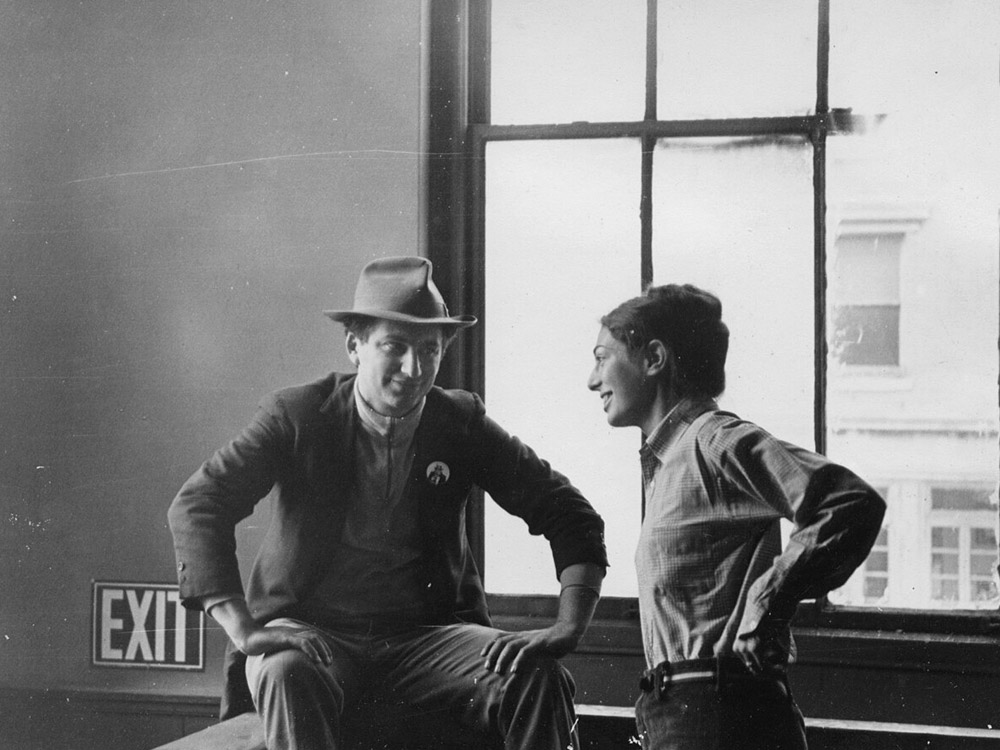
Ken Jacobs saw differently. He made moving image work over the span of 70 years: first in 8mm and 16mm film; then exploring how live performances with jury-rigged projectors could transform latent deep space in movie film into 3D images that dance from the screen into your eyes; after that through the transformation of his own films into digital moving images; and finally through “Eternalisms”—digital 3D-movie loops which could be viewed on screens big and small without glasses or special lenses. Ken finished his last Eternalism just days before he died at age 92 in October 2025. Flo Jacobs, née Karpf, his partner in life and art, and the most visionary producer a filmmaker could have, had died in June of that year. Azazel Jacobs, their son, sent this last work to the friends who had been receiving Ken’s “Eternalisms” in their email almost weekly for years. It depicts black line drawings of three cartoon figures cavorting through infinite space and time. I watch it often. It takes me to a place beyond these dark times.
Most of the short Eternalisms are not included in “The Whole Shebang: Celebrating Ken and Flo Jacobs.” But holy fuck: 14 venues are participating throughout April and the programming includes some best-known, some little-known, and some never-before-seen works. Organized by Andrew Lampert with Nisi Ariana, Azazel Jacobs, and Diaz, the series is collaborative in that programmers at each venue chose the works they will screen. It kicks off with two programs that likely will try the patience of even knowledgeable viewers. As much as Jacobs was dedicated to art as a formal practice, he was also a fierce anti-capitalist with a pedagogical bent. Thus the Museum of Modern Art, which now holds much of Jacobs’s film archive—and is the institution where Jacobs, an undereducated New Yorker, fresh out of the Coast Guard after World War II, discovered painting and movies that ravished him and determined the trajectory of his life’s work—will present the six-plus hour collage documentary Star Spangled to Death (1956-60/2003-04) where Jacobs gives vent to a rage that has never been more appropriate than it is today. It screens in MoMA’s basement theater for a week beginning on April 1, and the theater doors will remain open throughout the duration so that people can easily come and go. At Light Industry on April 7, J. Hoberman, who studied with Ken at Harpur College in Binghamton and was his projectionist, presents “Return to Lecture Hall 6,” a program of short films that Jacobs showed in his classes. Jacobs taught at Harpur from the late 1960s to the early 2000s. His influence on his students was profound, and none responded as deeply and has been, in turn, as great an influence on the history of cinema as Hoberman.
These are the two shows I will not miss, but there are others with masterpieces that might be more pleasurable, especially to those who are not familiar with this monumental and varied oeuvre. Orchard Street (1955), Jacobs’s first film, was shot with a handheld 16mm camera and reveals his already extraordinary eye for framing, detail, and portraiture. The camera homes in on faces and hands, a ballet of buyers and sellers in what was once a boisterous discount market in Lower Manhattan. The film is not only preternatural in its visual sophistication, it also reveals the desire that propelled Jacobs in his entire life and art. Jacobs was a discoverer of what was unseen and unknown, neglected and invisible in the familiar. Orchard Street is a home movie for generations of Eastern European Jewish immigrants like himself. It also prefigures his discovery of the latent third dimension—something more kinetic than the illusion of deep space—in motion pictures. In the first minute of Orchard Street, there is a close-up of eyeglasses arranged on a spinning circular rack that is topped with the signage “Come Up! Come Up!” The display looks as if it had been made with 3D technology. For Jacobs, films were a means of sharing visions and even the most off-putting of them manages to invite you in. I’m thinking of the adventure in hopelessness that is Blonde Cobra (1959-63), a collaboration with Bob Fleischner starring Jack Smith at his most defiantly abject.
Metrograph, an art theater in a now very different Lower Eastside, is showing Orchard Street on April 11 along with other portraits and streetscapes of a now lost Manhattan. Blonde Cobra, which is part of Anthology Film Archives’ Essential Cinema collection, will be screened on April 8, along with the premiere of the restored Artie and Marty Rosenblatt’s Baby Pictures (1963), the ur-text for Jacobs’s exploration of the ethnography of home movies. Anthology is devoting nine programs to Jacobs’s work including two on April 9 of late digital work programmed by Lampert, and two selected by West Coast programmer and former Harpur College student Steve Anker on April 22 and April 23. The latter program is titled “Late Eternalisms – New York Views and Beyond.” Most of these have not been screened publicly before. On April 15, I’ll present two programs, one comprising two portraits, both featuring Flo Jacobs, the other a combo of The Whirled (1956-63) starring Jack Smith, along with what for me is Jacobs’s most exquisite and heartbreaking movie: The Sky Socialist: Environs and Out-Takes (1964-66, completed in 2019.) Jacobs used an 8mm camera to record the destruction of the first Manhattan neighborhood he lived in, returning after he had moved in order to film the broken walls and the shifting light in newly open spaces covered with debris. In 2019, he and Nisi Ariana transferred the fragile 8mm frame by frame to digital, restoring the faded color to its full red brick and azure sky glory.
Ken was not only a great movie maker, he was also an actor of considerable agility and verve. He and Flo star in Azazel Jacobs’s fiction feature, Momma’s Man (2008), which was filmed in the Chambers Street loft where Ken and Flo lived from the mid-1960s until their deaths. Azazel will present his film on April 20 at Film at Lincoln Center’s Walter Reade along with the premiere of Downtown Loft with Skylights (2024). Another premiere, A Date With Shirley (2025) is the last long-form movie Jacobs made. It depicts the filmmaker getting his haircut by his longtime Chinatown barber. Shot with three cameras, it is very much a family affair. The Museum of the Moving Image screening is on April 26. At L’Alliance New York, Jake Perlin is pairing the transformed found footage Opening the Nineteenth Century: 1896 (1991) with Jean Vigo’s Zero de conduit (1933). More found footage shorts, some requiring 3D glasses at BAM on April 14, including Perfect Film (1986), a discarded TV news program on the assassination of Malcolm X, which Jacobs fished out of a Canal Street bin and bought for $5. A promising event is a screening at Union Docs on April 12, where Lampert and Hanna Rose Shell will lead a discussion of Jacobs’s confrontational anti-capitalist and anti-fascist Ghetto Fish Market 1903 (2006) and Urban Peasants (1975), the latter a compilation of Flo’s relatives’ home movies. And that’s not all folks: There are programs at Spectacle, the Rockaway Film Festival, the Roxy, Millennium Film Workshop, and the Film-Makers’ Cooperative. A great send-off for one of the most powerful, ingenious, and prolific moving image artists and his indefatigable producer. I will weep at every show because the Jacobs are not there. And one more thing that they will miss: Ken Jacobs: I Walked into My Shortcomings—an anthology edited by William Rose of Ken’s lectures, manifestos, interviews, program notes and other writings—has finally been published and will be available for purchase at several venues participating in “The Whole Shebang.” The maker of glorious images, Jacobs was also an expressive, forceful, inspiring writer. Who knew?
“The Whole Shebang” runs April 1-April 30 at 14 venues across New York City.