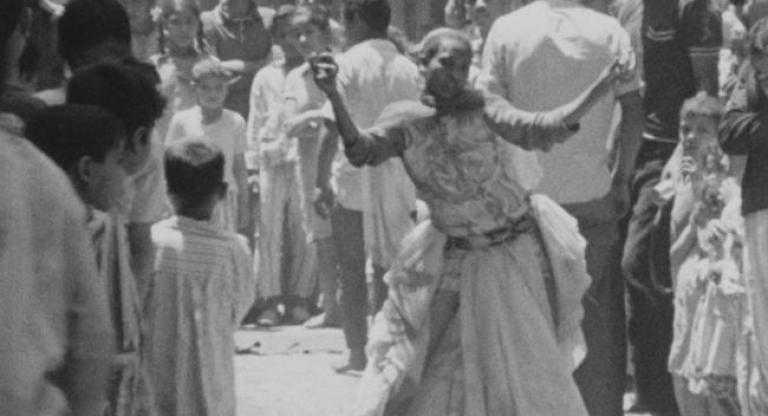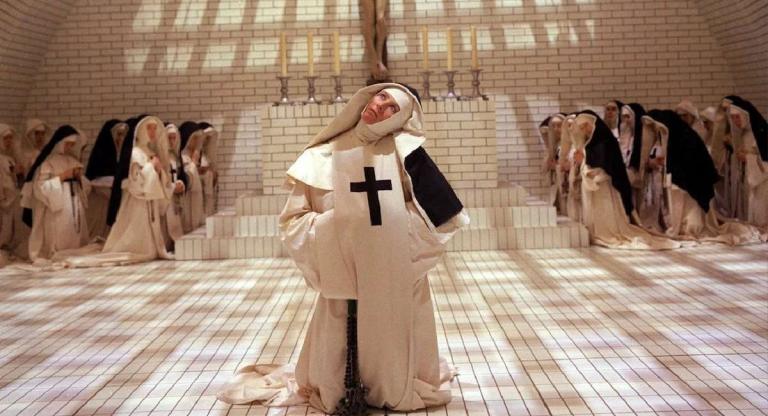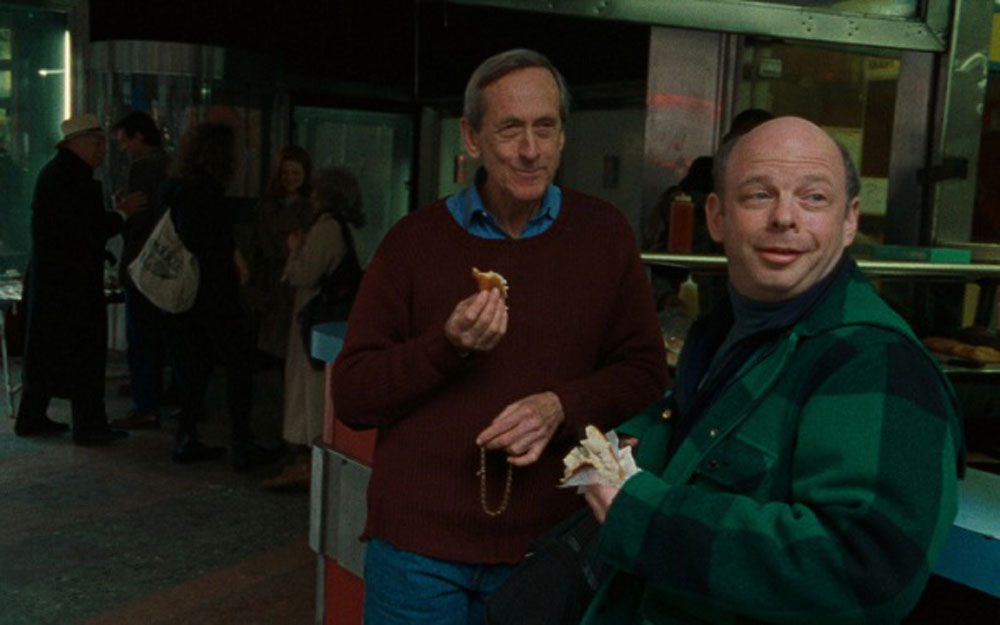
“There’s a whole enormous world out there that I just don’t ever think about. I certainly don’t take responsibility for how I’ve lived in that world.” These words are stammered by the character “Wallace Shawn” in Louis Malle’s My Dinner with André (1981). But Wallace Shawn, the man who penned the words, could not be accused of sharing his fictional counterpart’s myopia. Quite the contrary: his work as an artist is principally preoccupied with the question of responsibility. Art’s responsibility, specifically, is at stake; particularly for the bourgeois artist, whose privilege to create at all is a grotesque luxury in an appallingly unjust world. What is the duty of the bourgeois artist to that world from which he is insulated? What ought his art to do?
Shawn has sought answers to that question for over 50 years—sometimes satirically, as in Dinner; and sometimes severely, as in his 1991 monologue The Fever. His conclusions have grown more polemical over time, in large part due to the development of his socialist convictions. In his mature writing, Shawn’s portraiture of interpersonal cruelty is bolstered by a scathing critique of class relations, training a harsh gaze on the elite culture of which Shawn himself is a scion. What these plays share is an adamant refusal to flatter the self-justifications of their characters and their audience. A common figure in Shawn’s work, from Dinner all the way through to his most recent play (What We Did Before Our Moth Days), is the affable liberal humanist whose ostensibly magnanimous worldview is gradually peeled back to reveal the naked self-interest beneath. The pitiless clarity of these characterizations still has the power to scandalize: witness Joyce Carol Oates’s recent outburst after attending The Fever, which Shawn is performing weekly alongside Moth Days at the Greenwich House Theater. Time has only sharpened his art’s forceful insight.
Shawn’s unsparing moral vision is on dazzling display in the survey of his career currently running at Metrograph. His beloved work as a character actor is well-represented: by Amy Heckerling’s classic Clueless (1995), Richard Kelly’s notorious Southland Tales (2006), and Tom Noonan’s underseen indie The Wife (1995). These selections demonstrate the vibrant tonal range Shawn’s puckish persona can encompass, but it’s the films in which his voice takes the fore that provide the most impressive showcase for his gifts.
They are loquacious films, because, for Shawn, the possibility of change foundationally depends on the possibilities of language. How can hope even exist if people cannot speak to each other, let alone make themselves understood? This was the comic dilemma of Dinner’s bougie chatterboxes, but tragic outcomes prevail in this series. As in the films of Bergman, an avowed influence on Shawn, tragedy emerges from those fleeting moments when one consciousness grazes against another and fails to make contact. Yet unlike Bergman, who produces his effects through vicious dramatic compression, Shawn’s language tends toward excess. The surplus of speech does not always serve to consolidate our sense of the speaker. Shawn’s exhaustive accumulation of verbal material uncovers a multitude of voices at war within any speaking subject. (Per one protagonist: “My ‘self’ was just a pile of bric-a-brac.”) These divisions are formally mapped by schizophrenic slippages between inner and external voices and by provocative ruptures of diegesis. The characters, egotistically isolated from their narrative peers, often speak to us more than to each other. We are brought into their lonely confidence.
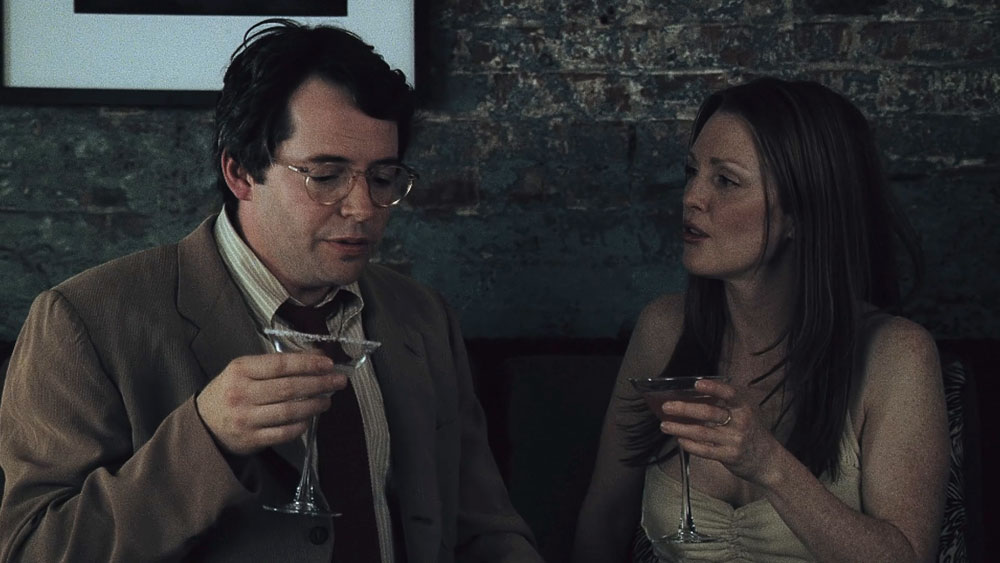
Despite these hefty concerns, Shawn is able to render his characters’ solipsism compelling and funny, even when their language threatens to collapse into nonsense. Marie and Bruce, Tom Cairns’s 2004 adaptation of Shawn’s 1978 play, mines that breakdown for sardonic comedy. Communication has already reached a point of terminal failure at the film’s commencement, signaled in the opening images of a typewriter tumbling through the air. It’s been hurled by Marie (Julianne Moore), who despises her milquetoast husband (Matthew Broderick) and has decided to leave him. But no matter how much invective she casts at Bruce, how loudly and viciously she proclaims her loathing, he responds with the same unruffled nonchalance, appearing not to hear her at all. Marie’s frenzied vituperation and Bruce’s bland gentility generate a comic verbal impasse alleviated only by her intermittent addresses to the camera. The unhappy lovers depart their anechoic apartment and embark on separate, hallucinatory experiences of erotic reverie, only to dead-end upon reuniting at a drab party, where guests mutter Pinter-ish inanities as if talking to themselves. After one final attempt at breaking through, Marie’s rage seems to deflate in the face of a minor concession from Bruce: the replacement of the noisy typewriter she destroyed with a noiseless one. The closing scenes depict a hollow restoration of domestic stability while Moore recites trivialities in voice-over. Her words are a pallid inversion of her previous logorrhea. They have lost all meaning save that of resignation.
In Shawn’s mature work, a more casual, conversational rhythm predominates. Here, too, we are brought into confidence, but the speaker is charismatic and convivial, digressively ambling along a train of thought with sprinklings of colorful imagery and wit. The Designated Mourner (1997) pushes this oratory approach to an extreme: the characters speak in scrupulously sculpted monologues, for minutes on end, constructing the narrative action in retrospect. The superabundant detail of the monologues is counterpointed by spartan staging. The actors remain seated, almost always facing the viewer, while measured shifts in lighting and camera position modestly variegate the images. The result is a sort of mental mise-en-scène, conjuring visual impressions almost exclusively from the inflections of the actor’s face and voice. Such austerity places an unusual degree of pressure on the audience. We are called on to play the role of psychoanalyst, confessor, and judge at once.
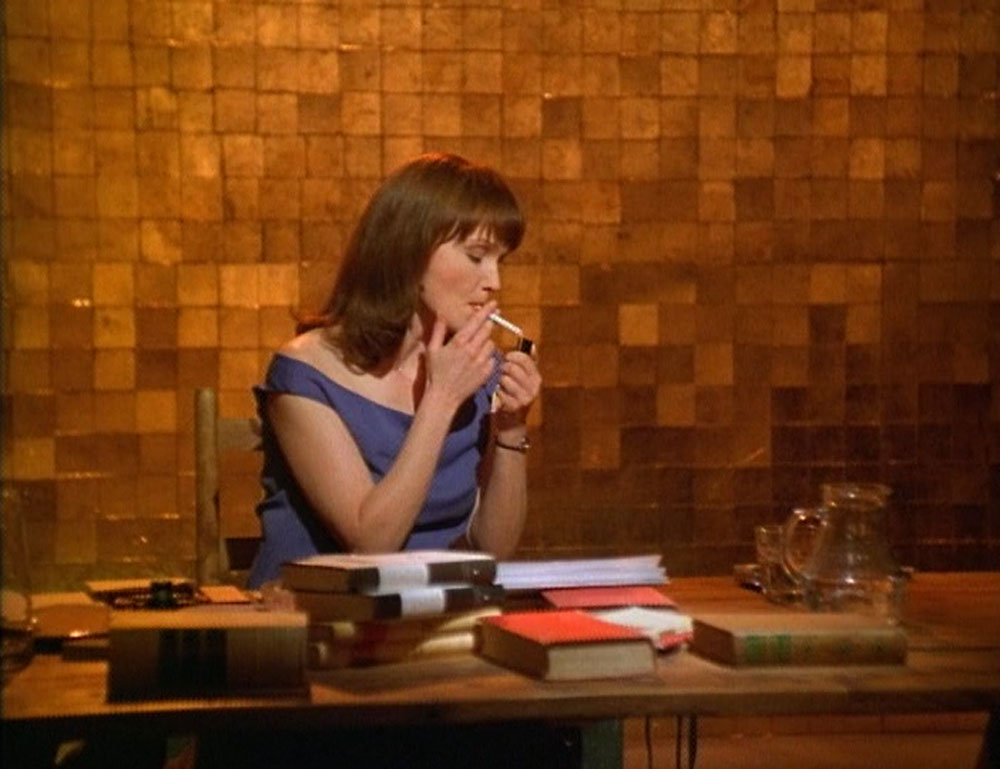
Mourner’s primary speaker is a cad: Jack, played by the director Mike Nichols in his only screen performance. Nichols’s warm voice and full, friendly face exude a rakish charm that belies the ugliness of his words. He presents himself as the ill-suited eulogist for “a very special little world” composed of his wife Judy (Miranda Richardson) and her father, the intellectual Howard (David de Keyser). Judy and Howard are present, too, speaking uncannily from beyond the grave to complement and complicate Jack’s soliloquy. The tale they tell draws out the parallels between Jack’s private resentments—his frustrated ambitions, his impotence and sexual jealousy, his mingled envy and hatred of the intelligentsia he affiliates with—and the violence of the nameless authoritarian government under which the trio lives, and by which their special world is ultimately crushed. Refusing to merely equate philistinism and fascism, however, the film partially legitimates Jack’s contempt for the “highbrow” world, soliciting our complicitous identification with his sentiments. Howard is both pathetic and pompous, espousing lofty ideals but speaking contemptuously, “on wings of scorn,” to everyone in his immediate orbit; Judy’s passivity verges on masochism, leading her, despite her hope for “a better world,” to meekly submit to her own erasure, first in marriage and then in actuality. The film’s great horror lies in how its characters variously rationalize, repress, or ignore the bad faith in which they live. The chilling ending sinks us into the silence of a world from which all beauty has been extinguished.
Despair would be all too easy a response to the dilemmas depicted in these films. But Shawn maintains an unwavering faith in the power of art to cultivate the vigilant listening his protagonists fail to achieve. This faith is powerfully demonstrated in the series’ most luminous selections: two film collaborations with Shawn’s longtime creative partner, the theater director André Gregory. Both films document productions that, following Gregory’s non-interventionist approach, were rehearsed and performed privately over a great number of years; and both put to shame the reductive epithet “filmed theater” in their inventive marriage of the forms.
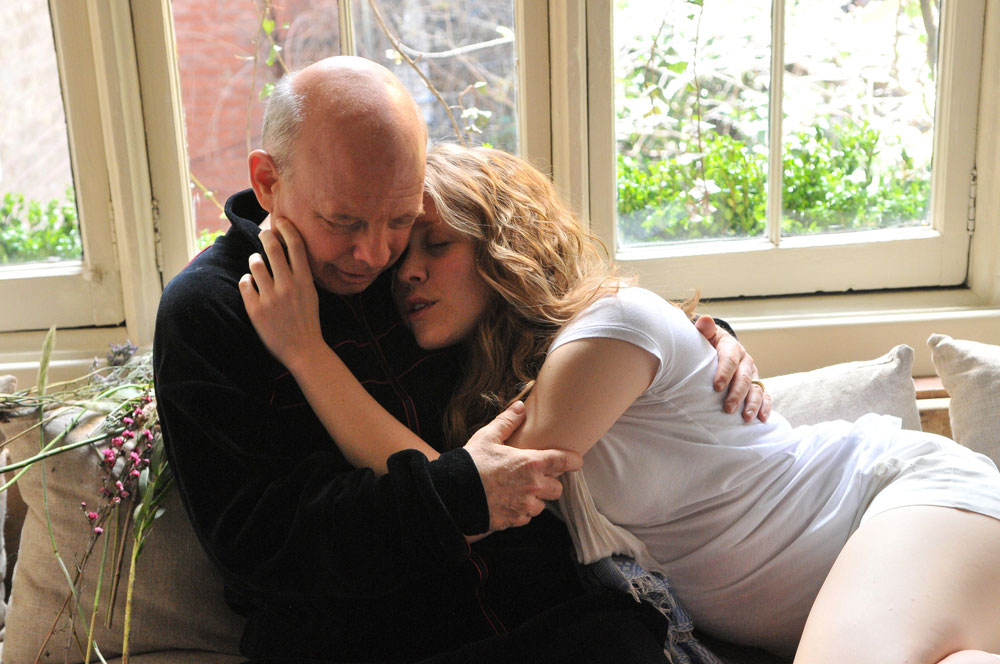
The later film, A Master Builder (2013), was adapted by Shawn from Henrik Ibsen, and his rendition decisively emphasizes the play’s most richly symbolic textures. The prologue finds the eponymous architect, Solness (Shawn, at his coldest and cruelest), reclining in a hospital bed surreally planted in the middle of his home. Even in his debilitated state, he barks orders like a sadistic potentate, denying a young employee (Jeff Biehl) the contract that would have given his dying father (Gregory) peace while indulging in a grotesque liaison with the employee’s fiancée (Emily Cass McDonnell). Art has had no ennobling effect on his soul, but is in fact implicated in the progress of his damnation and his corruption of the lives of others.
Wavering on the edge of oblivion, his brain conjures the grown spirit of a girl, Hilda (Lisa Joyce), who he may have molested some 10 years prior. Joyce is intensely unnerving as this embodied phantom; her giddy bursts of laughter erupt as violently as the tears that perpetually quiver at the edges of her eyes. Hilda acts by turns as muse and vampire, cajoling Solness to scale one of his phallic towers as a consummation of the forgotten vow he once made her. Solness’s embittered wife (Julie Hagerty) lurks at the margins, eventually developing her own poisonous kinship with Hilda, who she regards as both sexual rival and substitute for her dead children. The text’s psychosexual density makes for heady viewing, but director Jonathan Demme’s blunt point-and-shoot approach lends the drama an alarming directness. His jittery handheld camerawork offers a consciously crude foil to the architectural perfection sought by the authoritarian artist. Rather than succumb to Solness’s quasi-fascist romanticism, which consummates art in death, the film’s formal energy and vivid, devastating performances counter with a claim for art’s essential vitality.
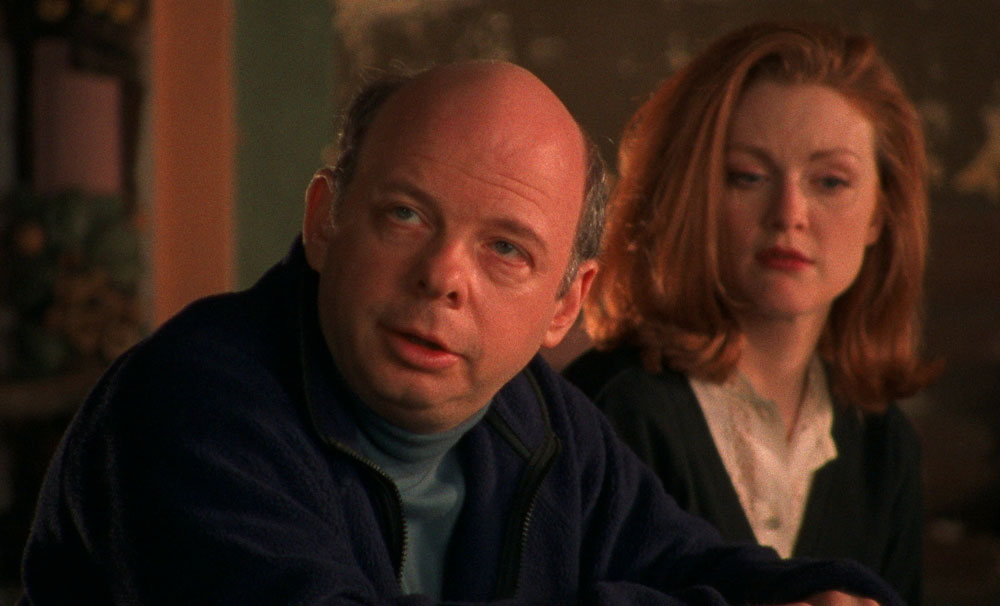
The flower of that vitality, and the jewel of this series, is the duo’s second collaboration with Louis Malle: 1994’s Vanya on 42nd Street. Vanya documents a “workshop” of Chekhov’s play, idiomatically adapted by David Mamet, in the amber-lit ruins of New Amsterdam Theater. The cast is introduced convening outside the theater, guiding their small group of guests in with unhurried ease. Their perambulations segue so smoothly into the commencement of the play that, when Malle reveals the small audience suddenly gathered in reverse shot, we feel as though a magic trick has been accomplished.
But Vanya’s peculiar enchantment can’t be reduced to the cliché that the actors “disappear into their roles”—that we somehow stop seeing their street clothes, which they wear the whole film, or forget that we’re watching a play. (Nor, indeed, a movie: Malle consistently undermines the illusion of unbroken performance by sparingly deploying cinematic effects like voice-over.) The effect, however, is not one of rupture or contradiction, but of sublime continuity. Rather than jerking us between emotional involvement and critical distance, Vanya holds our consciousness of character and actor in delicate equilibrium. The transparency of the fiction does not diminish its emotional force; the body of the actor does not disappear beneath the artificial being they suggest through speech and gesture. We see Julianne Moore and Yelena at the same time, as if superimposed. Art is revealed not as an illusion, deception, or escape from life, but a material practice—a way of being in the world. The result is rapt fascination, not merely with the drama, but with the human process by which drama is incarnated. Total clarity and total concentration.
It’s this manner of attention that art can and must bring about. That is the ethical assertion that underpins Shawn’s practice, and that is what is actualized in these films. Vanya thus acts as a kind of reply to a challenge posed in My Dinner with André. “The question,” says “André” to “Wally,” “is whether the theater now can do for an audience what Brecht tried to do, or what Craig or Duse tried to do. Can it do it now?” The characters may not always find a solution, but this remarkable body of work is an answer in and of itself.
“Wallace Shawn: The Master Builder” runs May 8-May 15 at Metrograph.