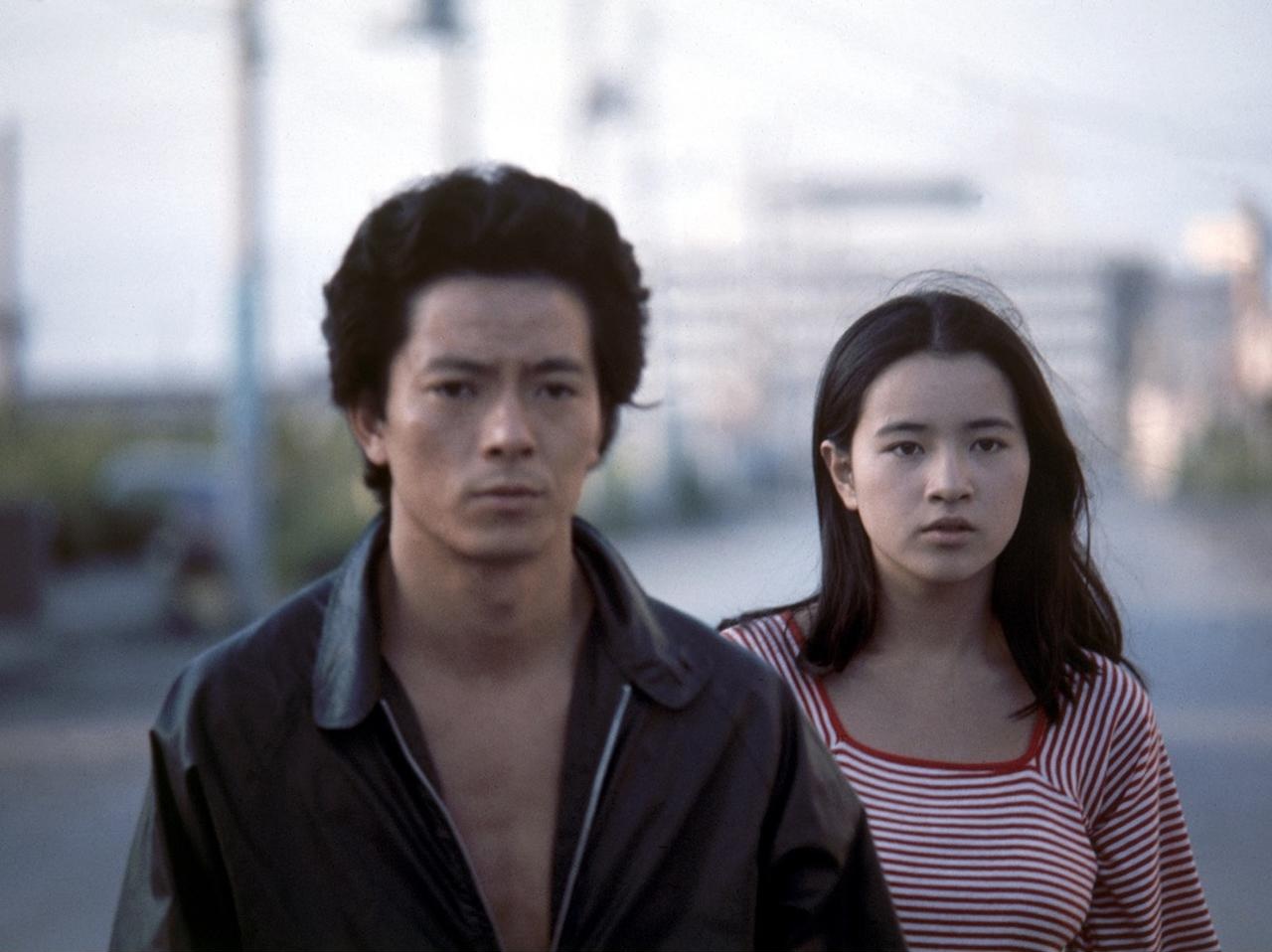
A grungy portrait of total nihilism, Kazuhiko Hasegawa's The Youth Killer (1976) opens innocently enough. A pair of aproned young people play outside, trading singsong rhymes and dancing about. This scene of childlike abandon offers the slimmest respite in what quickly becomes a long rainy day's journey to night—and Hasegawa's fearless filmmaking debut. Jun (Yutaka Mizutani) and Keiko (Mieko Harada) are the rambunctious duo. They operate a roadside snack bar on the route to Narita Airport and their interest in one another is quickly revealed to be more than collegial.
But Jun's parents, who run a truck repair shop, do not approve of their son's relationship with his young co-worker. This disagreement leads to a cataclysmic decision by Jun that sends the rest of the film onto its bleak, sweaty course. Besides manic knifings doused in glorious grindhouse blood-red, Hasegawa's tumultuous film touches on sexual assault, incest, and suicide—all scored with maximum post-Beatles mellow-gold tunefulness by Godiego, who would provide an equally incongruous soundtrack the following year for Nobuhiko Obayashi's House (1977).
Even as his characters spiral toward the unknown, Hasegawa's film detours and doubles back. Smash cuts send the story into the past; sudden longueurs dissolve into daydreams. The director's mise-en-scène also seems to evolve from moment to moment, whiplashing from tense psychodrama to pink-film titillation, from humid vérité to swooning melodrama. In one scene, a sumo-like struggle between Jun and his father turns into an embrace before devolving back into violence. Like Samuel Fuller, Hasegawa shoots his close-ups on the edge of a fistfight. Reflective surfaces splinter the image into a paranoid hall of mirrors. Shot by Tatsuo Suzuki—the same cinematographer behind Toshio Matsumoto's Funeral Parade of Roses (1969)—Hasegawa's film shares that film’s spirit of outlaw exuberance. Seeing it projected on 16mm should only enhance its samizdat aesthetic.
If this maelstrom of desolation has a center, it is in the two leads—particularly Mizutani, who gives a truly feral, hair-trigger physical performance, forever ready to burst out of his own skin. We encounter them in media res—from nowhere and heading nowhere. Not quite Bonnie and Clyde, the couple belong to the long tradition of doomed lovers on the run, even if their voyage turns out to be agonizingly circuitous.
Hasegawa made only one more film after The Youth Killer and passed away earlier this year at the age of 80. His incendiary debut was hailed as the best film of the year by Kinema Junpo and won an additional four awards from the magazine. His mentees would go on to include future auteurs such as Kiyoshi Kurosawa and Shinji Sōmai. Soaked by typhonic showers throughout, The Youth Killer ends in fire and darkness, an infernal combination befitting this Dante-like saga.
The Youth Killer screens this evening, May 16, at Japan Society on 16mm as part of the series “Kazuhiko Hasegawa’s Anarchic Ethos.”