Maybe this is an odd claim to make about an artist who died six years before Google was founded, one whose work dwells intensely on and in the material of his beloved Super 8, but I consider Teo Hernández an exemplary figure of online cinephilia. I don’t mean anything high flown here, only that his rapid ascent from somewhere beyond the margins—at least in the anglophone film world—to a central position in the avant-garde canon, now confirmed with a substantial retrospective at the Museum of Modern Art, is inextricable from his work’s circulation in high-quality digital scans across the various grey zones of Discord chats and private torrent trackers. That Hernández remained unknown to the doyens of the New American Cinema and their immediate successors is regrettable; if nothing else, it would have been historically useful to know what P. Adams Sitney saw in work closely aligned with many of the aesthetic precepts he so forcefully articulated. History didn’t take that path, and there’s no changing it. What matters, what’s meaningful and telling, is the fact that these films have belatedly found their audience now.
It’s too easy to chalk this up to contemporary culture’s fetishization of discovery; the shift from whisper or footnote to relatively easy bootleg availability can’t be discounted, but Hernández is hardly unique in this regard. And anyway, visibility alone can’t account for the ardor these films have inspired among a relatively young and online set of filmmakers, critics, and related enthusiasts. As to “meaningful and telling,” there’s a stark distance between Hernández’s opaque, sensual lyricism and the essayistic, even didactic, tendencies that continue to dominate the institutional spaces available for contemporary work outside the conventional narrative feature. His films, in a word, are naïve in a way that had gone entirely out of fashion a generation ago.
That naïveté, a simple and intense belief in the camera’s ability to make the world beautiful, grounds a wide range of approaches. At MoMA, “A Pomegranate and the Bitter Well”—the series’ title, drawn from Hernández’s own writing, nicely expresses his sensibility, though individual program titles like “The Jaguar Speaks the Language of Flowers” and “A Journal Is a Measure of Semen in a Die,” regrettably, do so even more acutely—brings together 17 of his films (barely a tenth of his output) alongside a small selection of work involving his close collaborators Michel Nedjar, Gaël Badaud, and Jakobois. There are mythic reveries, travelogues, impressionist studies in light and color, bohemian hangouts, dance films. It’s a restless array, one that speaks to a sensibility more comfortable with form than content.
This restlessness reflects Hernández’s own itinerancy, a winding path that led from his birth in Mexico in 1939 through a decade across his 20s and 30s spent circling the globe until finally making Paris his home in 1975. The films at MoMA all derive from this last phase of his relatively short career (Hernández died of AIDS-related illness in 1992), a surprisingly late flourishing into such massive productivity. Curators Carlos Saldaña and Francisco Algarín Navarro—both editors at the Spanish journal Lumière, which has played a decisive role in the emergence of a robust small-gauge scene in Europe over the last decade—have put together a sensible, sensitive survey, one that makes clear both the progressions and refinements that mark the major period of Hernández’s career. The opening night pairing of two pieces of camp performance, Salomé (1976-1982) and Vloof l’aigrette – Pain de singe (1987), for example, points quite painfully toward the emergence of a bawdy sense of humor, a quality I wish he had arrived at sooner. Salomé, a woozy, narcotic nocturne in red, comprises 65 minutes of slow-motion tableau, a cousin to haute symbolic anti-narratives from Andy Warhol to Werner Schroeter to early Philippe Garrel, played with what I find to be a suffocating earnestness. The small portrait Vloof l’aigrette, in contrast, condenses a whole arc from severity to voluptuousness into its four minutes, allowing the dancer Bernardo Montet—a muse for Hernández, and the star of Pas de Ciel (1987), the only of his major choreographic films showing here—a range of expressiveness not given to the automatons of Salomé.
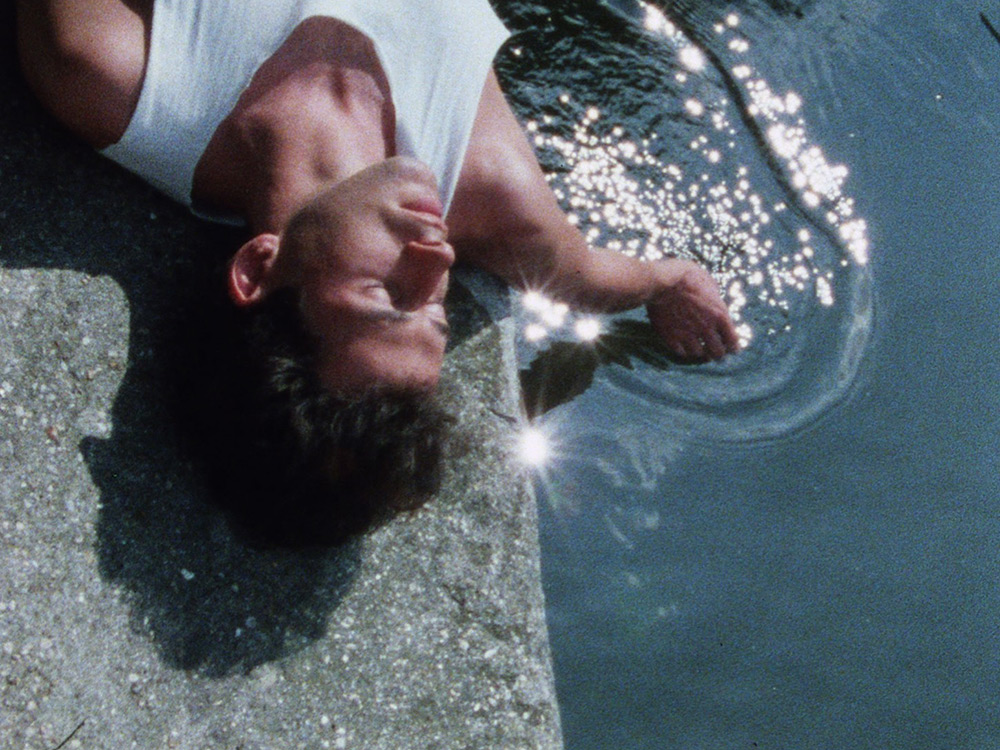
Elsewhere, the four films that make up The Body of the Passion—Cristo (1977), Cristaux (1979), Lacrima Christi (1978-79), and Graal (1980)—and the adjacent Maya (1978-79), a secular counterpoint to the cycle’s revisioning of Christian myth, see Hernández moving from stillness to speed in the space of months. This new camera style reaches its height in the two strongest of his works I’ve encountered, Nuestra Señora de París (1981-82) and L’Eau de la Seine (1982-83). If these films bear more than a passing resemblance to Stan Brakhage, Jonas Mekas, and Marie Menken, Hernández’s juncture of quick handheld movement and quicker editing strikes a balance between the abstract and the indexical that’s uniquely his own: these studies of, respectively, Notre Dame and the Seine, remain concrete—there’s never any doubt about what we’re seeing—even as they smear and explode the image into pure chromatic intensity.
Perhaps it’s not an enormous surprise that two of the most cliché sites in Paris would lend themselves so well to Hernández’s project; to the truly naïve artist, what does it matter if something’s been photographed to death? I’ll confess that, even in films as accomplished as these, I find his wide-eyed romanticism trying, but then I expect I would have felt differently at 20 than I do nearing 40. Regardless, I’ll hold out hope for the future work Hernández might yet inspire.
“Teo Hernández: A Pomegranate Orchard and the Bitter Well” runs May 14-26 at the Museum of Modern Art.