Computer cards fluttering from a burning building. A masc lesbian’s bare breasts buoying in a jacuzzi. Bankers boxes of ancestral remains. A crown made of AR-15 bullets. An airlifted bear’s fur poking through netting. Americans giddily staring into the mouth of the eclipse. A dumpster filled with queer and feminist literature. The conch-lined walls of a school for girls. A death certificate for a glacier. Eyes, so many pairs of eyes. This 23rd edition of True/False left more imprinting images in my mind than years past—a collocation of sights and sounds that I had seen, or felt, before in less lucid forms, but which sit heavy in the corners of my mind.
In Aanikoobijigan, an autopsy of the archive by Ojibwe documentarians Adam and Zack Khalil, Indigenous ancestral remains are repatriated to their requisite tribes, often with a dearth of empathy from the institutions that held them captive. The film surveys the colonial hangover of scientific racism and the emergence of the Michigan Anishinaabek Cultural Preservation and Repatriation Alliance (MACPRA), a coalition of tribes who have initiated the return and funerary rites of ancestors since 2000. The liveness of the film’s archival materials—reminiscent in part of Mati Diop’s nuanced repatriation doc Dahomey (2024)—is twofold. The Khalils redact footage of the remains out of respect for the ancestors’ bodies and also assert the artificial separation of past/present/future, giving way instead to an ongoing futurity, a disruption of the binaries which Western archaeology insists upon. In voiceover, we hear, “If an object is animate, an archive is a prison. If an object is an ancestor, when can the grandkids visit? Who pays for the plane ticket?”
Under the guise of preservation, museums, universities, and art institutions have always engaged in the economic exchange of bodies. Aanikoobijigan confronts the sterile, gloved, taxonomized, proper conditions of archives such as Michigan State University, which have systemically held Indigenous human remains captive in a chalky repository underneath the school’s football stadium. Institutional suppression is also the marrow of Patrick Bresnan’s First They Came for My College, which follows Ron DeSantis’s hostile takeover of the New College of Florida, and Michèle Stephenson’s True North, on the 1969 student sit-in against anti-Black racism at Sir George Williams University (now Concordia University) in Montreal.
The latter film makes use of black-and-white archival footage coupled with craftily-shot interviews of the protestors today; the result is so stylistically consistent—not to mention striking—that the already porous border between past and present seems to dissolve. Composed largely of news clippings, onsite recordings, and excerpted documentaries, True North shows the violent opposition to the student occupation with unassailable detail: thuggish cops brutalizing students in the basement without reproach, hordes of white students cheering when the building fills with smoke. These are ugly, horrible images from the belly of the thing—evidence of Canada’s true nature. (From the balcony, I watched a sea of exasperated heads shake at every instance of racism; I’m always baffled by Americans’ disbelief in Canada’s violence and bigotry—whoever invented the stereotype that Canadians are “nice” was surely pale and ill-read.) The film is dedicated to Coralee Hutchison, an 18-year-old student who suffered a fatal head wound at the hands of the riot squad.
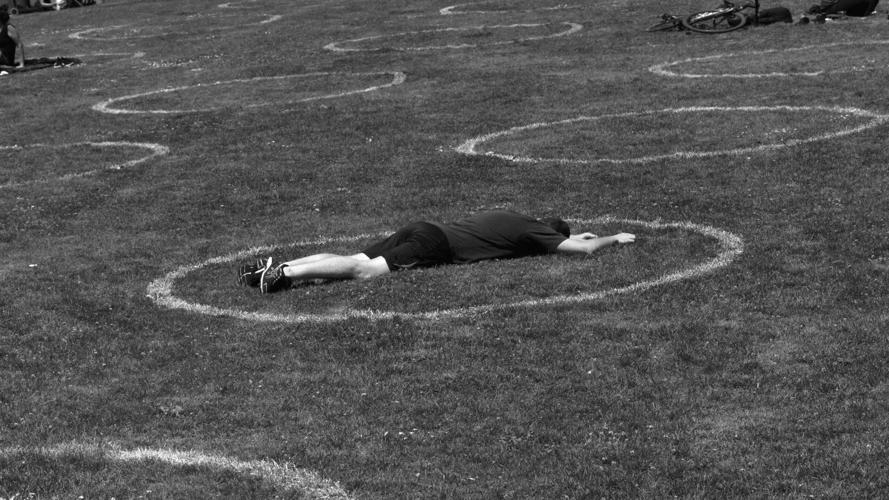
A deeply localized world premiere, The Great Experiment (pictured at top) by Stephen Maing (co-conspirator of 2024’s Union) and Eric Metzgar traces American routine through black-and-white vérité-style vignettes from 2017 to 2020. Divided into four parts (“i’m sorry, my love,” “this is my home,” “how will we look back,” “welcome and thank you”), the film observes the politicized gulf in the country’s populace: anti-Trump protests, white guilt focus groups, ICE arrests, civil war reenactments, confederate statue removals, immigration, both official and undocumented. Without firm context for these unwitting movie characters, the images fall somewhere between the styles of Frederick Wiseman and Arthur Lipsett, though the result is less interrogative than pensive. Here, the camera is best at reading the unresolved air of its subject’s expressions: nobody of either bent looks confident in their actions, which is perhaps the most worthwhile minutiae of this moment.
For some Americans—seemingly mostly white women—the Trump administration is a total uprooting. A new set of indignities. For others, this is business as usual, only bullhorned from the small mouth of a disagreeable man. To many, this is justice. The Great Experiment feeds on such dissonance: left versus right, urban versus rural, interpersonal versus personal. Whether it’s the ruthless hum of a drone observing Rikers Island inmates digging graves or the clacking expanse of Pennsylvanian wedding guests unfurling their AR-15s, the soundscape (which features music by Meredith Monk) draws out the dystopic conditions of our present. In the Q&A, Metzgar interestingly noted that they chose monochrome for its sense of distance, as reprieve from the current moment that rendered the images “historical.” I think back to the starkness of True North, where the colorless images made every detail more violent, every action more visible.
In any case, the film made me more attentive. I took a walk afterwards through the University of Missouri’s quad, where I observed undergrads at dusk from the six pillar landmark at its centre. The sound of the wind slapping against the U.S. flag across the way was overkill—in a sense, I’d just seen that for the last 100 minutes—but I resolved to people-watch until the next screening. A security guard taking long strides on the pavement. A blond couple kissing behind one of the pillars, giggling in my direction every so often. Two smiling couples unknowingly walking in step with one another. Hollering jocks. I delineate the screen images from the ones in between them in my notebook so I don’t confuse myself.
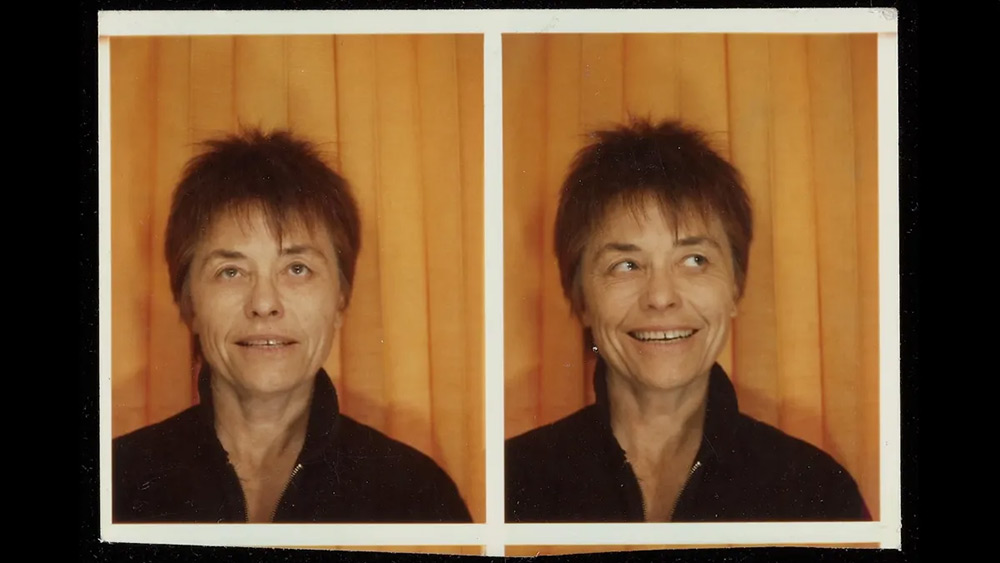
Two portraits of sinewy feminist archives, Brydie O’Connor’s Barbara Forever and Louis Massiah and Monica Henriquez’s TCB - The Toni Cade Bambara School of Organizing locate their heroines through their colossal contributions to art and literature. The former sees the lesbian experimental filmmaker Barbara Hammer emerge through her own lens, from the creation of her first short film Schizy (1968), a four-minute psychodrama shot through bifocal lenses, to her sole multichannel installation Evidentiary Bodies (2016), a performance piece on the subject of her terminal illness. True to her claim, “I was born when I became a lesbian,” Barbara Forever is non-sequential, beginning in the fruitful middle and only divulging the past after Hammer, who narrates in various states of health, has cultivated her own creative mythos.
Hammer’s commitment to a tactile screen, to filmmaking as “another layer of touch,” pairs well with the dynamism of American writer and cultural worker Toni Cade Bambara’s creative practice. Bambara, author of The Salt Eaters and Gorilla, My Love, is affectionately conjured through interviews with her prolific company, including Toni Morrison, Nikky Finney, Zeinabu irene Davis, and Haile Gerima. The interviewees remark upon the embodied potential of Bambara’s voice, “stitching us together.” Save for an excess of title cards that frequently cut into the rare footage’s momentum, I could have watched several more hours on Bambara’s legacy.
Neither film formally inhabits the singular practices of these women—their fragmentary styles, their bodily narratives—but both are nevertheless totally energizing; a shot in the arm to take better stock of your life. Barbara/Bambara show us how to live collectively, how to care for your neighbor, how to find in words and images what otherwise resides deep in your chest. “Don’t leave the arena to the fools,” Bambara instructed Finney and, subsequently, all of us. There’s so much to learn from her, but I was inspired by the minor detail that, when teaching students, Bambara would not stand at the front of the class but would teach instead from the side.
Recalling Boyd McDonald’s claim that “motion pictures are for people who like to watch women,” two lengthy restorations stick with me most: Ed Pincus’s Diaries (1981) and Ross McElwee’s Sherman’s March (1985). (McElwee, who received this year’s True Vision Award, also presented his staggering latest film Remake at the festival.) Shot with a 16mm Eclair and a Nagra SN (an analogue recorder first developed as a surveillance tool for the CIA), Diaries spans 1971 to 1976, with Pincus chronically recording his family: his wife, Jane, and their tots, Sami and Ben. Indeed, these instruments of infiltration, respectively resting on Pincus’s shoulder and stuffed in his back pocket, catch people at their most vulnerable: trysts, medical procedures, fights.
“No one has as few friends and acquaintances as the Ed we see on-screen, nor as little professional life,” wrote Stephen Schiff for Film Comment in 1981. “In fact, only fictional heroes do [...] This, then, is a diary that’s compressed like a fiction: it gives us five years in one sitting.” Both films find the macro in the micro, scrutinizing the most intimate of encounters until they curl into fiction.
Listed at perhaps my favorite cross-section (“Documentary/Romance”), Sherman’s March begins as a supposed travelogue of William Tecumseh Sherman’s route through the Confederacy during the American Civil War, but soon unfurls into a rompy treatise on coupling. McElwee—a self-described lust-ridden, anxious despondent who monologues at the moon about nuclear war—immediately derails his own project, instead chasing a rotary of romantic prospects: an aspiring actress, a lawyer, a PhD student, a singer (Mormon), another singer (non-Mormon). Through images of these women’s lives, McElwee reveals himself, flitting from one to the other when they tire of him.
Whereas the camera taunted and destabilized its women in Diaries, McElwee observes the vignetted women along Sherman’s route with horndog reverence. The original cut of the film was nine hours, and a part of me wished the final could have been that long, if only to stay with the sublime women whom McElwee orbits. “This is not art, this is life!” exclaims one of them, theatrically exasperated and attentive to the audience on the other side of the lens. Like several of the figures populating these most recent documentary offerings, you get the sense that she doesn’t quite believe herself.