In the opening scene of the Canadian documentarian Ron Mann’s Poetry in Motion (1982), Charles Bukowski sits on a couch that was maybe once white in front of a coffee table littered with empty bottles of wine and beer, crumbled paper, and ashtrays. “Poetry’s always been said to be a private, hidden art, not appreciated,” he says after lighting a cigarette. “The reason it’s not appreciated, because it hasn't shown any guts. Hasn't shown any dance. Hasn't shown any moxie.”
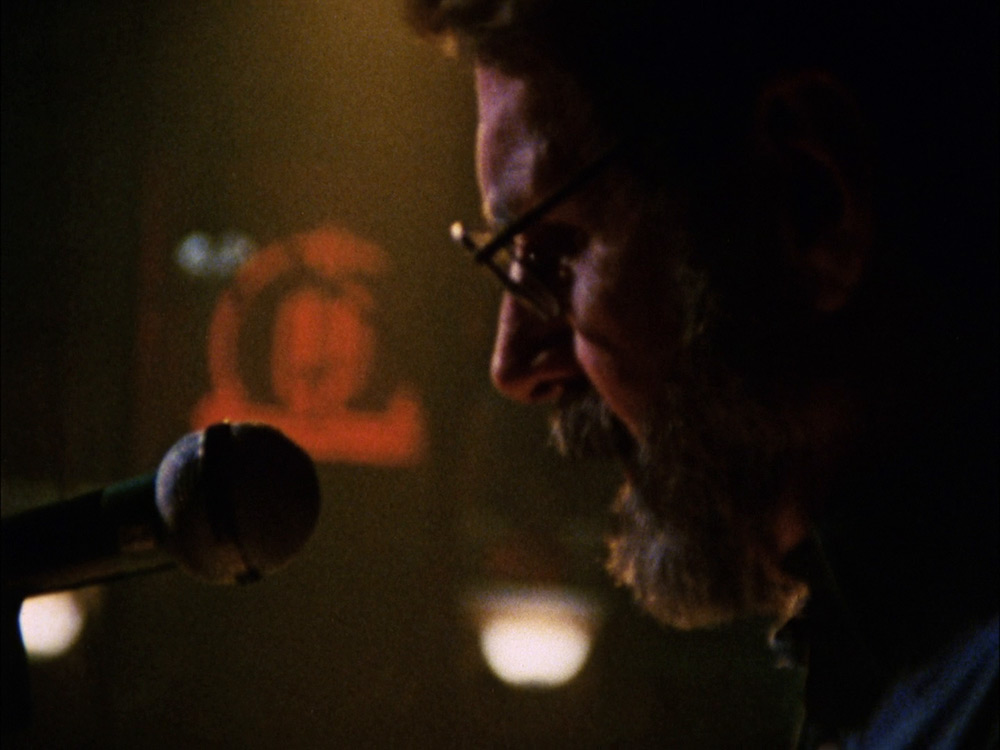
Mann’s film assembles clips from readings and interviews with more than two dozen major North American poets of the late 20th century, the generation that reintroduced song, spectacle, and yes, even dance, to their craft. In an interview with Daniel Nester published by The Poetry Foundation, Mann described the film as an homage to the documentary Woodstock (1970), and that influence is evident in its attention to the live, frenetic performances of a countercultural artistic movement. Some sections were filmed on a bare soundstage in Toronto, others in the poets’ natural habitats (studios, porches), but much of it was captured at the bacchanalian readings of 1970s New York and San Francisco. Watching Poetry in Motion can inspire jealousy—God, I wish I had been there—but the soft 16mm footage is shot in such close proximity to its subjects that it feels intimate enough to almost convince you that you were.
William Burroughs, dressed in a handsome grey suit, describes a man “losing control of his bowels” with his signature nasal drawl. Ntozake Shange wears a purple patterned headscarf and mismatched earrings while two dancers gyrate behind her. Allen Ginsberg wears his round wire-framed glasses as he shouts onstage alongside the punk band The CeeDees. Helen Adam’s silver bob and large pendant, hung on a thick gold chain, swing wildly as she gleefully sings her poem “Cheerless Junkie’s Song,” about mixing speed and LSD among the roaches and rats of Tompkins Square. But Robert Creeley is a tad more understated. He wears what looks like a clean LL Bean jacket over a white T-shirt while reading his poem “Bresson's Movies.” His cadence is calm and steady. He barely moves beyond the occasional glance from page to camera. Even without theatrics, he is riveting.
Poetry in Motion opens a new series at Anthology Film Archives celebrating Creeley’s centenary, which includes films in which he appears, alongside work by his peers and collaborators. Mann’s film is not just an excellent introduction to Creeley, but to the literary culture that preceded the MFA system now so central to American poetry. Creeley’s sole degree was a BA from the short-lived Black Mountain College. Over half of the subjects of the film didn’t get any degree whatsoever. What the film preserves is a scene shaped not through formal (and expensive) academic training, but through social proximity and cross-disciplinary immersion.
Poetry in Motion screens this evening, May 12, and on May 16, at Anthology Film Archives as part of the series “The Story Is True: Robert Creeley on Film.” Poet Anne Waldman will introduce this screening.