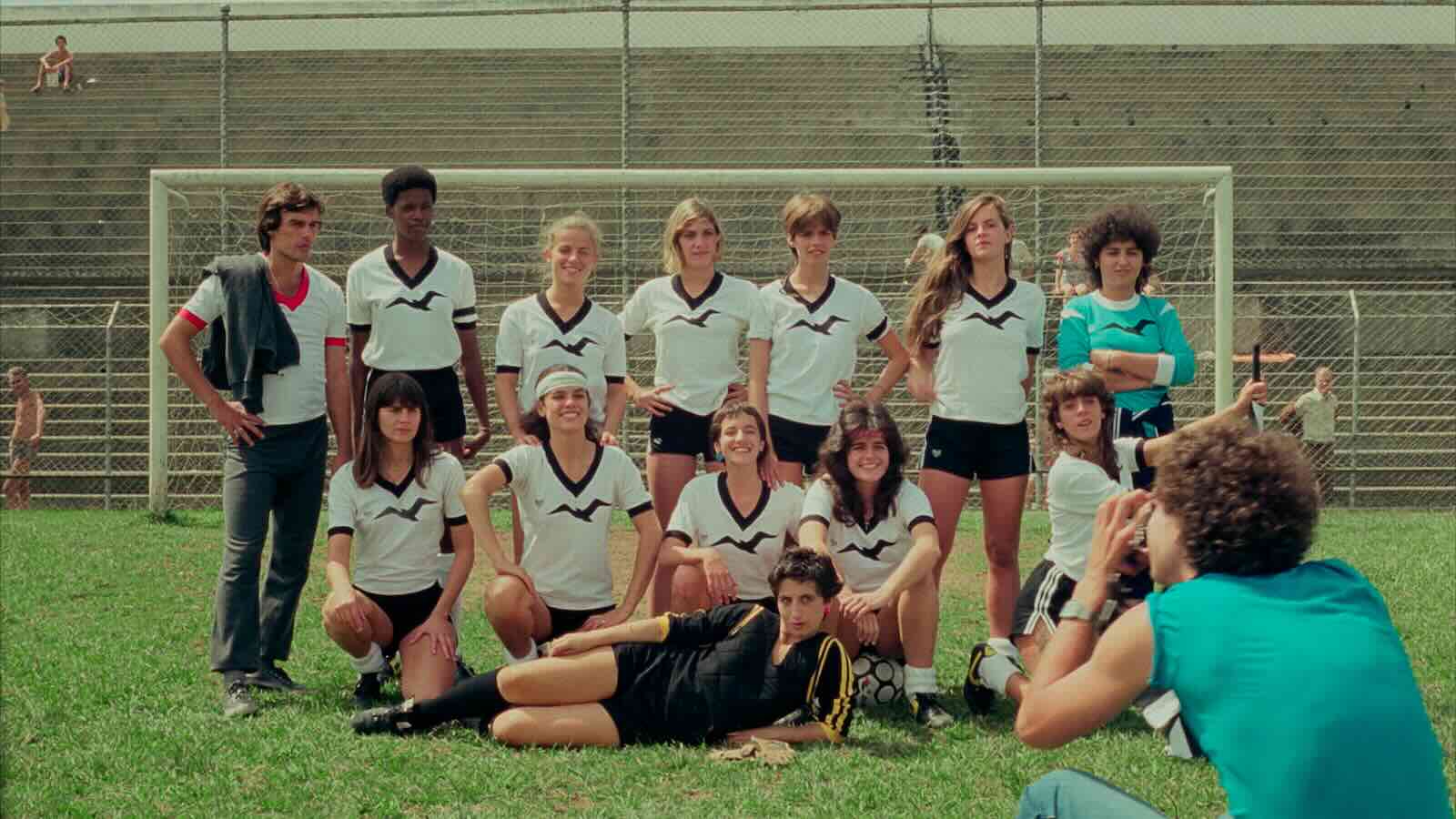
“Soccer is entertainment, a spectacle, and an art form,” one friend says to another as they watch the first match of the Gaviotas, the women’s soccer team at the center of Onda Nova (1983), from a distance. Moving clumsily over grass so green it looks iridescent, the eclectic squad passes the ball around in outlandish costumes: decked in accessories, lips painted deep red, wearing fuchsia dresses and tutus. One player is even dressed to look as if she were pregnant. Dolled up, against the backdrop of the Brazilian dictatorship and the nation’s ban on women’s soccer, the team giggles through their match in a carefree manner, as if nothing were amiss and as if theater were not a tool they had chosen, but the only language they had ever spoken.
Onda Nova, the second installment in José Antonio Garcia and Ícaro Martins’ “Desire Trilogy,” presents youth as an explosion of colors and free will. It’s a vision of São Paulo at night, where there's always somewhere to go and someone to hook up with. Interdicted by military censors who deemed it “amoral” after its premiere at the 7th São Paulo International Film Festival in 1983, Onda Nova circulated in alternative circuits during the late 1980s and 1990s until its 4K restoration in 2024. Made under the guise of the pornochanchada genre—the bawdy, wildly popular sex comedies that dominated the Brazilian market throughout the 1970s—Onda nova delivers a complex portrait of queerness that’s anchored in a vale tudo (anything goes) ideology. It presents a John Waters-esque world where a father knits and the mother is a transvestite; where a slice of pizza can lie on a hairdryer and still be offered up to eat; where three people climb onto one motorcycle; where sex is interrupted to take out a tampon and… throw it out the window. Anarchist and erotic, comedic when it needs to be and dramatic when it feels so, the film navigates the dilemmas of the newly formed football team, which has to deal with the prejudices of a conservative society that reviles them while also occupying their minds and their bodies with personal problems that feel as absurd as the prohibition on their ability to play soccer.
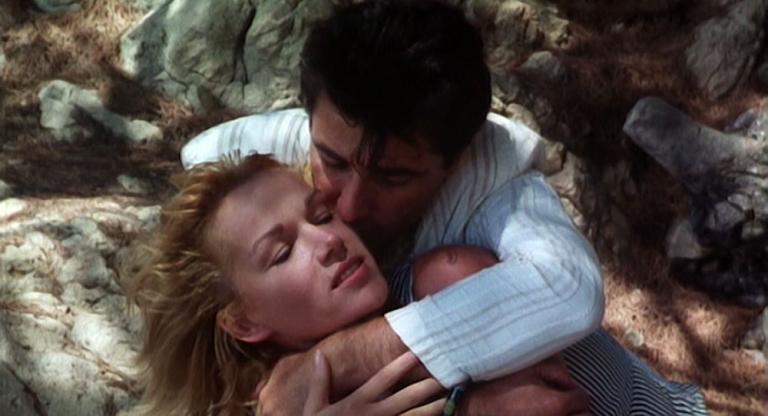
In a press kit written for the film’s new restoration, Martins stated that desire is the film's protagonist. Not as a theme, but as an engine. It is the thing that defines and drives the characters and the narrative alike. Sexuality bubbles up from the streets and sex is everywhere: in houses, in taxi cabs that seem to contain entire apartments, on basketball courts, and on friends’ staircases, where the light is all wrong and the angle is worse and nobody cares. Everyone sleeps together with an ease that reads as the film's sole naturalism, while everything around it—the mise-en-scène, the framing, the performances—is outstandingly polished and self-aware for a film depicting such an unconcerned ‘80s lifestyle. Even the dubbing, campy and cumbersome, coats the film’s images, making the entire affair shimmer with self-awareness. The soundtrack thickens this artificiality with a load of national and international hits: Rita Lee, Gilberto Gil, Tim Maia, Michael Jackson, and David Bowie. The characters recite them, absorb them, and let them become the language of their desires.
If desire is the engine, drag is the chassis. The Gaviotas don't perform queerness to survive a hostile society, they perform it nonchalantly because performance, for them, is the only form of freedom that actually works. In 1984, Garcia told the founder of the São Paulo Film Festival: “Our film is avant-garde, it will only be understood ten years from now.” Reflecting on this decades later, Martins has said: “Maybe it took a little longer. But he was right.”
Onda Nova screens tonight, June 13, and tomorrow, June 14, at Metrograph as part of the series “The Art of Soccer.”