Although his name recognition and refrigerator magnet sales are laughable in comparison to both his contemporaries and antecedents, Marcel Duchamp is inarguably the most important artist of the 20th and 21st centuries. What’s more, he’s surely the current frontrunner for Most Important Artist of the 22nd century. Despite his lifelong allergy to movements, circles, and the like, his work—a relatively scant corpus comically disproportionate to its influence—is central to the study of most of the modern and postmodern art world’s strongest currents: cubism, surrealism, dada, pop art, kinetic sculpture, assemblage, experimental cinema, conceptual art, and installation art. Sure, he never made a video game (although, you can play his “ghost” in online chess) or an earthwork, but no artist has contributed so vastly to our understanding of art making and perceiving. Or rather, to the act of surrendering to a lack of understanding of art making and perceiving, and instead crawling through a rabbit warren of unanswerable ontological questions, not the least of which is: “What is art?” This stature is all the more impressive considering that he spent his last 20 years playing chess and secretly working on one final masterpiece, the installation/assemblage Étant donnés (1946 - 1966), while even close friends thought he had given up art entirely.
In a brilliant companion to the Museum of Modern Art’s current retrospective of the artist, the first American Duchamp exhibition in over 50 years, Anthology Film Archives has organized “Marcel Duchamp On Film,” an eight-part series of cinematic Duchampania for obsessives and neophytes alike. Beginning with a program centered on Duchamp’s few forays into filmmaking (his own film Anémic Cinéma from 1926 and Witch’s Cradle, an unfinished collaboration with Maya Deren), the series expands to include film and video pieces inspired by his conceptual innovations (the recontextualized but unaltered “read-mades”). Fittingly, the series ends with Marcel Duchamp: A Game of Chess (1987), an interview documentary filmed five years before the artist’s death in which he plays chess against the filmmaker Jean-Marie Drot while discussing his life and work. The series also includes work from avant garde luminaries working in film and video across the 20th century: Andy Warhol’s screen test captures a seductive Duchamp chomping on a cigar: found-footage work by Joseph Cornell, Ken Jacobs, Peter Tscherkassky, Luther Price, and Joseph Cornell are presented as extensions of the “ready-made” concept; Peggy Ahwesh riffs on Anémic Cinéma; Charles Atlas, Merce Cunningham, and Duchamp pal John Cage offer idiosyncratic tributes to the artist and his preoccupations.
Central to Duchamp’s artistic development was a pivot away from what he called “retinal art” that appealed to the eye with craftsmanship and beauty toward modes “at the service of the mind,” as he told the American art curator James Johnson Sweeney in 1946. This conviction might have put him at odds with cinema, a medium naturally bent on delivering visual pleasure, but, as he told the art historian Pierre Cabanne, “I wasn’t interested in making movies as such; it was simply a more practical way of achieving my optical results… It was a convenient method.”
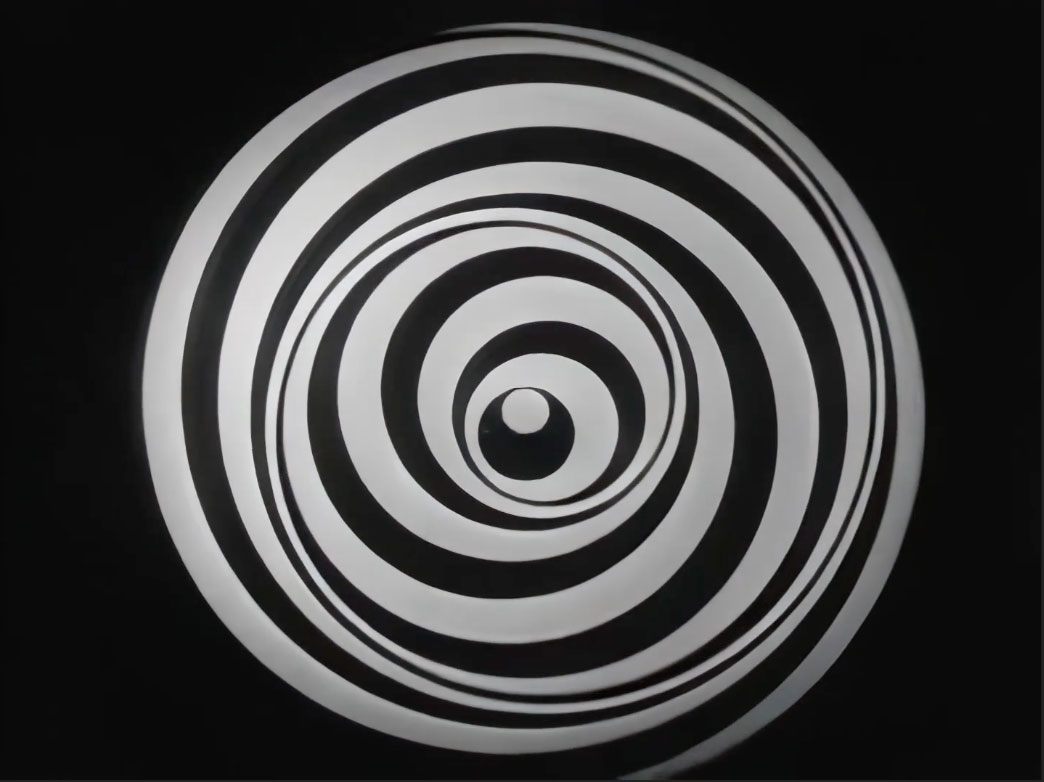
Duchamp’s direct involvement in filmmaking was brief and is now characteristically shrouded in uncertainty. Film scholars have spent decades analyzing and situating his sole completed film, Anémic Cinéma, but the work is barely mentioned in most critical surveys of the artist as well as his preeminent biography, Calvin Tomkins’s otherwise comprehensive Duchamp (1996). According to the scholar Alexander Benjamin Kauffman, he was one of the first artists to obtain a motion picture camera (around 1920) and incorporate it into his studio practice. Accounts vary on how many lost or intentionally destroyed films he produced with his new toy, but the primary result was Anémic Cinéma, which he credited to his female alter ego Rrose Sélavy. The film consists of disks (“rotoreliefs”) coated in 3-D optical illusions and spiralling, untranslatable, and filthy french puns rotating against a black background for seven hypnotic minutes. In the August 2 program dedicated to the film and its legacy, Anthology is screening Duchamp’s 1926 original, as well as an alternate version co-credited to Man Ray that might not have involved Duchamp at all.\
Accompanying both Duchamp’s original and pseudo-remake is a segment from Gustav Deutsch’s Film ist. (1-12) (1998) entitled Film Is. A Blink of an Eye. In his own dizzying sequence, Deutsch demonstrates rotoreliefs among other optical phenomena that informed the development of cinema. He reflects the rotoreliefs in the pried-open eye of a woman in an image that suggests Duchamp, Alfred Hitchcock’s Vertigo (1958), and Stanley Kubrick’s A Clockwork Orange (1971). (Incidentally, Duchamp and Kubrick both participated in Hans Richter’s film Dreams Money Can Buy [1947]; the former contributed an entire segment which is also screening in the series, while the latter appears briefly as an extra.) Deutsch puts another woman in front of a zoetrope, and juxtaposes both experimental subjects with a view from a train where passing telephone poles create a flicker effect while their wires suggest celluloid frames passing through the projector gate. It’s not so much retinal art as art concerned with the retina whose saccadic movements argue with the smooth turning of the disk.
The conjunction of flickering and rotation recurs in Paolo Gioli’s Images Overtaken By The Wheel of Duchamp (1994), the most comprehensive tour through Duchamp’s oeuvre in the series. The wheel in reference is Duchamp’s readymade sculpture Bicycle Wheel (1951), which consists of an inverted bicycle wheel attached to a three-legged stool; it’s a sculpture more found and presented than conceived and created. (Two programs in the series fully explore cinematic approaches to the concept of readymades). In his breakneck montage, Gioli places a wheel in front of his lens, inducing another rotating flicker effect. On the other side of the spokes, Gioli takes nearly every Duchamp piece as components of a moving assemblage. Among other exhilarating bastardizations, he aligns Duchamp’s hand-torn silhouette Self-Portrait in Profile (1958) to another self-portrait, this one a plaster cast of the artist’s bulging cheek entitled With My tongue in My Cheek (1959) to create an overwrought act of devotion that is also a Duchampian doubling. In fact, the entire film acts as a kinetic variation of Duchamp’s La Boîte-en-valise (1935-1966), the “portable museum” of painstaking color reproductions that he packaged in a suitcase and sold by subscription. Montaging close-ups of plaster nipples, chessboards, the mustachioed Mona Lisa, and the famous urinal, Gioli’s editing re-retinalizes the Duchamp corpus, an apostatic process that casts off enough conceptual exhaust that the artist might have even approved of it. He ends with the Italian translation of Duchamp’s epitaph, which, translated once more, might read: “Besides, it’s always the others who die.”
“Marcel Duchamp On Film” runs July 30-August 3 at Anthology Film Archives.