Decades before the term “manosphere” was coined, 30 years ahead of Blue Velvet (1986), and just one year before Jack Arnold’s The Incredible Shrinking Man (1957), Nicholas Ray delivered Bigger Than Life (1956), a seminal psychodrama about the unrest hidden behind the United States’ white picket fences. The screenplay was adapted from “Ten Feet Tall,” a 1955 New Yorker story by Berton Roueché about a Queens schoolteacher who was diagnosed with a rare and life-threatening inflammation of his arteries. The man (identified by Roueché as “Robert Laurence” for anonymity purposes) was written a prescription for the steroid cortisone, then enjoying one of those Eisenhower-era “miracle drug” reputations, and its countereffects were nothing short of miraculous—until he became addicted to it, such that he saw fit to hide his consumption from his family and underwent a severe personality shift, becoming impulsive and domineering.
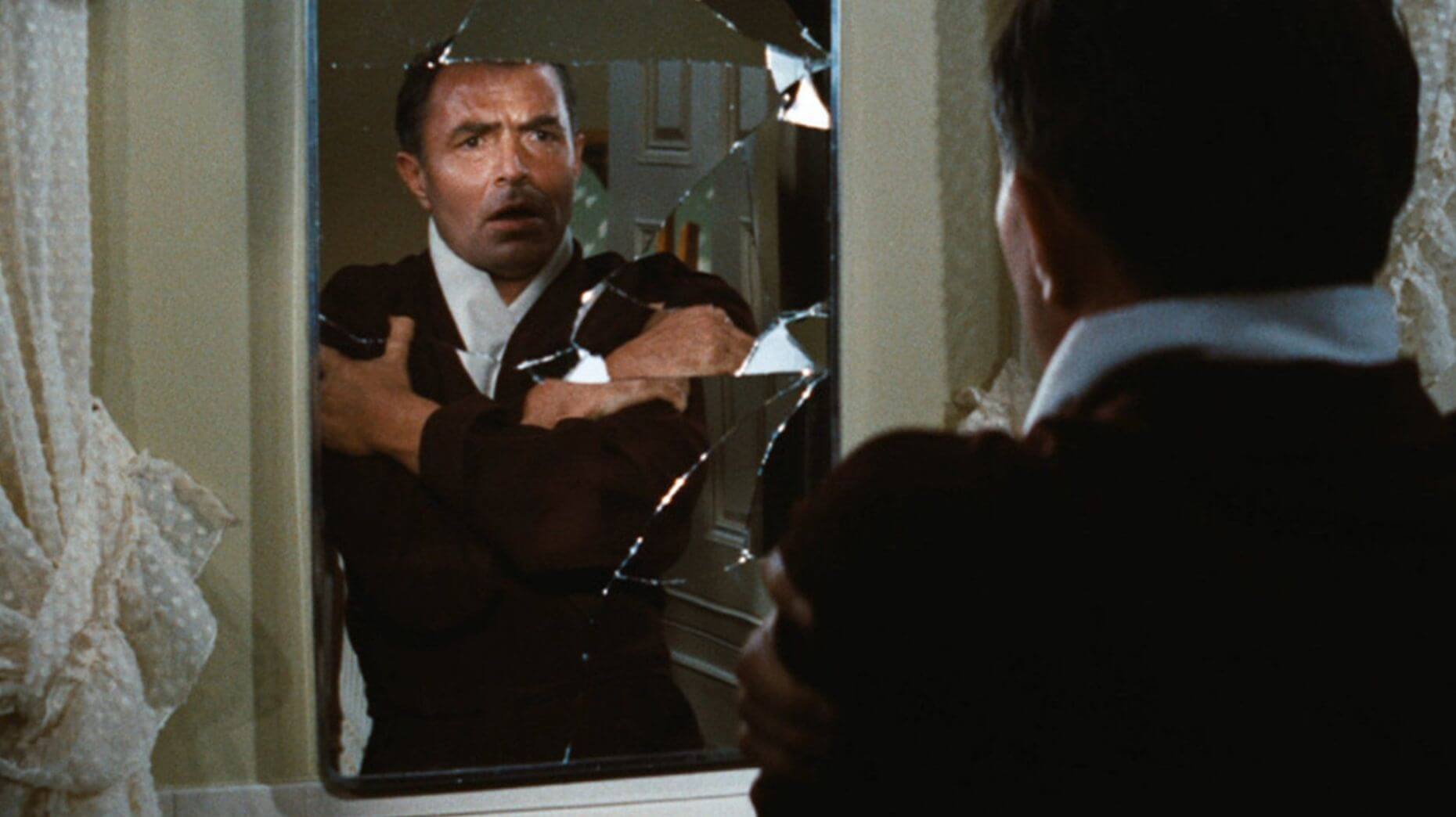
For Bigger Than Life, Ray and his team relocated the action from Forest Hills to a more idyllic American everytown, and Lawrence became Ed Avery (played by James Mason, who co-produced the film as part of a three-picture deal with 20th Century Fox). At first, Mason seems an odd choice for this all-American schoolteacher who unsuccessfully tries to hide his after-hours gig as a taxi dispatcher from his dutiful wife Lou (Barbara Rush) and cherubic son Richie (Christopher Olsen). But one of Mason’s gifts as a performer was his ability to portray flawed and flummoxed men either entrapped in denial or coming to a slow realization of it. Avery’s exhaustion at the pageantry of American life fully predates his diagnosis; early in the film, he sits watching a shoot ‘em up cowboy show on TV with his son and asks, “Doesn’t this stuff bore you? It’s always the same story.” It is hard to imagine Ray’s scene of Avery sobbing alone in his den, powerless and pathetic, working in the hands of a less incisive (or more gee-whiz American) lead actor.
The film plays like a darkly ironic inversion of the Road-to-Damascus dramaturgy (the Greeks called it “metanoia”) that marks It’s A Wonderful Life (1946) or subsequent knockoffs like Liar Liar (1997) or The Family Man (2000). The cortisone catalyzes a latent realization in Avery that his life sucks, changing him overnight into a pontificating blowhard whose concerns about the dumbing-down of his students justify a new, top-down paradigm. Much has been made of Ray’s choice to use the CinemaScope format on a story largely set within the claustrophobic interiors of the Avery household-under-siege. Rather than concerning itself with explicitly left or right-wing politics, the movie focuses instead on the effects of power and the authoritarian tendency in American culture. That such a paradigm can take root in the absence of a coherent body politic invokes the sociologist Jerry B. Harvey’s 1974 concept of the “Abilene Paradox”, in which a group’s lack of consensus leads to a chosen course of action nobody individually wanted, but everybody believed was desired by other members of the group.
Bigger Than Life is dense and complicated but not especially subversive; it screams in your face about what it wants to say. Seen today, the movie evokes after-school specials about teenagers abusing speed or steroids, as well as the grandiose-yet-conspiratorial thinking encouraged by ketamine (infamously embodied today by Elon Musk, among others). Also of interest is the casting of Walter Matthau as Avery’s even-keeled best friend. Matthau returned to the sprawling suburban milieu in Robert Quine’s Strangers When We Meet (1960), but this time as the soul-poisoned pervert whose genteel manner hides his base impulses. Quine was no Ray, but that film, in which Kirk Douglas portrays a brooding architect tasked with designing “the city of tomorrow,” shares Bigger Than Life’s clean, angular depiction of domestic life—an obsession with making things perfect (homes, families, neighborhoods.) Put another way: Bigger Than Life is about the tragically misaligned hopes of those who believed, as Lou says after one of Ed’s episodes, everything would be back to normal by Monday.
Bigger Than Life screens this evening, July 28, and on July 30 and August 1, at the Roxy on 35mm as part of the series “Rebel: The Cinema of Nicholas Ray.”