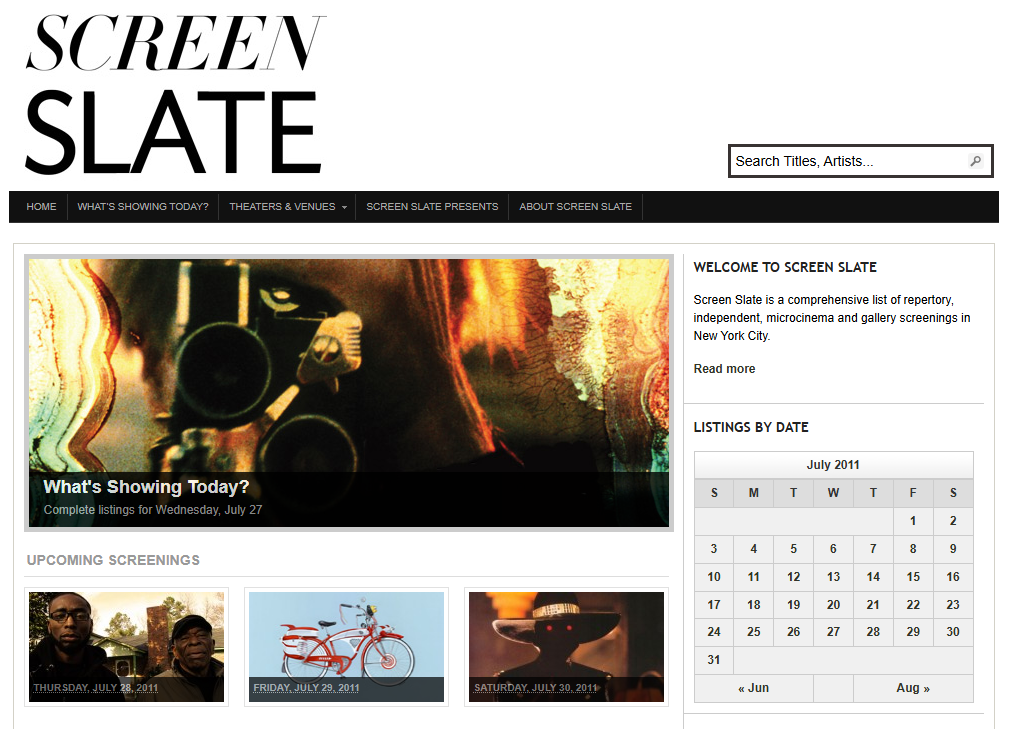
Today is Screen Slate’s 15th anniversary. When I started compiling listings with short writeups and emailing them to a group of about five friends and my mom, I was unsure whether the project had any legs. It was just an attempt to fill a gap in specialized local listings that I recognized, especially as it became clear that alternative print media was in decline and legacy publications were turning their backs on local coverage. Its growth has been slow and steady: Screen Slate has never had a major inflection point that led to a significant bump in audience expansion or a large grant or donation that gave us the resources to rapidly scale. I, and eventually a growing circle of friends, committed to doing work that we felt was important. To date, Screen Slate has included the work of five developers, two designers, three managing editors, two Bay Area editors, dozens of people who update listings for venues, various people offering critical guidance and support, and more than 400 contributors. Only two of these are people whom I’d met before I started Screen Slate: Patrick Dahl, the first “guest contributor,” who has been my best friend and collaborator since middle school, and longtime member of our development team Jeremy Fisher, who I met at a gallery opening in Chinatown and somehow recognized as my friend from preschool despite having not seen him since we were four years old. (Such forms of serendipity, coincidence, and chance are enthusiastically embraced as part of the Screen Slate ethos.)
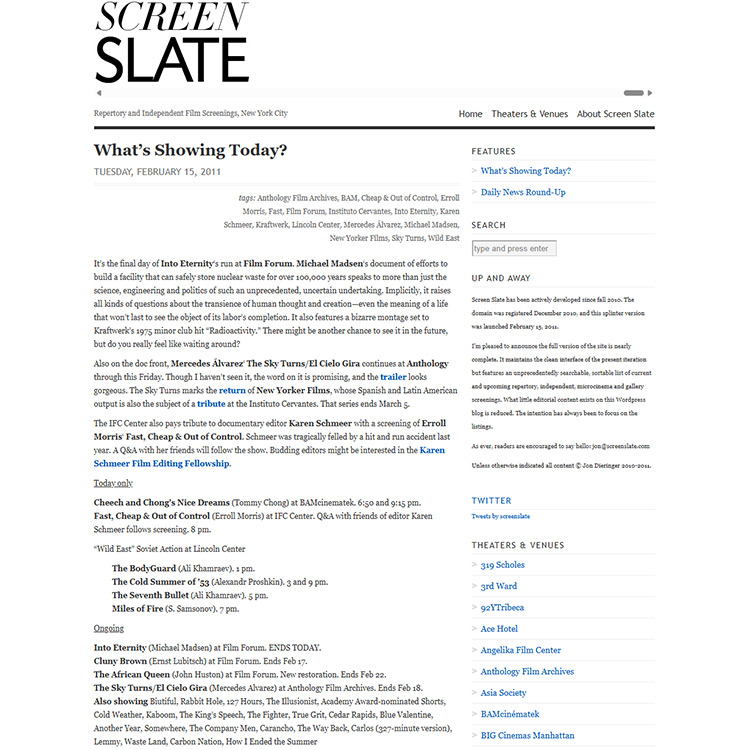
It’s difficult to sustain a project like this, both materially and in spirit. Screen Slate’s journey has taken it from being a literally no-budget DIY project to being a figuratively no-budget DIY project. It has zero full-time staff members. Everyone volunteers or works for honoraria. With the exception of a few pinch-hitter days, I have personally compiled and sent the daily email each morning (or afternoon, if I’m lazy) for the last 5,479 days. I have only half-joked that the Screen Slate Daily email is my .NET art conceptual performance practice. (There have been nearly twice as many Screen Slate emails as there are On Kawara date paintings… just something to think about.)
I think when you do this work regularly, and without commercial exploitation or tailoring work to social media, it becomes invisible. A compelling case for this is a recent New York Times article about the effect of social media platform Letterboxd, attributing to it a growth in repertory film attendance, especially in two cities: New York City and the Bay Area. The latter, it noted, occurred specifically post-pandemic. (Screen Slate SF Bay launched July 2023 after joining forces with our friends SF Bay Film, which started October 2020.) I think one of the greatest challenges facing grassroots, noncommercial community efforts is that many people, including—and perhaps especially—those working in legacy media are unable to recognize anything outside of their Instagram feed or backed by venture capital and private equity as having value and influence. On the nonprofit side, it often seems that resources are misallocated to out-of-touch, overly professionalized new projects that speak the language of funders but are ineffective at actually reaching audiences.
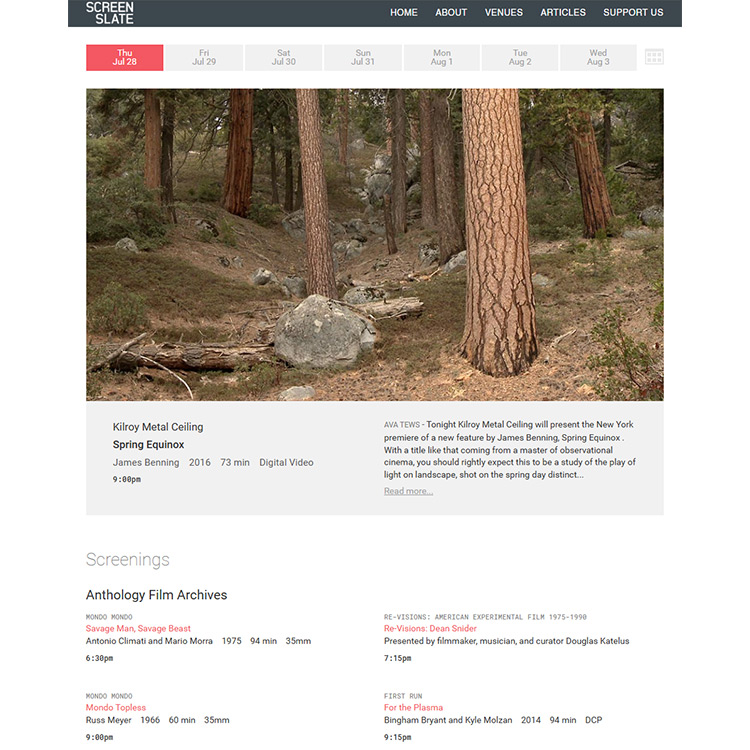
As we look toward the future, this anniversary is a major one. This year, Screen Slate will boldly advance its no-budget-to-“no-budget” trajectory to the next step: some budget. The work we do is important. It has an impact. And everyone is increasingly contending with a diminished landscape for thoughtful media arts writing and clear information about what’s happening. So as Screen Slate moves toward sustainability, we’ll be making the most of our anniversary throughout this year with programming, special events, big public parties, and our first-ever gala fundraiser to be held late spring at Artists Space. (Stay tuned for an official save-the-date and more information.) And if you can, we encourage you to support year-round by becoming a member on Patreon or making a one-time donation—this is our main source of funding to pay honoraria to writers and editors.
Local coverage is important. It helps to shape the values and identities of our cities and renew and sustain their cultural and social lives. Screen Slate’s readers know this, and so do the hundreds of people who have contributed to it over the last decade-and-a-half. And as Hollywood falls, repertory film screenings are sold out to packed auditoriums of attractive young people, and New York City has a newly elected socialist government, it seems that fifteen years in, maybe our moment has only just arrived.