The Spanish filmmaker Carlos Saura was awarded the Golden Bear at the Berlinale in 1981 for Deprisa, Deprisa. The film’s title translates to Faster, Faster or Hurry, Hurry depending on who you ask. Regardless, Saura’s thrill with all things quick and immediate is present in each second of Deprisa, Deprisa—in its in media res start, in its fast cars, in its haphazard heists, and in the many sudden and casual drug-induced highs it depicts. It makes sense considering the film focuses on a quartet of teenage delinquents caught up in a life of crime, where one night’s successful carjacking might mean disaster the following morning. These kids, like those in Nicholas Ray’s Rebel Without a Cause (1955), live fast and die young.
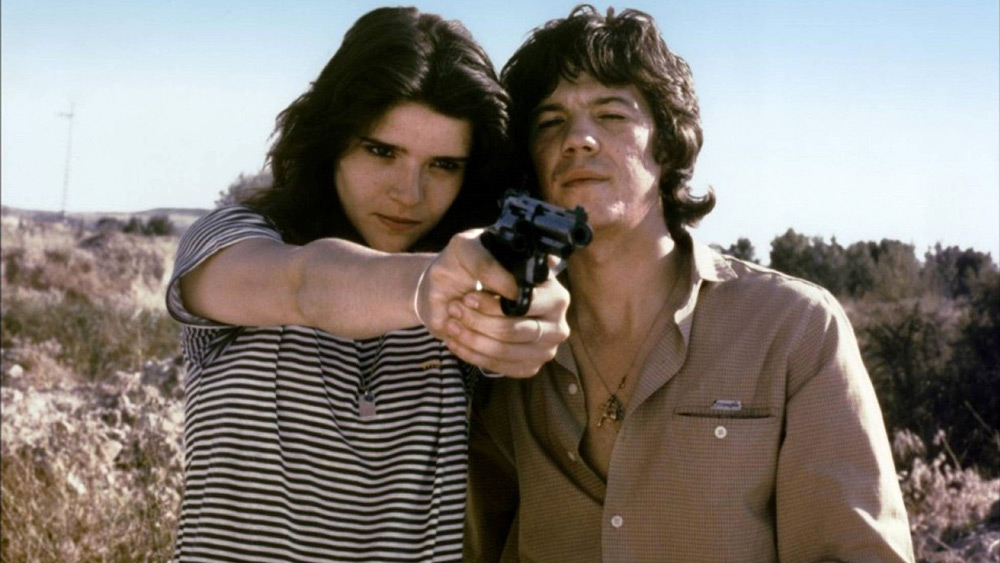
Filmed with real lowlifes, two of whom Saura had to bail out of jail mid-shoot, Deprisa, Deprisa primarily focuses on the love affair between Pablo (José Antonio Valdelomar) and Ángela (Berta Socuellamos Zarco), as well as the misadventures of their friends/accomplices “El Sebas” and “El Mecas.” Mecas likes to drive fast and burn things; Sebas is mercurial, but ultimately well-meaning; Pablo is streetwise, but cannot bother to think about the future; Ángela is new to the group, a barmaid-turned-criminal whose ambition trumps that of any of her male counterparts. They amble about Madrid smoking weed, getting drunk at nightclubs, and occasionally racking their brains together to figure out what cash register they’ve got to hit up next in order to pay the next month’s rent. For all of their faults, the group does well for themselves, keeping each other company while the rest of Spain awkwardly stumbles from autocracy into free-market capitalism. The aimlessness of their moment, which pervades the film, is symptomatic of the era: a period of extreme economic uncertainty during which an entire society had to contend with life in the wake of a 40-year military dictatorship. During the preceding years, Spanish cinema gave the world Pedro Almodóvar’s early punk masterpiece Pepi, Luci, Bom y La Chicas del Montón (1980) and Iván Zulueta’s cri de cœur Arrebato (1979).
But both of the aforementioned films were more representative of the Movida Madrileña, above all else, than Deprisa, Deprisa ever could be. The scope of Saura’s film is wider, perhaps more universal. It captures a national state of affairs, presenting itself as a prime example of the Cine Quinqui movement, a short-lived subgenre that focused on the lives of marginalized working-class teenagers who turned to crime after the fall of Francoism. (Among many highlights, Cine Quinqui presented the world with such gems as José Antonio de la Loma’s Street Warriors and Eloy de la Iglesia’s Navajeros.) Despite being lambasted within Spain’s border upon release, Deprisa, Deprisa’s international acclaim, a clear reflection of Saura’s caring approach to making the film, justified its look at street-life, paving the way for similar portraits of teenage misery in years to come, as seen in films like Teresa Villaverde’s Os Mutantes (1998) and Uli Edel’s contemporaneous Christiane F. (1981). Whether or not such films took direct influence from Saura, his film stands out for its depiction of waywardness in the face of capitalist expansion, and of criminality against corporatism.
Deprisa, Deprisa screens tomorrow afternoon, February 14, and on February 19 and 21, at Anthology Film Archives as part of the series “Valentine’s Day Massacre.”