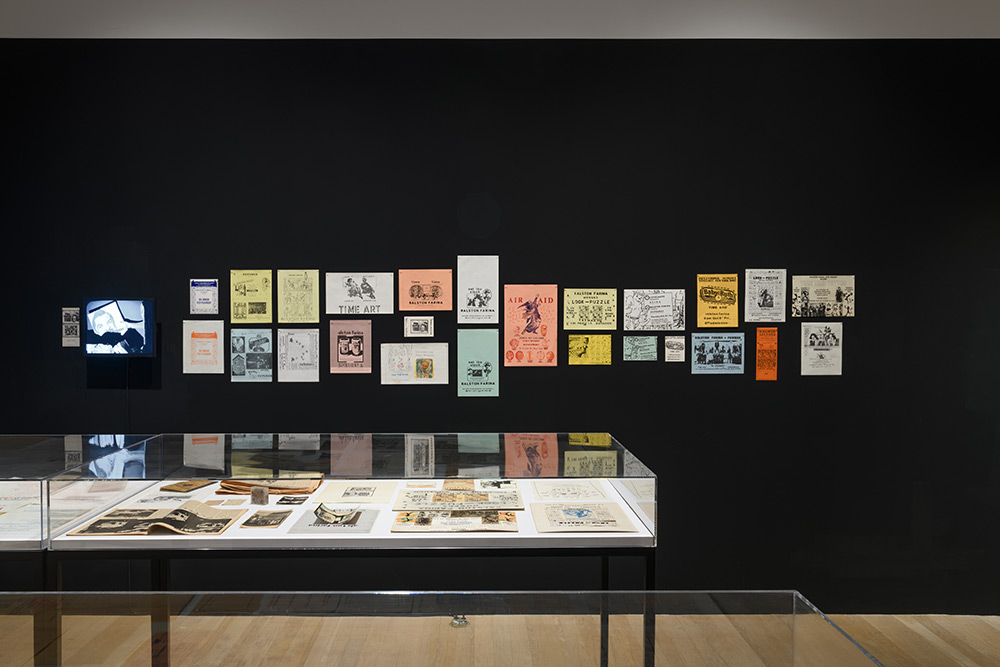
Before the categories of performance art and time-based media were institutional mainstays, Ralston Farina repeatedly asserted “My medium is time” when presenting his work at various Downtown venues beginning in 1965. The ephemerality of his performances was underscored by his resistance to their documentation, insisting that his spectators’ subjective experience of his acts was the true substance of his art. Still, fragments of his work remain in the form of enigmatic diagrams, notes, drawings, promotional flyers, a small group of assemblages, and, despite his ideological objections, a handful of video recordings of his performances. It is this archive, preserved by his friends Richard C. Skidmore and Dennis Hermanson, that comprises the works on view in Ralston Farina: Time // Time at Artists Space, curated by Jay Sanders and Stella Cilman, with Nusheen Ghaemi, a pseudo-retrospective of an artist whose attempts to forge an art purely on the fourth axis resulted in an ongoing experiment with human cognition.
Born Steven Robert Snyder, the artist's pseudonym is a combination of references to the dog food brand Ralston Purina and farina, another name for cream of wheat porridge. Breakfast cereals and dog treats were recurring props in his performances, the former embraced for its homonym for “serial,” invoking the segmented interruptions of TV shows by commercials. Active in New York until his premature and unexpected death in 1985, Farina’s art attempted to reconcile “the methodology of Wittgenstein's ‘doctrine of showing’ (what cannot be said),” Edmund Husserl's “‘phenomenology of internal time consciousness’ (expectations, recollections, phantasy, and imagination),” and Henri Bergson's “ideas on duration as duration.” Farina also cited John Cage and the improvisational comedian Ernie Kovacs as influences—Farina's reverential collage of the comedian greets visitors at the show's entrance—and his art is best understood as one of timing, rather than time-based. He began performing at age 12 as an assistant to his father, a mentalist who performed for Elks Club audiences in Philadelphia. Similar to the feats of intuition and suggestion performed by conjurers, the manipulation of audiences’ expectations became a central concern in Farina's art.
Where film or audio recordings capture perceptive phenomena on physical media, Farina sought to reconfigure time itself within his spectators' minds, often using props indicative of time's measurement, such as a metronome or birthday cakes complete with lit candles. In the video of TIME//TIME: Portrait of a Half Hour, performed at the Internationaal Cultureel Centrum Antwerp in 1977, we see Farina pouring out entire boxes of cereal, painting with Campbell's tomato soup, and tracing a drawing of a reclining nude from an overhead transparency. These actions are woven into projected excerpts of the Elvis movie Blue Hawaii (1961) and accompanied by songs played on a turntable, including The Velvet Underground's “I'm Sticking With You” and Ian Dury's “Sex & Drugs & Rock & Roll.” Toward the end, we see him spray a liquid from a spray bottle onto what at first seems to be a blank posterboard, but as the substance soaks into the paper, the message “TIME//TIME” appears, like a thought or memory forming from the ether of our consciousness.
As Farina explains in his statement for Portrait of a Half Hour, “This show, a half hour serial of abstract random events will display two aesthetic distributions of temporal characteristics, Deja-Vu//Jamais-Vu.” Separated by the double slash that he insisted divide the repeated “TIME” of his performances’ titles, the “already seen” and “never seen” description of Farina's statement is a key to his technique; as he explained in a text for his performance at the 10e Biennale de Paris, also held in 1977, “The future that may happen is just as much a part of the future as the future that will happen. Both futures are equally real.” For Farina, mental projection and anticipation is the main event. The impression his strange actions make on the spectator’s mind, what he termed “the meta image,” is a convergence of the spectator's observations of his actions and their expectation of what he would do next. Like comedians and stage magicians, Farina responded to his audience’s reactions, but rather than having a set of polished jokes or tricks up his sleeve, his reactions were thoroughly experimental, allowing “rough spots” to remain in the act, adding “texture” to the aesthetic of the performance as a way to prompt spectators to consider how their experience of time's passage changes according to various stimuli, or, as he termed it, the “phenomenal aspects of time.”
Ralston Farina: Time // Time is accompanied by a booklet of artist statements, excerpts from contemporaneous reviews of his performances, a 2013 article by J. Hoberman, and a short text by the mathematician Philip Ording shedding light on Farina's detailed, matrix-like diagrams that create a schematic for translating his readings on phenomenology, music, signal processing, and many other subjects into performances. These texts are all illuminating and helpful to discerning what occurs in the videos and in his works on paper, but perhaps the most affecting section is the collection of texts from spectators recalling both Farina's performances and the man himself. Contributions from Cage, Daryl Chin, Edit DeAk, Anthony McCall, Michael Smith, Anne Waldman, and others describe wildly varying experiences as audience members at Farina's shows, offering the truest remnants of Farina’s art and a poetic meditation on the nature of human perception, memory, and, of course, time.
Ralston Farina: Time // Time is on view at Artists Space through February 21.
Photo: Carter Seddon. Image Courtesy Artists Space, New York.