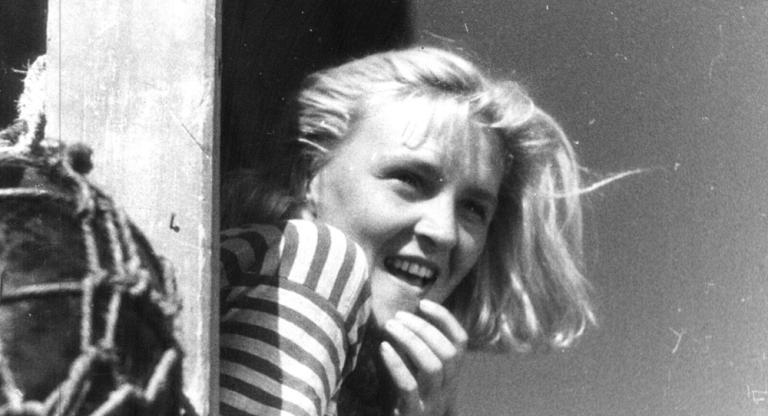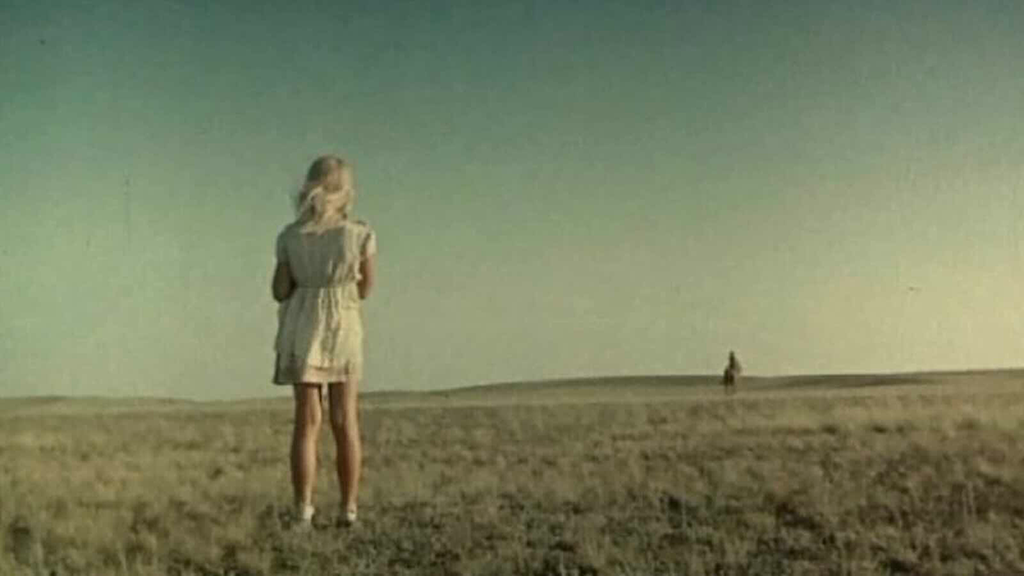
Not a final statement in the literal sense, but a suggestion of a new era that never came, Boris Barnet’s penultimate film, Alyonka (1962), is both more personal and grandiose than his studio assigned follow-up: Whistle Stop (1963). That film, while being great on its own merits, saw Barnet constrained by a lower budget and the studio decision to shoot in black-and-white after Alyonka’s box office failure—another set of indignities for Barnet, who had his resignation from directing at Mosfilm accepted in 1965, before tragically taking his own life while working on his next (and never completed) film in Riga only a few months later. Alyonka, meanwhile, sees Barnet unleashed, sending his free-flowing cinematography across the Kazakh countryside as he puts together a collection of pastoral narratives set during Khrushchev’s Virgin Lands campaign, wherein the previously barren steppe was to be converted by settlers into fertile farmland.
The story concerns a disparate group of travelers packed together in the back of a truck headed off the edges of the Virgin Lands and toward the city at the district’s center. What unfolds is less a road movie or packing of personalities, but a series of vignettes as varied in genre as they are in character, with the passengers recounting their lives and what led them to the Virgin Lands. The young idealist dentist, Elza (Anda Zaice), has her story presented like a coming-of-age film; the tractor driver, Stepan (played by Vasiliy Shukshin, who was culturally one of the most important writers and filmmakers of the post-war Soviet generation, and owes some of his pastoral inclinations to Barnet), has a tale of snow-isolated marriage filmed as a stunning melodrama; meanwhile, the titular Alyonka (Natalya Ovodova) presents her anarchic school hijinks as a cute comedy, with even a bit of speed ramping. Here, on the back of a truck in the wake of progress, Barnet is able to stretch his arms and freely paint portrait after portrait of the extents of Soviet life.
Part of what makes Barnet a standout among his peers, especially those who worked primarily within the Soviet studio system, was his improvisatory nature as director. He often threw out and rewrote whole scripts, or even found his cinematic language while on shoot. It allowed Barnet’s decoupage to be informed not just by a preconceived notion of what the film should be, but what he could find while making it. In a literal sense, this manifests in Alyonka as stunning visual sequences of the camera dancing with its characters across the vast Kazakh landscape, while symbolically the concept of putting people together in the back of a truck is a thought experiment for what kinds of stories can be imagined, where, like the Virgin Lands themselves, the cinema becomes a limitless frontier waiting to be cultivated.
Alyonka screens this afternoon, April 11, at Metrograph on 35mm as part of the series “Boris Barnet: A Soviet Poet.”
Correction: This article previously stated that John Ford directed The High and the Mighty when that film was actually directed by William Wellman.
See Also