Would you break a strike for art’s sake? At the risk of letting the wolf of reaction in the door, the question becomes irrepressible at the climax of Robert Wilson and the Civil Wars (1987), Howard Brookner’s chronicle of the late theatrical visionary’s race to complete something like a global masterpiece. We are in the passenger seat of a breakneck production, behind schedule and over budget, at the Teatro dell’Opera in Rome, the fourth of six proposed sites for Wilson’s avant mega-opera The CIVIL warS. The Olympic Arts Festival in Los Angeles, where the pieces are meant to be reassembled just two months from now at the ‘84 games, has already threatened to cancel its invitation. Now, the Teatro’s electricians are striking, slowing rehearsals to a trickle, and threatening to seal the fate not just of the project (subtitled “A Tree Is Best Measured When It’s Down”) but, in a sense, of Wilson himself.
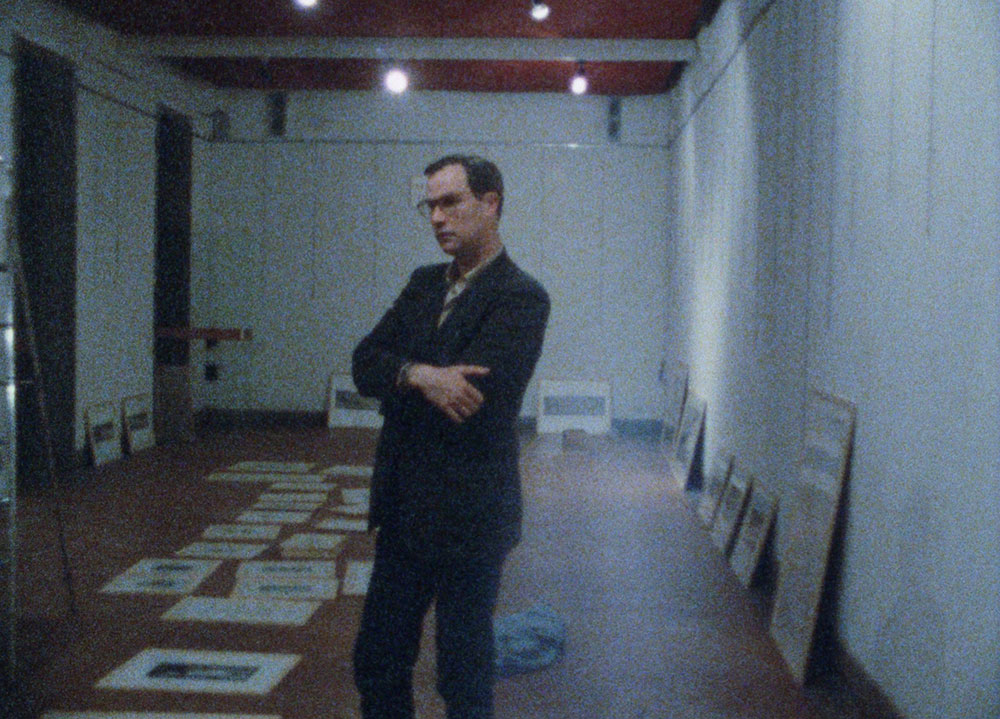
This feeling is in part an effect of Brookner, who uses the genesis of Wilson’s new work to narrate his life and career, accompanied by commentary from collaborators like Lucinda Childs, Etel Adnan, and Philip Glass. Originally made for public television, the documentary is one of two portraits (alongside 1983’s Burroughs: The Movie) in Brookner’s short filmography. Feared lost after his death from AIDS in 1989, it has been painstakingly reassembled and restored by his nephew Aaron Brookner. In the improbable journey from stuttering son of Bible-thumping Waco, Texas, to arts teacher for the developmentally-challenged in New York City, to laureate of the trans-Atlantic avant-garde, we see Wilson (dashing but now definitively middle-aged) wrestle to merge his grandest expression yet with a larger consolidation of postmodern theater as official culture.
Postmodernism, what Fredric Jameson called the cultural logic of late capitalism, describes not just Wilson’s ice floe aesthetic of history, melody, and symbol on the verge of nonsense, but his jet-setting, overleveraged relations of production. In restless motion between the likes of Minneapolis, Paris, and Tokyo, his hand in a constant frenzy of drawing, painting, and diagramming, Wilson seems at times to be planning this complicated work in literal midair. Nearly as impressive as his list of collaborators is his rolodex of prospective donors, who include J. Paul Getty and Pierre Cardin. Buttressed by institutional pedigree and philanthropic largesse, the CIVIL warS troupe registers the labor action in Rome quizzically, more as a bit of in-flight turbulence than the vibrations of a class struggle that Wilson’s work (like its contemporary, Reaganomics) has largely rendered abstract. And yet this quintessentially pax-American freedom—to absorb, redirect, and discard whole categories of history and culture—is also part of what’s so exhilarating about Wilson’s vision. Like the atomic blast at the core of his first, most famous collaboration with Philip Glass, Einstein on the Beach, Wilson seems intent on reordering the values of art through sheer poetic force. Under this new regime, the wars of the future will be fought onstage.
In Rome, relations with the theater have deteriorated. Rehearsals carry on intermittently without anyone to properly light them; as a circus-tall figure of Abraham Lincoln glides across the stage like a vertical horizon, he slips out of his spotlight and begins hopelessly to wobble. At last the sangfroid Wilson loses his cool and threatens to walk off the set. He’s to win this battle, but news from the front is grim: the money for Los Angeles will not arrive in time. It’s a joke that befits the production’s cosmic stature: the civil war has been indefinitely delayed.
Robert Wilson and the Civil Wars screens tonight, May 30, and on June 5, at Anthology Film Archives as part of the series “Robert Wilson On Screen.”