A man is crawling around on the floor. He has the frame of a prizefighter, a square jaw set slightly offline, a full mouth and wide eyes that he has learned to narrow for effect. He crouches astride a long scroll, having put his boots at either end to keep it from furling back up. It is midnight. He has not allowed himself a drink in several weeks. Instead, he has had a lot of coffee. Now he is exhausted, but not sleepy. The electricity in Kyiv is rationed, and he knows he will only have an hour or so to work, if he can bear the sound of the neighbors’ radios through the walls. He runs his finger along the fragments of typewritten dialogue and description he has pasted to the scroll, atop which he marks revisions. He knows that he will change everything again as he shoots, and he can already hear the censor haranguing him for having departed from the approved script. He thinks, not for the first time, that he has chosen his profession poorly.
In December of 1946, Boris Barnet is working on a film called Secret Agent. He will eventually be recognized as a lyric genius whose career bridged the silent era and the advents of sound and then color, an artist who defied genre by folding comedy and tragedy together in every moment. For now, he is assured of being entirely inconsequential. To get anything done, he must expend a lot of energy to convince himself that he might be wrong. He hopes to get to the bottom of this script before shooting begins, but what he’d really like right now are a few extra rubles to send to his wife in Moscow, who has been asking for a new pair of house slippers.
It wasn’t always like this. Twenty years ago, at the beginning of his career, Barnet was full of hope and promise. The Girl with a Hatbox (1927), his first solo directorial effort, would remain one of his favorites, unimpeded by the excessive constraints to come. It is a raucous comedy premised upon competing claims on the same room of a Moscow apartment, subject to Soviet communal housing policy. The antagonists, a frigid milliner and her uxorious husband, use the surplus space to sleep separately, as she prefers. Their distinctly bourgeois unhappiness is made possible by the New Economic Policy, which allowed private ownership of small businesses to temporarily resume while the state restored productive capacity to pre-war levels (Lenin described it as communism “taking one step back in order to take two steps forward later”). The resulting class of NEPmen, so called, provided an ideal foil for comedists like Barnet, but also for Stalin, who made them the avatars of greed and corruption. Barnet does not go that far, always reserving a ration of sympathy and even the prospect of redemption for his villains. His best films will have no villains at all, unless you count Time, War, or Desire. When the critic Jonathan Rosenbaum calls Barnet’s propaganda “politically incorrect,” this is the kind of thing he means.
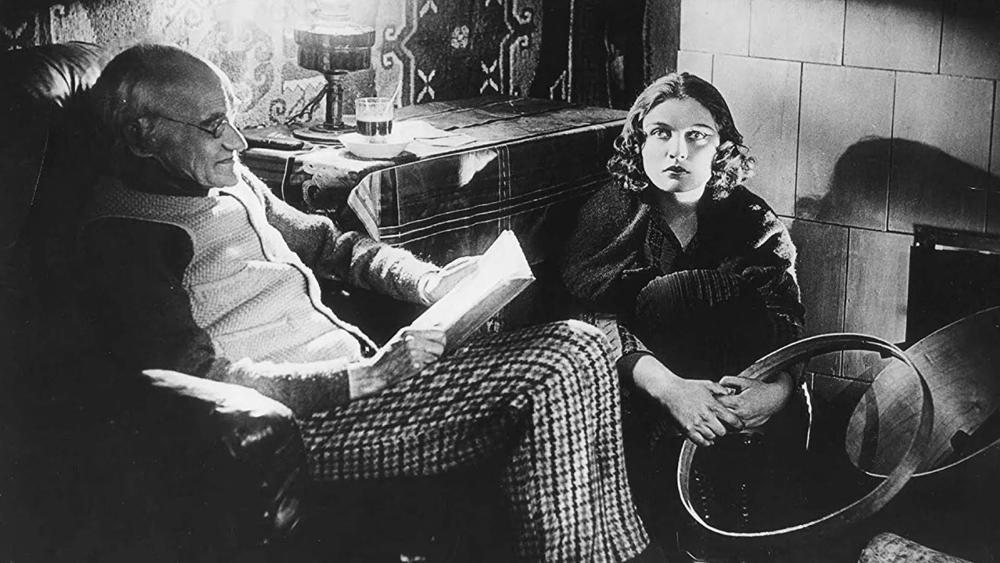
From the beginning, Barnet’s work teems with blink-and-you’ll-miss-them moments of sublime comedy and pathos, as when a crowd at the train station quickly organizes itself into a queue, then comes to seem almost a cabaret dance line. The titular hatbox is an inherently whimsical prop: crushable, stackable but liable to topple, fit for use as a shield or a drum. At one point, it serves as a modesty barrier while man and woman bed down in the same bare room. Barnet establishes a trope that he will later transpose even to the trenches of the First World War, arranging hats, shoes, and clothing to make sleeping bodies look other than they are. Here he makes a mockery of the anticipated conjugal morning when the man awakes with his boots on his hands, dangling down by his stockinged feet.
The girl who has already gone is played by Anna Sten in her first leading role, five years before Samuel Goldwyn imported her to Hollywood, dreaming of a “new Garbo.” She is more fortunate in Barnet’s film, which was commissioned to promote the new Soviet lottery bonds. Like U.S. Treasury securities, these were a means of raising capital for government spending, supplemental to taxation. Rather than guarantee a rate of interest to their holder, the Soviet bonds made one eligible for cash prizes. An earlier film, Yakov Protazanov’s The Tailor from Torzhok (1925) was made with the same purpose, and both were originally scripted by the same writer, Valentin Turkin. Curiously, in neither case do the protagonists buy the bonds themselves but come by them secondhand, as apparently worthless pieces of paper that skitter along the surface of the film until they are discovered to be winners. (For this, Barnet reuses Protazanov's footage of a little boy drawing a number from the revolving drum.)
The Tailor from Torzhok features Vera Maretskaya as an abused housekeeper given a means of liberation through the labor union. She would play a similar role in Barnet’s next film, The House on Trubnaya (1928), a sort of Cinderella story that first takes cues from the city symphony to stage a sonata of the stairwell. “The city wakes up, looks in the mirror, and begins to wash up,” an intertitle reads before street sweepers impede upon a puddle’s reflection of the original Cathedral of Christ the Savior, already slated for demolition. As in the cinematic day constructed by Dziga Vertov’s Man with a Movie Camera, which would be released the following year, the pace quickly accelerates, but in this case the action is not organized into industrial productivity but dysregulated into the frenzy of a panicked mind.
Where Hatbox had captured a snow-choked Moscow, Trubnaya finds the city in spring. In a bitter irony of crossing trains, a young woman from the country finds herself in search of an uncle who has already returned to their village. Among the passersby she asks for directions is Barnet himself, who offers no help at all. As in his previous film, the director evinces an interest in the comic nature of a crowd, as soon assembled as dispersed. He understands well the alternating, sometimes overlapping anonymity and visibility of city life, by which a girl can be ignored and neglected until she is recognized and redeemed by a chance encounter, or by which a case of mistaken identity can, however briefly, turn her world upside down. Just as our lives in the city are everywhere intersected by those of others, Barnet’s films do not content themselves with just one story. Incident overflows from them, and we feel as deeply for the minor characters as for those more central to the plot. In this case, my last thought is for the plight of a different housecleaner, Marisha (Anel Sudakevich), a burgeoning love interest who is soon tossed over for the lead.
Barnet’s films are often premised upon arrivals: After train rides, shipwrecks, or capture by enemy forces, characters must navigate an unfamiliar place and learn its ways. The Thaw (1931) is an exception, featuring only those who have lived their whole lives in the farming community of Uslada, though the arrival of winter defamiliarizes the environment and forces most of the action indoors. From its opening on the banks of the Volga River, the sense of unified space achieved in Hatbox and Trubnaya is notably absent. Instead, a romantic disorientation takes hold of the dunes, on which a young couple makes love beside a beacon meant to aid sailors’ navigation. Later, the implicit horror of the wide shot is summoned to great effect on the frozen tundra, where events unfold with a sense of awful destiny.
The Thaw relies more heavily on intertitles than do Barnet’s other silents, thematizing the instability of the written word in the form of claim and counterclaim, record and forgery. Made at the outset of the famine years, it involves a conspiracy of kulaks—wealthy, farm-owning peasants—to evade requisitions by underreporting their harvests (it was on such instances of corruption that Stalin would try to pin responsibility for the grain shortage and misallocation that killed millions). It’s a film about taxing the rich, in other words, which analogizes the coming of spring to a long-overdue political reckoning. Despite its relevance to our own time, this one was regrettably left out of Metrograph’s highly anticipated 13-film retrospective, but it is not difficult to find online.

With his next film, Outskirts (1933), Barnet made the transition to sound, though this and subsequent works would continue to be structured by long periods of silence. The first words spoken in his filmography are those of a carthorse, who shakes its head and sighs, “Good lord!” Soon workers are identifying and even imitating the surrounding factories by the sound of their whistles. As in Trubnaya, the story is focused on a single building, a society in miniature. In this, one of his few historical films, the director captures the ambivalence of the Russian people to the First World War—which counts a friendship among its first casualties—but also the confusion and disappointment accompanying the initial news of revolution and the establishment of the provisional government. In the incongruity between harrowing trench scenes and triumphal headlines, the state is revealed to be an unreliable narrator. It is the rare war film that does not harden itself to its subject, never feigning to understand the logics of brutality.
In Barnet’s filmography, it is possible to trace the Soviet revolutionary dream as it is born, boxed in, and betrayed. He began working for the screen in the first years of Stalin’s reign, and one senses the state’s grip gradually tightening around its cultural organs until the director’s humanist vision is not only out of fashion but essentially forbidden. Though he was tolerated as an entertainer, many of his projects were spiked well into their preparation, and others were banned for many years. The Old Jockey, made in 1940, was only allowed to be released in 1959, during the Krushchev Thaw; this despite having no overtly political angle, but maybe that was the point.
The critic A. S. Hamrah writes that Barnet “explodes his characters out of the monumental Soviet marble. They abandon poses and come to life.” The historian Bernard Eisenschitz has noted that a Barnet film is “fantastic, or at least marvelous, at the very moment it should be socialist realism.” The scholar Nicole Brenez writes, of By the Bluest of Seas (1937, pictured at top), that it is set in “the concrete, materialistic, physical paradise that humanity proves incapable of living in.” We in the West have a perverse fascination with artists working under totalitarianism, who give credence to the notion of art’s power and danger, which is mostly neutered under free-market capitalism, received vicariously in the form of cultural imports. It is tempting to think of Barnet as a dissident filmmaker, smuggling illicit expressions into his promotional assignments. Some have imagined an alternate reality where he follows Anna Sten to Hollywood and works freely, though of course different problems would have awaited him there. A younger colleague in the Soviet film industry, Alexander Mitta, spoke of his gifts instead as a congenital affliction:
He thought that the people who had been put up there to rule us were great figures, simply because they were there; he listened to their speeches and really wanted to put these themes into films. But he did not know how to make the stereotypes that the bureaucrats gave him: he only knew how to reflect life. He did not attack the stereotypes, but life seeped into them, washed them away.
Unlike his peers, who theorized a seventh art entirely distinct from the traditions of theater and literature, Barnet’s cinema is a container for the abundant irony, melancholy, and hilarity of life itself, which might otherwise pass unremarked. In January of 1965, he will find himself working on another film in another hotel room, this one in Riga. It is there that he will take his life, leaving instructions for his wife to redeem his pension, which he hopes can secure their daughter’s future. Two years before, Barnet had met the young Georgian filmmaker Otar Iosseliani. “Above all, don’t watch my films twice,” he told him. “They are made for one viewing, and afterwards, when you go for a walk and remember them, they become better.”
The scene that begins this essay is partly imagined, but based on details from Barnet's letters to his fourth wife, Alla Kazanskaya (star of Bountiful Summer, 1950), translated by Ted Fendt and published by Metrograph Journal (March 2026); and on a tribute by his second wife, Yelena Kuzmina (star of Outskirts and By the Bluest of Seas), translated by Steven P. Hill and published by Film Comment (Fall 1968). The quotations from Mitta and Iosseliani are from interviews conducted by Bernard Eisenschitz and published in his essay “A fickle man, or a portrait of Boris Barnet as a Soviet director,” in Inside the Film Factory: New Approaches to Russian and Soviet Cinema, eds. Richard Taylor and Ian Christie (Routledge, 1991).
Boris Barnet, A Soviet Poet runs March 13-April 4 at Metrograph.