“Maidstone is a phenomenon to which standard film criticism is almost superfluous” wrote Andrew Sarris in the The Village Voice, wrestling with Norman Mailer’s chaotic film-within-a-film, a movie he dismissed as “punch-drunk dilettantism” but which now feels like an essential artifact of its time. Conceived in the days after the assassination of Robert Kennedy and the shooting of Andy Warhol, Maidstone was improvised in a five-day frenzy by Mailer with a cast of around a hundred friends and associates and a team of documentary filmmakers that included D.A. Pennebaker and Richard Leacock, who captured the fictional but unscripted action taking place in three different East Hampton mansions. The storylines all focus on film director Norman T. Kingsley, a Mailer alter ego who is weighing a presidential run while an elite cabal called PAX,C (Prevention of Assassination Experimentation, Control) is deciding whether to protect him or kill him. Meanwhile, Kingsley is getting ready to make a soft-core art film inspired by Luis Buñuel’s Belle de Jour (1967) that’s set in a brothel where men are the prostitutes and women the clientele.
Might this sound like a progressive feminist concept, Kingsley’s behavior in his first scene, crassly interviewing potential actresses about how willing they would be to undress for the camera, suggests otherwise. Mailer seems to relish playing a sexist pig, revealing an aspect of himself while also satirizing his own macho image. The richness of his performance is one of the biggest surprises about this underrated film, the other being the novelist’s embrace of working without the safety net of a screenplay.
Epic in scale compared to his first two movies, the improvised chamber pieces Wild 90 (1968) and Beyond the Law (1968), Maidstone features an entourage that includes actors, writers, fashion models, poets, journalists, Black activists, a boxer, Mailer’s then-wife Beverly Bentley, and his two ex-wives. Punctuated by sex scenes and drunken horseplay, there is little coherent dramatic structure. Journalist Sally Beauman’s summary in her on-set report for New York Magazine could serve as a synopsis: “Belligerent celebrity had conquered the citadel of gentility.”
But there is more to Maidstone than its brashness. Mailer felt that the virtues of well-crafted literature were antithetical to cinematic vitality. As he wrote in his foreword to the published screenplay, which was transcribed from the finished film, “A reader interested in stories will find himself lost in Maidstone, lost in its lack of concern for the proportions, conventions, and sinews of literature… to see the film is to have an experience.” In a way, Mailer wrote Maidstone after shooting it, with an editing process that lasted for nearly two years, piecing the film together in an impressionist, at times dreamlike style, favoring footage “where the event has been innocent of script and yet resonant with life.” A genuinely experimental feature, Maidstone captures the spirit of a time when social turmoil engendered artistic innovation.
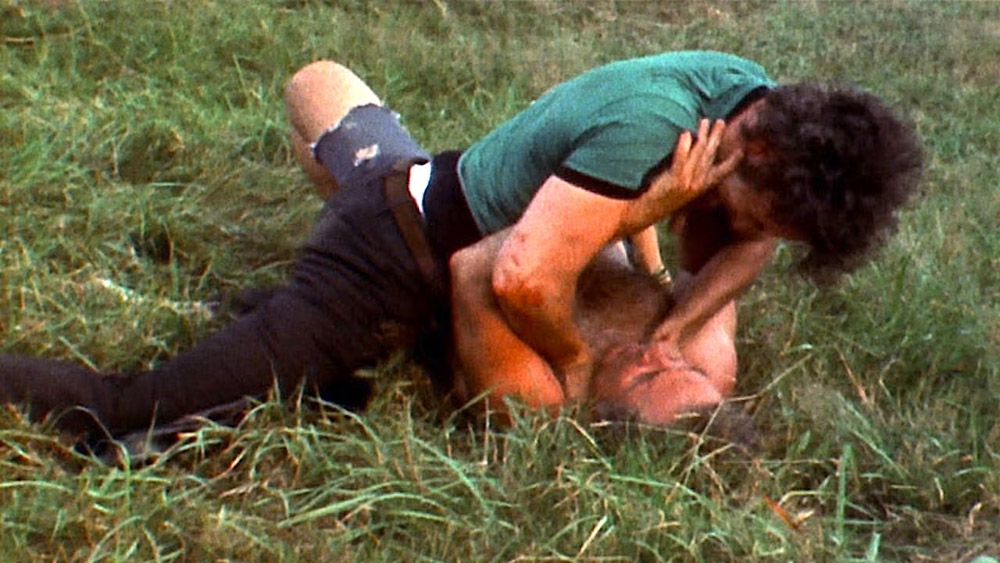
The film did not open at a commercial movie theater in New York, but at the Whitney Museum of American Art in their “New American Filmmakers” series. After filling the museum’s small screening room for two weeks, Mailer rented a commercial theater, the Lincoln Art on 57th Street, where Maidstone flopped in a three-week run. Given Mailer’s fame at the time, its failure was surprising. After all, such provocative movies as W.R.: Mysteries of the Organism (1971) and Dennis Hopper’s The Last Movie (1971) were playing theatrically. To its detractors, Maidstone only came to life dramatically when, on the last day of filming, actor Rip Torn attacked Mailer with a hammer in a scene that may be shocking but is foreshadowed throughout the film in Mailer’s intricate editing; it’s also perfectly in keeping with the underlying dread that permeates the film. As Kingsley tells the fictional cast and crew at the end of his shoot, in words that really are Mailer’s to the actual cast and crew, “We’ve been making an attack on the nature of reality.”
Maidstone screens this evening, May 6, and on May 9, at Anthology Film Archives on 35mm.