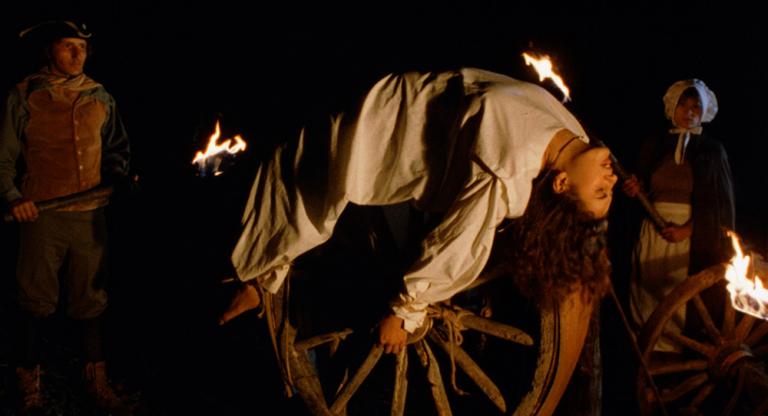
It’s tempting to view Tenderness of the Wolves (1973) as an addendum to Rainer Werner Fassbinder’s oeuvre. The cast is loaded with Fassbinder regulars: Ingrid Caven, Brigitte Mira, Margit Carstensen, El Hedi Ben Salem, and star Kurt Raab. Raab wrote the screenplay with Fassbinder in mind, but it ended up in the hands of Ulli Lommel, who had acted in six Fassbinder films before directing Tenderness of the Wolves. Lommel’s approach to the material is all his own. Instead of amping up irony or melodrama, he slows things down. Tenderness of the Wolves is hushed and leisurely paced, set in a grey maze of concrete alleyways.
A civil servant in 1920s Germany, Fritz Haarman (Raab) picks up teenage boys, brings them home, sexually assaults, and murders them. He then sells their meat to restaurants. He has an adult lover, Hans (Jeff Roden), and gets along well with all but one of his neighbors, Frau Linder (Carstensen). Growing suspicious, she follows him to the nearby river, watching him toss away the bodies of his victims. Since Haarman’s case inspired Fritz Lang’s M (1931), Lommel and Raab knew what big footsteps they were stepping into. With a slightly chubby and childlike face, the latter’s appearance inevitably suggests Peter Lorre. The killer behaves like a real-life vampire. His attention goes to teenage boys’ necks, which he grasps long before committing any violence. He’s even filmed in ways that accentuate his resemblance to Dracula; he sleeps with a window open to the night, as though he might fly away.
But, in the end, his monstrosity is all too human. Haarman is connected to institutions like Christianity and the police. He keeps a large crucifix on the wall of his apartment and dresses as a priest to con women into giving him their old clothes. Much more directly, he begins working for the police after they catch him in bed with a naked boy. Almost everyone in the film shares guilt in his actions. His neighbor Dora remarks sweetly on “his little boys.” While there’s only one reference to the Nazis, the 1920s setting is no accident. In Tenderness of the Wolves, child abuse and murder are a feature, not a bug, of German society.
Tenderness of the Wolves screens this evening, May 7, at Anthology Film Archives as part of the series “Narrow Rooms.”
See Also