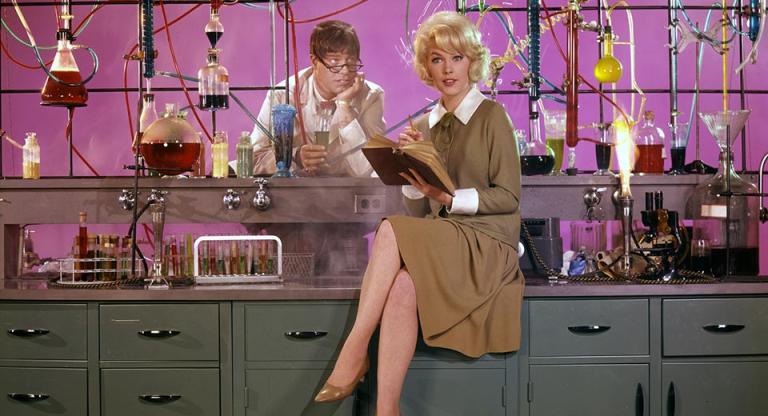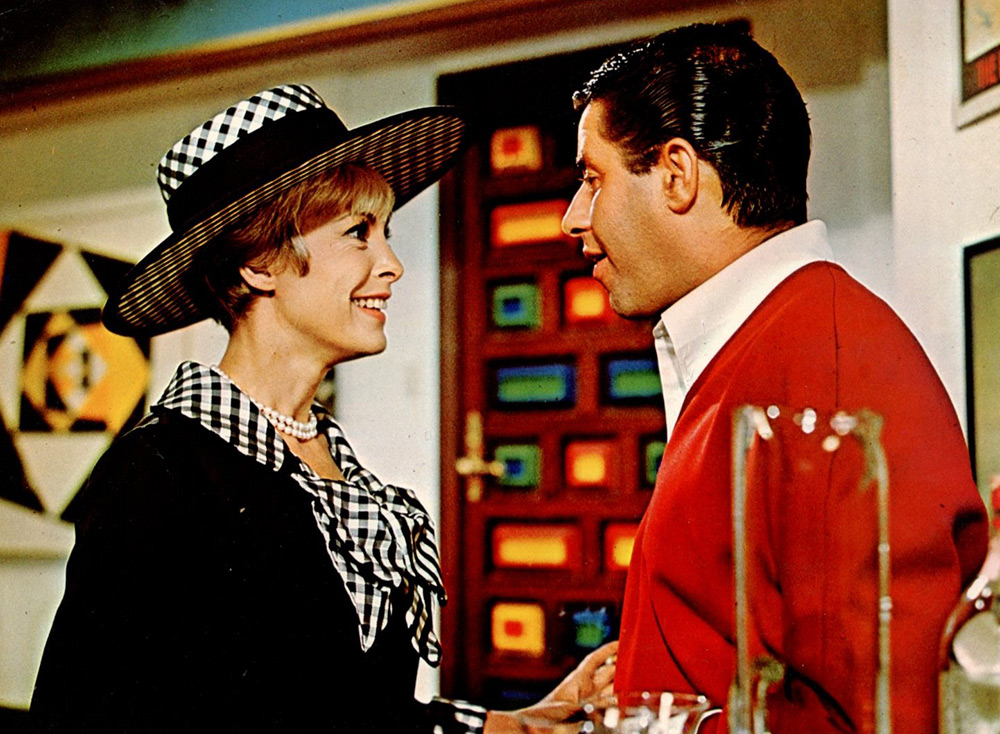
Jerry Lewis began his film career with Dean Martin, performing as “Martin and Lewis.” Martin played a charmer, down on his luck but with enough integrity to keep Lewis, the klutz, around. When the duo broke up, all that was left in his films was the social wrecking ball. Lewis directed The Nutty Professor in 1964, and it changed the direction of his on-screen persona for the rest of his career. In the film, he splits in two, playing both Professor Julius Kelp and Buddy Love. He recaptured the magic of his earlier duo with a twist: now the suave personality takes the form of a social monster that must be expunged for the down-on-his-luck nut to find true happiness. Kelp must vie against Love for sex and whether Kelp or Love wins, Lewis always gets the girl.
In Three on a Couch (1966), Lewis plays Christopher Pride, a painter who has earned a new commission in Paris and wants to take his bride-to-be, Dr. Elizabeth Acord (Janet Leigh), to France. But she can’t leave three of her female patients who are suffering from an acute fear of intimacy with men. In order to “cure” them, Pride designs three personalities—each uniquely calibrated to his knowledge of the patient—so the girls will fall in love with him and he can ditch them to be with his future wife. As in The Nutty Professor, Lewis plays another hybrid seducer-monster. But while Kelp has to chemically alter himself to seduce, Pride is a natural success. The film unveils a new layer of Lewis, introducing a character closer to the real version of himself, a professional artist whose every lie is an opportunity to convince someone new to love him.
Up until this point, Lewis understood he was mostly making kiddie pictures. But with Three on a Couch, he strived to make an adult film. In an interview published in a 1968 issue of Cahiers du cinéma, Lewis said, “To get [the moviegoer] to accept a character he doesn’t know, we have to proceed with grace [...] I approach him [Lewis] slowly because he can be overbearing in certain situations, and a very trying actor for those who don’t like him very much. Many people hate him: to give them a chance to reexamine, I have to tread carefully.” Lewis choreographed the conflict in the early scenes with Leigh so that his presence might be de-emphasized, focusing the camera on his back.
Pride only faces the audience without hesitation when he is playing a character. For the “foreign” girl, Anna Jacque (Gila Golan), he plays a cowboy; for Susan Manning (Mary Ann Mobley), whose last partner was gay, an archetypal hetero man; for Mary Lou Mauve (Leslie Parrish), the nervous Southern zoologist, a nervous Southern zoologist. Each performance is a ridiculous mirror of the woman he intends to seduce, removed from any actual interest in what fascinates them about men. His performances of the loudmouth, the needy, and the caligynephobe are routine. Pride’s seriousness is not. The mystery of Pride is not if, but when he will crack.
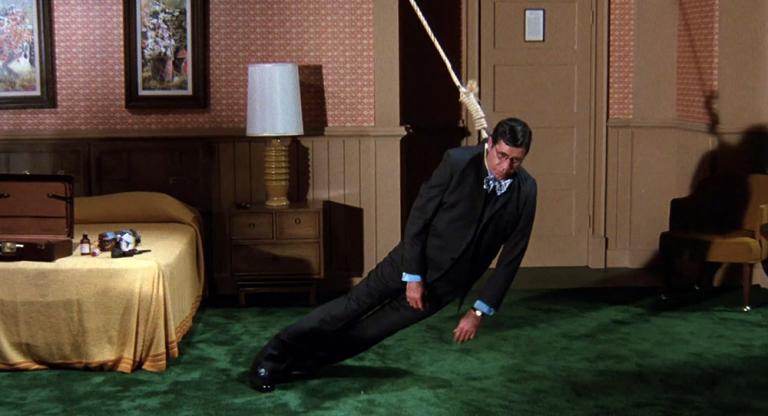
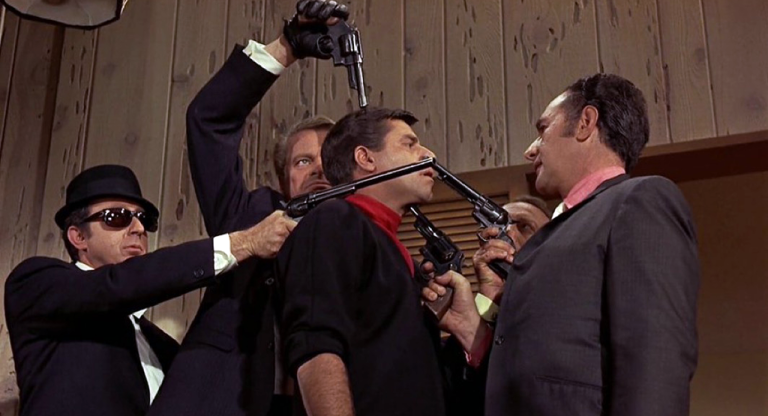
At his engagement party, his personas come crashing down on his life in waves. Pride believes the only possible resolution is to jump into the sea. Suicide became a fixation for Lewis throughout the latter end of his directorial career. Here, Pride gestures at a recognition that there is nothing he can do to earn Leigh’s grace and Lewis acknowledges the contempt he faces from audiences who have grown tired of his shtick. However, when Leigh believes Pride has killed himself, she runs toward the ocean to find him, bury her pride, and pardon his trespasses. She calls out his name four times—three to negate each fiction and a final time to affirm the man who, suddenly, stands before her alive. It’s a finale that wants you to believe Lewis can change, but those who have seen the next film he directed, The Big Mouth (1967), know he did not. Instead, he jumped even further into the rabbithole of obscurity.
Three on a Couch screens this evening, March 25, and on March 30, at Anthology Film Archives on 35mm as part of the series “Metaphysics of the Pratfall: Jerry Lewis and Jean-Luc Godard.”
See Also