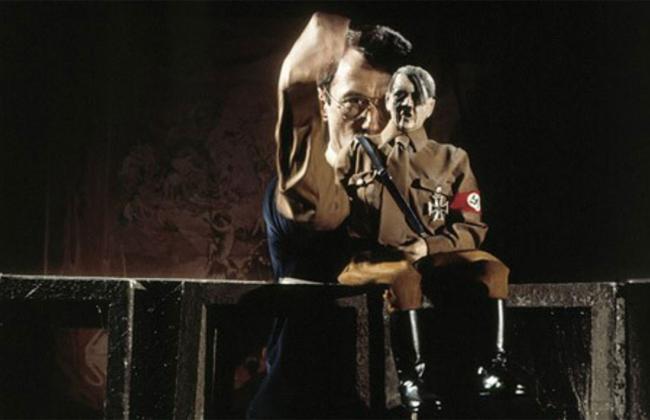
Hans-Jürgen Syberberg’s German Trilogy is about men who put on a show for the nation as it slowly descends into a self-made hell. The first two entries are about relatively sympathetic figures: Ludwig: Requiem for a Virgin King (1972) focused on the doomed Richard Wagner acolyte, and Karl May (1974) on the eponymous writer of tall tales and his posthumous co-opting by the Nazis. (The latter even featured former Nazis in its cast.) All three films are sprawling avant-garde collages that investigate the mythical qualities of the men they’re titled after, but Hitler: A Film from Germany (1977) represents Syberberg’s most extreme attempt at creating something akin to a Wagnerian Gesamtkunstwerk (a total work of art) to explore the totality of the infamous historical figure. One of the creepier implications in this final entry, which is divided into four parts and has a seven-hour runtime, is that the embodiment of human evils (both German and otherwise) is a little bit of Ludwig, May, and especially Syberberg all rolled up into one.
Although the 20th century wasn’t over, Hitler saw Syberberg use film, the era’s defining artform, to wrestle with one of its most important figures. He was well-suited for the task as someone who had made films about larger-than-life Germans whose work was crucial to the nation’s identity, and because he understood that there were plenty of similarities between a director (like himself) and Hitler. Both of them shared a love of phony sets designed for self-centered, provocative performers, and both worshipped Wagner. As a member of New German Cinema’s post-Brecht vanguard, Syberberg also explored the playwright’s ideas surrounding Verfremdungseffekts (alienation effects) and their potential for intellectual engagement in cinema. The film’s alternative title, “Our Hitler,” and the subtitle’s insistence on its status as “A Film From Germany” suggest a work that is both collective and subjective: a myth drawn up from the psyche of the German people who empowered Hitler, and a bitter tribute to the cinephilia that he and Goebbels weaponized to stoke the fires of the Holocaust with their propaganda.
The film is also collective in its incorporation of as many different artistic references, mediums, and techniques as possible—puppetry, rear projection, slideshows, 8mm home movies, and even a bit of flicker film strobing alongside the script’s abundant quotations: The Merchant of Venice, Thomas Mann, Fritz Lang’s M, and Auschwitz survivors. Also embedded in the film is a sly tribute to Rainer Werner Fassbinder’s The Bitter Tears of Petra von Kant (1972), which Syberberg invokes with the use of mannequins that are used to represent different German leaders. That Syberberg called Fassbinder “the bootlicking mirror image of the German establishment” who turned “the overworked formulas of ‘Heimat-film’ into those of the faggot film” in the wake of his premature death is telling of the contradictory streak that both fuelled and damaged his reputation.
Despite receiving initial critical praise, most famously from Susan Sontag, Syberberg’s post-Hitler film career frequently faltered as he began attacking both the concept of German Holocaust guilt and Jewish people’s claims of victimization in what amounted to a maddening mix of anti-Zionism and anti-Semitism. As the years went on, it became difficult for him to attract financiers (even though Hitler was shot fast and cheap on soundstages) and he became more whispered about than outright discussed in film circles. (He recently made two small-scale documentaries about his hometown in 2025, his first films in over 20 years and part of an increasingly sparse output after the mid-1980s.) Syberberg has always been uncompromising and so is Hitler. The film is a postmodern photomontage about someone who craved uniformity, designed as a synthesis of the dialectic between Wagner’s Gesamtkunstwerks and Brecht’s Verfremdungseffekts: a total immersion into a world that repels.
Our Hitler (a.k.a. Hitler: A Film From Germany) screens this Saturday, May 16, at BAMPFA as part of the series “Fassbinder and the New German Cinema.”