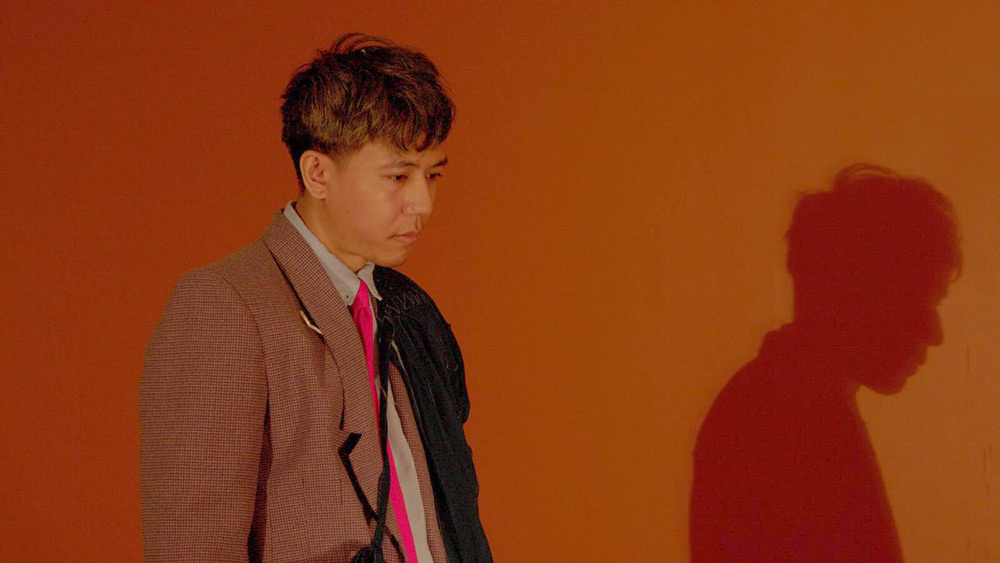
“I felt so rich of world when I had no budget,” says Clem (Marc Bacolol), the on-screen avatar for Gangsterism (2025) filmmaker Isiah Medina. The fifth feature from the Winnipeg-born, Toronto-based experimentalist is at once a concerted continuation of Medina’s erudite output—replete with repetitive dialogue loops, academic jargon, and rapid cuts—and a meditation on the unexpected pitfalls of benefitting from Canada’s robust arts funding.
The sparse storyline, which mostly exists as a theoretical framework for Medina’s moviemaking manifesto, centers on the manifold stressors that obstruct Clem’s creative flow as he preps for production. Most pressingly, the director sends his cineaste comrades to collect outstanding debts in order to supplement the government grant he recently received. He must also fervently defend his practice to an unrelenting stream of critics. “Whose gaze am I supposed to make the film for?” Clem demands during a particularly harsh pitch meeting. “Not just for your gaze,” responds his detractor.
Despite constant negative feedback, it’s revealed that someone finds Clem’s work valuable enough to leak online, which sends him on a vengeful quest to eliminate this pirate. In truth, the fact that Clem’s work is being sought out at all should be a compliment. “Be proud to know,” remarks Clem’s closest confidant Ez (fellow Canadian filmmaker Kalil Haddad), “regardless of race, most people don’t like your work.” Clem clearly doesn’t care to be recognized by the broader film industry, which he views as inextricable from imperialist violence (in one sequence, a TIFF lanyard and the Israeli flag are intentionally juxtaposed). But without some semblance of acclaim, and the money that comes with it, Clem literally couldn’t afford to make more films. Or is that line of thinking itself a capitalist conceit?
Gangsterism, as a title, is both a description of the characters’ criminal activity and a prospective moniker for a newfound ideology. Medina paradoxically posits that a filmmaker who receives ample funding has less artistic integrity than one who creates in spite of their struggle. “As my filmmaking gets better, my vision will get worse,” Clem chants. This doesn’t seem to be the current case for Medina, whose latest film feels politically, thematically, and aesthetically assured. Yet while watching, a thought emerges: could this film have been made without what was likely a Canada Council for the Arts grant? Perhaps technically, but then Medina’s takedown of Canada’s state-funded colonial cinema culture would be all theory, no teeth.
Gangsterism screens tonight, May 3, at Metrograph as part of “Prismatic Ground 2026.” Director Isiah Medina will be in attendance for a Q&A.