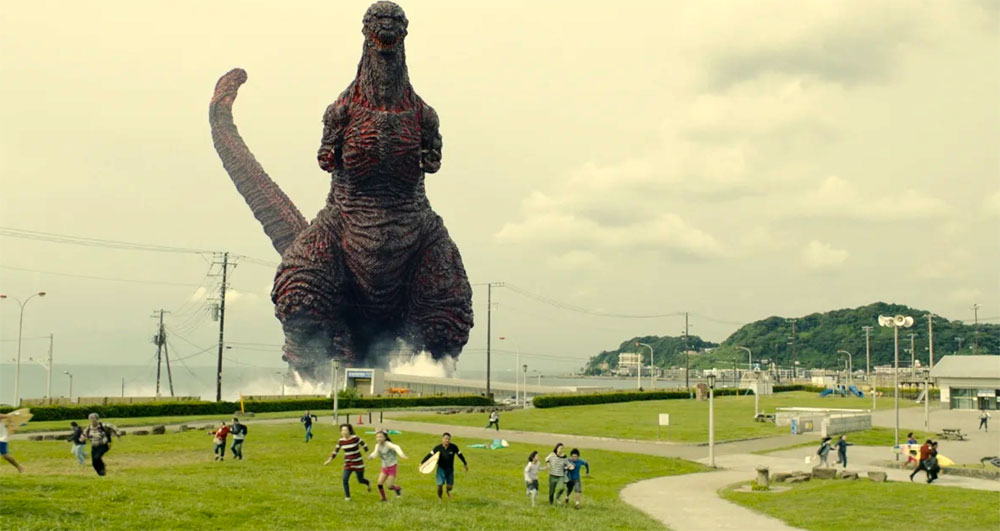
If you've ever wondered how governments make major decisions in emergency situations, or if you've ever experienced the consequences of poor judgment from your authorities, then you're probably well aware of the myriad representations of the political-office genre. Dramatic (The West Wing, House of Cards), satirical (Tanner '88, In the Loop, Veep), and critical (Wag the Dog, Fahrenheit 9/11) portrayals of officials in charge have been a longstanding source of popular American entertainment in film and television, but the format can only change so much when repeatedly filming office meetings and press conferences. With Shin Godzilla (2016), co-directed by Neon Genesis Evangelion's Shinji Higuchi and Hideaki Anno, we're immediately dropped into Japan's belly of bureaucracy through first-person smartphone videos, bodycam footage, handheld cameras, and tidily framed cinematic shots as officials race to understand, and destroy, the eponymous marine creature that is disastrously making its way onto land and toward Tokyo. You don't have to be familiar with the Godzilla enterprise to understand or appreciate Shin Godzilla, you only need to have a working idea of governmental emergency response protocols and how they can spectacularly fail to address problems as a whole.
Originally created in 1954, the creature known as “Godzilla” has had the longest-running career of any movie character, with international series, remakes, and sequels in both animation and live-action formats. But what we know as an iconic movie monster is a manifestation of trauma, made in response to the atomic bombings of Hiroshima and Nagasaki in 1945. The horrors of nuclear warfare, decimation, and fear that infected Japan during and after World War II were understandably not wounds that healed quickly or fully; Godzilla's merciless and unpredictable reign of terror on Japan's people begins after it's awoken by American atomic testing in the 1954 film. Man made a weapon that could not be defeated and Godzilla is the incarnation of how nuclear dangers propagate simply by being made.
Shin Godzilla gives the monster an origin story in the modern world (shin can be translated from Japanese as “new”), directly inspired by the tsunami and earthquake that hit Japan in 2011, which led to the Fukushima nuclear disaster that same day. The film is for fans of debating national publicity tactics and attack strategies more than it is for fans of monster movies though, as the horror of the situation is primarily discussed (rather than shown) between newly created bureaucratic teams with laughably evolving titles. Cushioned by being in a political office and not in the path of the monster, our protagonists are at an eerie distance from the reality of the situation they're spending days and nights trying to solve—not unlike the desensitized coolness in which a headline announcing terrible tragedies may pop up on our screens today. As clearly computer-generated as the creature is, its creatively imagined presence on-screen can quickly and easily be seen as a metaphor for crises across the world.
“Postwar Japan is a vassal state,” says Shin Godzilla's Aide to the Prime Minister (Yutaka Takenuchi) after learning that Japan must follow a US-led mission to exterminate Godzilla.
“‘Postwar’ extends forever,” replies the Deputy Chief Cabinet Secretary (Hiroki Hasegawa). The mission, approved by the UN, would require the use of nuclear weapons to destroy the monster, only 71 years after the WWII bombings on Japan. In Shin Godzilla, the monster is not the only deadly creature, so are the man-made policy traps seen throughout the film. If “postwar” extends forever, then Godzilla's enduring legacy in popular culture is an undying reminder of war and what “post” could mean for us in the future.
Shin Godzilla screens tonight, May 25, at the Roxy as part of the series "I Paused My Game to Be Here."