“Freak” originated as a neutral term meant to denote something whimsical or suddenly unusual in nature or behavior. This is now considered an “archaic” definition by Merriam-Webster, with 9 out of 19 current definitions considered to be “offensive and derogatory” by the Oxford English Dictionary. Although it's common to say you're “freaking out” nowadays, or to use the term with regards to rampant enthusiasm (“health freak”) or obsession (“neat freak”), its historical terminology—“freak of nature”—still lingers behind its casual usage. As quoted in Farran Smith Nehme's Criterion essay “Tod Browning's Ballyhoo Art,” in 1932 Elinor Hughes of the Boston Herald wrote that, “Any who enjoy watching the pitiful, grotesque mistakes of nature may behold them in Freaks.” This interchangeability between “mistakes” and “freaks” paints only a mild picture of the reaction Browning's film faced upon release: “Freaks permanently damaged Browning's career” reads Criterion’s synopsis for the film. After screening in New York in the summer of 1932, Freaks was pulled from circulation.
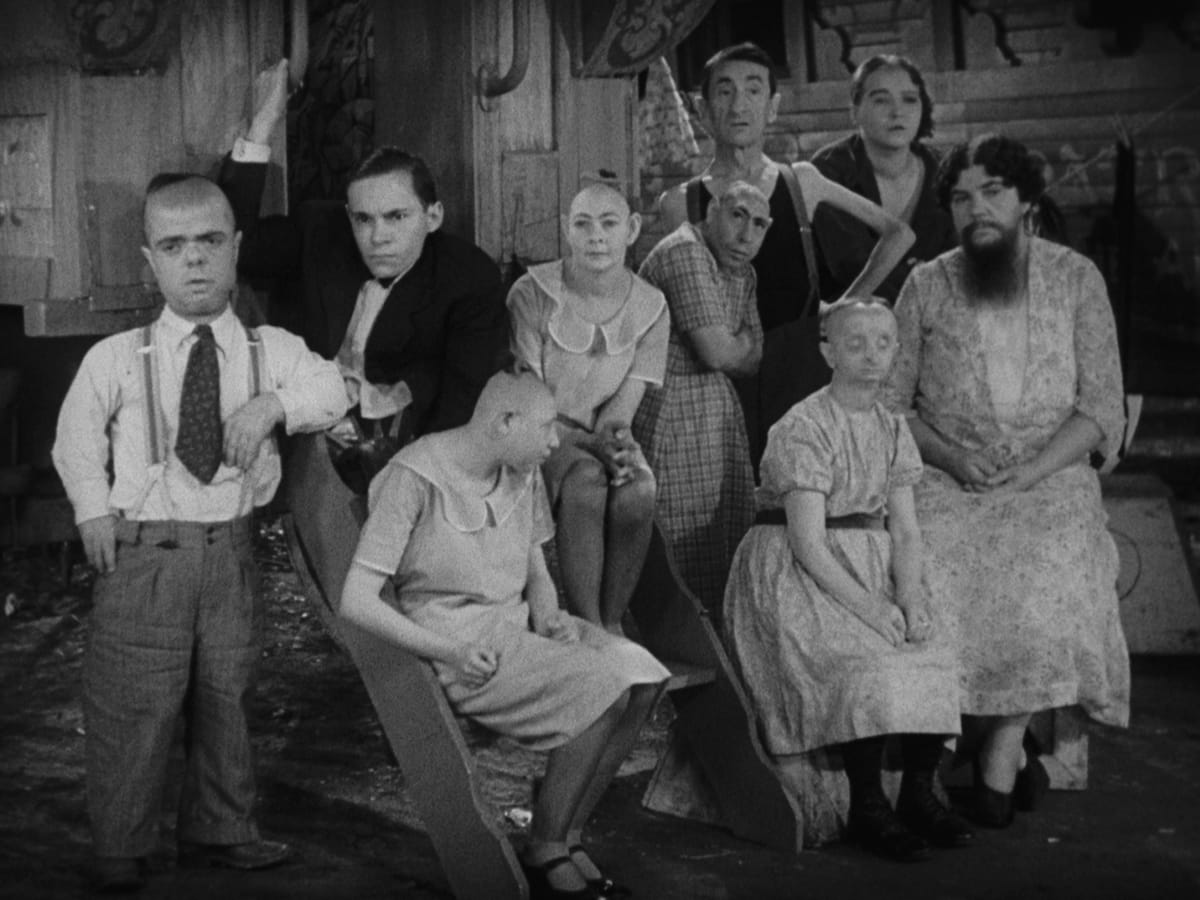
Why did this black-and-white film, barely longer than an hour, purportedly send people screaming out of the theater, and one woman to sue MGM because she claimed it had caused her to suffer a miscarriage? Freaks portrays a large carnival troupe traveling through Europe. We witness romances blossom and wither between the performers; laundry being hung between cozily decorated caravans; hot meals with goblets of wine consumed on the picnic tables as they gossip and swap notes on their acts. It puts the backstage life of show business on center stage with heartwarming conviviality. But these aren't ordinary performers: these are the sideshow acts of a freak show, displaying their very extraordinary selves, often because of physical abnormalities and disabilities from birth.
Browning had previously cast Lon Chaney as an armless circus knife-thrower in his silent film The Unknown (1927), but for Freaks he cast real-life performers rather than pretending actors to play fictionalized versions of themselves. We see these people as people: going about their days, their chores, their friendships and relationships—and going to work, even if work meant showing how they lived with physical differences from the average population. Many performers in Freaks were well-known among sideshow and circus acts at the time, although MGM had tried repeatedly to also cast celebrities in the mix; in her autobiography, Myrna Loy said that she had begged to be released from the script in her contract. But we can admire how Prince Randian (Freaks's “The Living Torso”) adapted to having no arms or legs and could light his own cigarette with his mouth (the shot of him rolling it was cut); Frances O'Connor (“The Living Venus de Milo”) and Martha Morris (“Armless Girl”) using their feet to do everything without the aid of hands; Daisy and Violet Hilton (“Siamese Twins”), who were conjoined twins but led individual romances; Johnny Eck (“Half Boy”), who walked on his hands for not having legs; Harry and Daisy Earles (“Hans” and “Frieda”), siblings from a family of little people who had commanding screen presence; and Angelo Rossitto (“Angeleno”), who would go on to be a founder of Little People of America. We see microcephaly in Schlitze Surtees and Elvira and Jenny Lee Snow, fetishized for a time as a missing link in evolutionary theory. A bone disorder presents itself in Minnie Woolsey, “Koo Koo the Bird Girl,” whose act plays up her appearance.
Browning's history is little-known, although he claimed to have joined traveling acts as a teenager, working through vaudeville, slapstick, and as a successful ballyhoo barker at the turn of the 20th century. His filmmaking had centered on carnivals, sideshows, the paranormal, and the macabre, including the successful Dracula (1931). But he never made another circus film again after Freaks. Despite the joyous (Hollywoodized) carnival life depicted in Freaks, cemented by a dark plot in which the sideshow bands together to defend their pride and each other against a disdainfully ableist trapeze artist, the film's terrible reception led its performers to have mixed opinions (mostly negative) about their participation in it. Olga Roderick, the Bearded Lady, said she regretted her role in the film and considered it an insult to circus work. Reclaimed in the early 1960s, shortly after Browning's death, Freaks took on new meaning among the era’s counterculture and found support in audiences who didn't fit into the mid-century mold of what people should be like.
Freaks screens tonight, July 8, at BAM as part of the series "Spectres, Devils, and Bad Blood in Old America."