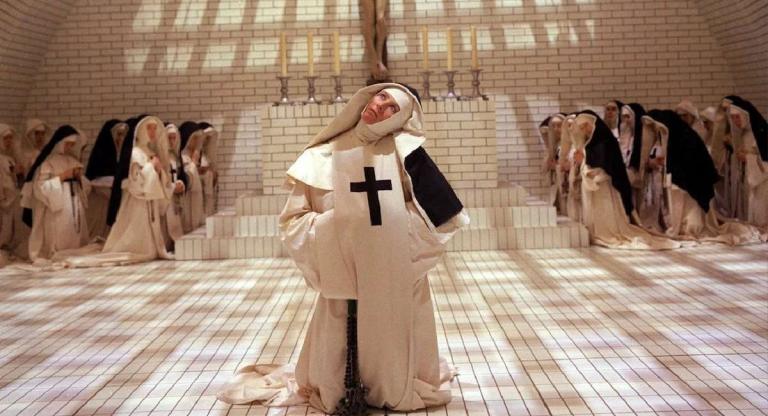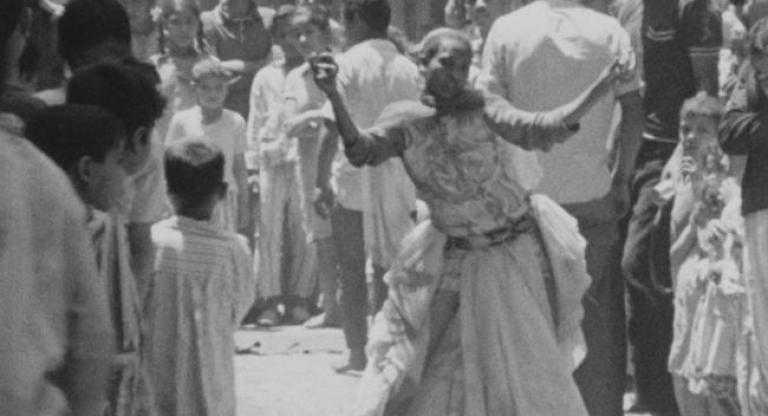
In Lebanon, no single institution has been entrusted with the authority to preserve and maintain the country’s significant historical inheritance. Consequently, what has emerged is a decentralized and highly fragmented archival system. The point of departure for Lana Daher’s Do You Love Me (2025) is not a single image, but rather an assemblage of 20,000 testimonies from the Lebanese cultural landscape. Daher began shaping this material into a singular documentary in 2018. These testimonies—feature films, home movies, documentaries, TV footage, news bulletins, photographs—narrativize the past and present, weaving them into a resonant contemporary image. Spanning a period of 70 years, the viewer assumes the vantage point of Lebanese citizens, filmmakers, and artists. Through the use of high-contrast moments—images of Beirut under bombardment coupled with campy clips of television characters dancing—Daher calls into consciousness the grotesqueness of how trauma is processed and absorbed into popular culture. What results is an evocation of a collective fatigue that continues to disorient.
Throughout Do You Love Me, Daher compiles parallel excerpts from various source material and features them in sequence, one after the other: men at the corniche, vendors selling fruit at the market, people crossing busy roads in downtown Beirut, buildings exploding, people tossing and turning in bed, people playing cards, people getting married, horses running into freedom, horses running from falling bombs, Middle East Airlines flights landing in Beirut, mountains and hills lined with olive trees, homes that have been decimated by Israeli bombs and civil war. She draws from films by Jocelyne Saab, Fouad Elkhoury, Maroun Bagdadi, and Eliane Raheb, among others. These particular moments serve as the scaffolding for a film that is not definitively tethered to any one historical period. These clips follow a rhythm: joy and grief, freedom and restriction, belonging and the emptiness of what once was, resilience and impermanence. The resulting image, thus, cannot be readily identified as belonging to any one war or time of stability in Lebanese history. They serve to identify the continuity in Lebanon’s historical and contemporary reality. Daher’s film is a practice of both safekeeping and reconstruction, piecing together a history shaped by decades of crisis. It turns to what has circulated in fragments and situates it in a more permanent resonance.
The soundtrack of Do You Love Me in itself is an account of the transmission of inherited traumas, as Fairuz and her late son, Ziad Rahbani, both sing of love and longing for a Beirut that once was. Today, there are more Lebanese people living in the diaspora than in Lebanon. The film ends with a clip of a man who is asked to complete a form with information about his planned return date to Lebanon. “Return?” the man questions as he removes his glasses to think. For the first time in the film, the viewer is met with a black screen and, in this rupture, the question transcends the immediate context of Lebanon, resonating with broader histories of exile, displacement, and return. At this moment, “return” is not merely a logistical question, but rather a political and personal one.
Do You Love Me? runs July 10-15 at Metrograph.