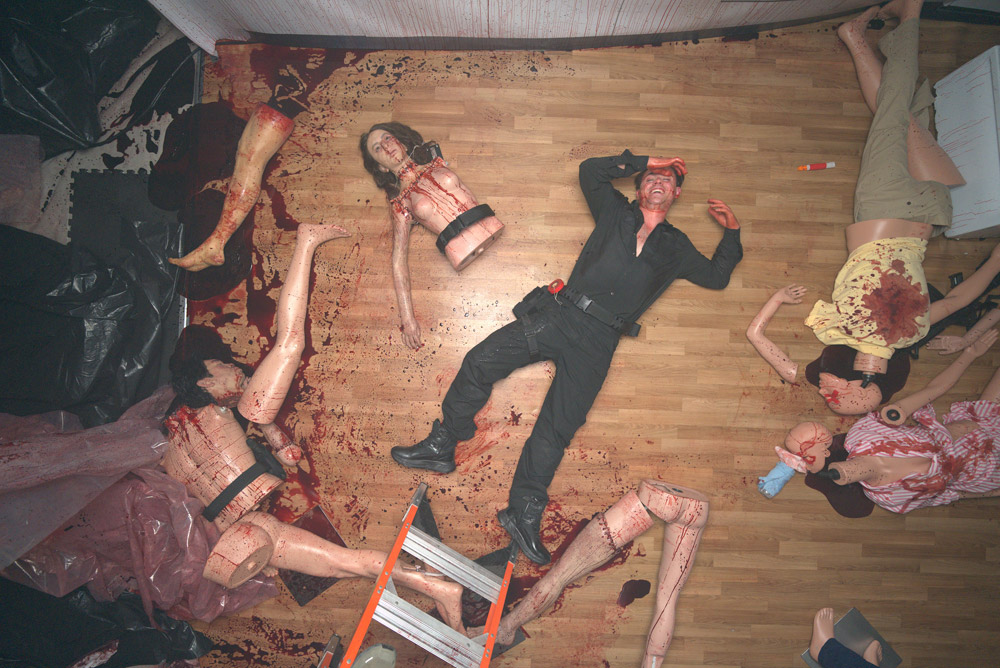
Three years ago, I paid a set visit to Faces of Death, Daniel Goldhaber’s third feature, shot while his second feature, How to Blow Up a Pipeline, was entering theatrical release. Rebooting the infamous franchise, nü-Death stars Dacre Montgomery as Arthur, a killer recreating the original film with victims including Barbie Ferreira and Josie Totah. My visit was a quick 36-hour parachute in-and-out to the biggest set I’d ever been on, some 70 crew members strong. I took notes so that I’d be ready to publish when the film came out, and now the time has come; Faces of Death opens from IFC Midnight today. There’s no point in pretending Goldhaber isn’t a friend, so he’s “Danny” throughout.
The night I arrive in New Orleans, Danny and his artistic consultant Jason Lester are looking at dailies on PIX. (“Do you have the eye bleeding?” “Yeah, it’s coming.”) At dinner, they worry about extreme close-ups they need and wide shots that can’t be used; the footage review process continues long after I crash. The next morning we’re out the door at 5:47 am, in the car by 6:05 am and on-set just before 6:30 for a day that’s been described as “ridiculously underscheduled.” On the way, DP Isaac Bauman works on a set of Midjourney storyboards for a forthcoming project; he doesn’t mind that one of the resulting horses has two heads and thinks it’s kind of cool. When we get to the set—a suburban cul-de-sac house in Luling, just outside the city—I’m worried about being in the way. “Corners are your friend,” Bauman says.
The day’s first shot will be the decapitation of Dacre Montgomery’s first victim executed in a fluid moving oner—a dolly out, then a 180 pan and zoom in—followed by a mix of 35mm and DSLR inserts. “Our goal is to get out of this scene an hour ahead of schedule,” Danny says. “Sounds great!” Jason says. “Let’s do that!” The garage contains five mannequins who have yet to be fully clothed; it’s not yet time to deploy their decapitated heads, two of which sit in a basket outside, one having her hair brushed. The lights are rigged and, after a safety session, the set’s dressed. I wander around and listen to crew members talk about their weekends. “I crawfish boiled it on Saturday, had three beers, fell asleep and woke up at six am on Sunday morning,” says one. “I just got asked to do a Tier Zero,” another laughs in a way that suggests this is definitely not happening. Another guy is wearing a shirt that says “Killing It AD Department”; despite the lack of italics, this turns out to refer to a TV show rather than just being self-aggrandizement. Gear carts are covered in stickers for bands, restaurants (“Zero James Beard awards. Mom’s Basement—B’ham, Alabama”) and libertarian sentiments (“Question authority”); there are generators labeled Ren and Stimpy, Biggie and Tupac.
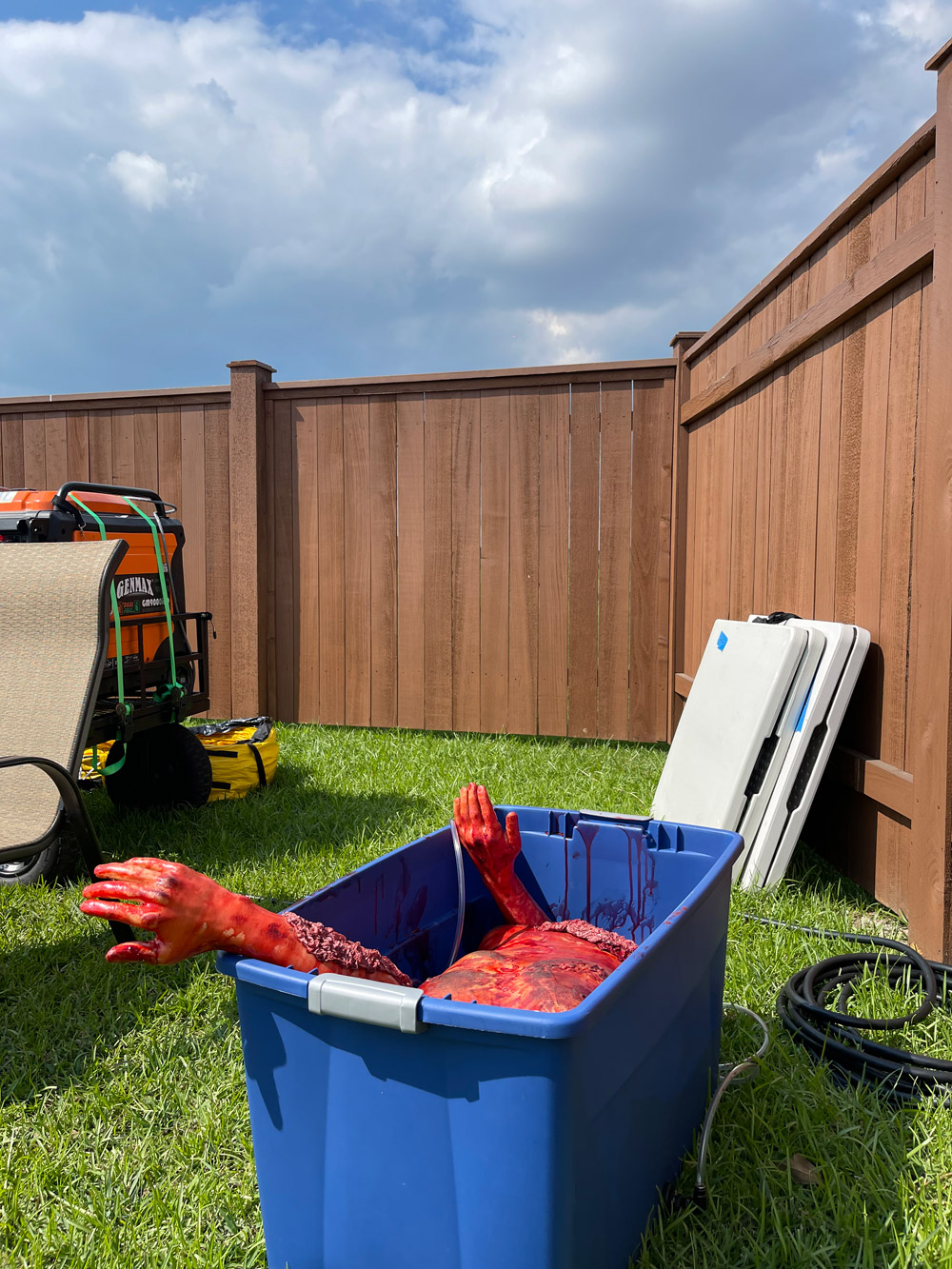
1st AD Tommy Davis notes that he’s worked on seemingly every vampire production that’s shot in town, most recently on the TV version of Interview with the Vampire (2022) which shot at the same time as Renfield (2023)—at the same locations and, as Goldhaber’s longtime collaborator, co-writer and fellow producer Isa Mazzei notes, using the “same black Cadillacs.” Tommy’s also worked on Abraham Lincoln: Vampire Hunter (2012) and Vampires Suck (2010); a non-vampire production, he notes, is “a nice break.”
Just after 9 am, the set’s ready for rehearsal. “Pretty sick!” Danny enthuses after the first camera movement rehearsal, then meticulously runs it over and over while adjusting the zoom and boom framing. “Dacre clearing the frame is what motivates the boom backup,” he explains in one of many iterations to clarify what his extremely detailed timing instructions mean in a way that makes sense for the crew. The actor who’s going to be faux-decapitated asks logical questions: “Am I bound? Or gagged?” Once Danny has the motion down to his satisfaction, the first take begins at 9:20 am. On the video monitor, there’s three brief stuttering flickers after the camera begins to roll, which are created by the 35mm camera coming up to speed. The shot lasts a minute from start to finish. After the first take, someone yells “Checking the gate, moving on” to general sardonic laughter. On each take, Danny keeps telling the beheaded man to increase his resistance levels. “Stop!” the victim yells; “Go!” Danny instructs the boom operator.
After half-an-hour and around eight takes, the shot’s complete. It’s time for one mannequin to behead another, inserts of which will complete the scene. The camera switches to a close-up of the mannequin’s chest interior and the springs lowering its arm. “Look at that depth!” Danny enthuses. Once the 35mm shots are done, they switch to DSLR; some of these shots will serve as the base for VFX comp shots. The mannequin that’s going to be decapitated has its head removed and artists come on to smear some blood on the neck stump; spurts will be added in post. While the setup is underway, Goldhaber alternates between answering production office emails and doing social media monitoring and promotion of his just-being-released second feature, How to Blow Up a Pipeline. The mental alt-tabbing would kill me, but he says he finds the distraction helps with waiting for shots to be set up.
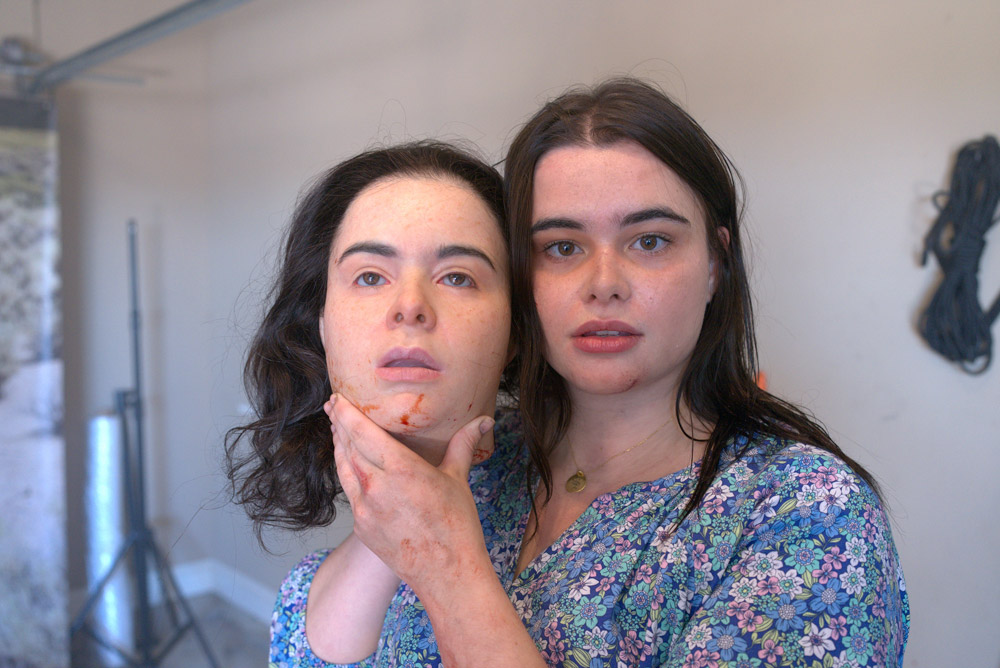
Next it’s time for overhead views of the head falling into a basket, which means a crew member needs to briskly remove a metal rod from the head. The head’s resting position after falling isn’t controllable with absolute precision, and it takes three takes for it to land exactly as desired. There are two mannequin heads, male and female, to be captured, and Barbie Ferreira comes in to match one. She looks down at the basket, laughs, lies down and matches the head-tilt exactly. A couple of MOS takes of her gasping later, scene 32 is wrapped. It’s 11:48 am and everyone’s happy to move out of the garage. Outside, the driver of the f/x truck is sleeping peacefully in the front seat. The crew heads to lunch; Danny heads to tape Chapo Trap House.
After lunch, it’s time to fill out a simple sequence of Barbie running away from Dacre; he’s at the second-floor window, she’s running away outside as he shoots once, grazes her shirt and she hops the fence. Predictably, this takes a long time to get all the pieces of coverage for. The first shot was already captured, which Goldhaber has to be reminded of: “I literally can’t remember.” Does that mean that they’re ahead of schedule? “Don’t jinx it,” someone says. Dacre’s rifle is brought out, with the armorer displaying it to everyone who wants to confirm for themselves that it’s got no ammunition loaded, either live or dummy, just blanks. As the angles captured outside change frequently, I retreat to video village within, where Mazzei hands me Producer #3’s headset. The f/x guy congratulates her on having a script that she gets to have filmed as is, rather than being bought and rewritten to pieces. She can see it both ways, she says; a lot of her work is anonymous rewrites for scripts, sometimes for just a single scene if a female actress feels that something’s not right.
Barbie runs for the fence, and the question now is whether her top billows out enough that it’ll look plausible that she’s been grazed but not hit after a bullet hole is added with vfx. On the fourth take, the hard drive she’s holding in her pocket disappears as she’s running, and no one can find it despite combing the grounds. The footage is reviewed for forensic evidence, but offers no clues; half an hour later, the hard drive will be found floating in the pool. Coverage now shifts to prioritize Dacre firing the rifle; he’s got a red contact lens in his left eye, which is incredibly unnerving to see up close. Next it’s Josie Totah’s turn to run, again captured from multiple angles; inside, Barbie watches her and admires how close she’s sticking to the fence. That’s smart, she notes; it’ll help with maintaining continuity later.
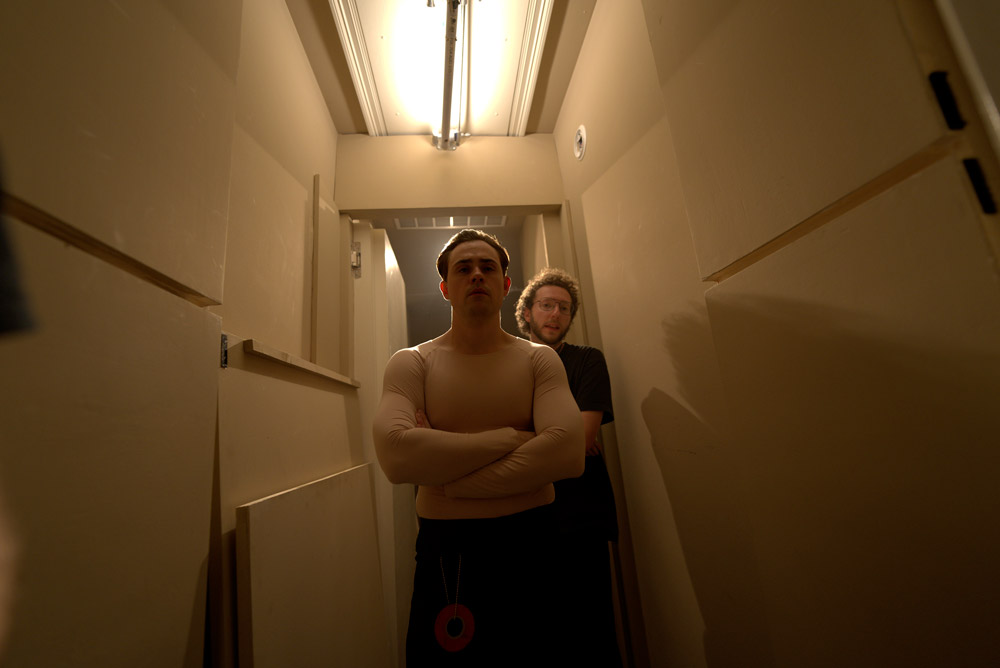
Coverage priorities shift to capturing Dacre at the window. I wander outside to get an orange from the craft table, where bored crew members have hooked up a hot-dog grilling machine and are idly trying to figure out how to turn it on without short-circuiting anything. I’m hearing “checking the gate” more and more; in my head, it increasingly sounds like Beavis & Butthead chanting “BREAKING THE LAW.” By the time the set wraps for the day, the sequence will be captured in over 40+ shots, with Danny making up the set-ups up as he goes along. It makes me nervous; he says it’s a rush.
In the next morning’s scene, a police officer arrives to investigate but, of course, doesn’t get to the bottom of things. The first and most elaborate part of this sequence is a dolly track that slides around the perimeter of the house as the officer approaches from the back and sees Dacre doing some gardening in the front lawn. It takes a while to get the track laid and smooth; meanwhile, Dacre wonders at the unnatural hues of the sunrise. It’s explained to him that we are in “Cancer Alley,” a concept whose savagery and unabashed contempt for citizens blows his non-American mind. As we stand and wait on the sidewalk, our collective attention is drawn to ants industriously building away on a tiny patch of green. “I wonder what they’re doing,” someone says. “They’re forming a content creation company,” Danny deadpans.
Later in the day, I finally talk to producer Don Murphy, who’s been on-set the whole time. I’ve been told this is a conversation I should try to have because he’s a big deal (among other credits, the Transformers franchise is his), which is precisely why I don’t want to approach him; he seems very above my pay grade. But Murphy is happy to chat and tells me two things that really stick. The first is about one of his signature productions, Natural Born Killers (1994), on which every night the cast would get together and party heavily—but not Robert Downey Jr., who was by himself at a separate hotel. “I thought he was smart,” Murphy notes. “Turns out…” (Two years later, Downey Jr. would go to rehab for the first time.) The second thing he says explains how we all wound up here in the first place. Faces of Death was a franchise Murphy had gotten the rights to and set up at production company Legendary Pictures, then asked 11 filmmakers, including Radio Silence and Osgood Perkins, to audition with pitches on how to reboot the series. At the end of the day, he simply liked Danny and Isa’s take best.
It’s lunch time and I’m about ready to leave, which is a shame because shortly all those mannequins are going to be deployed for the finale. There’s a lot of argument about how to stage this, and Danny is joking about shooting it all like Apichatpong Weerasethakul. Isa is not amused: “Listen to me,” she says. “If you don’t, you’ll regret it for the rest of your life.” On that note, I’m gone; three years later, the movie will be out, and the scene I just saw shot will not be in it.
Faces of Death is screening in select theaters across New York on 35mm.