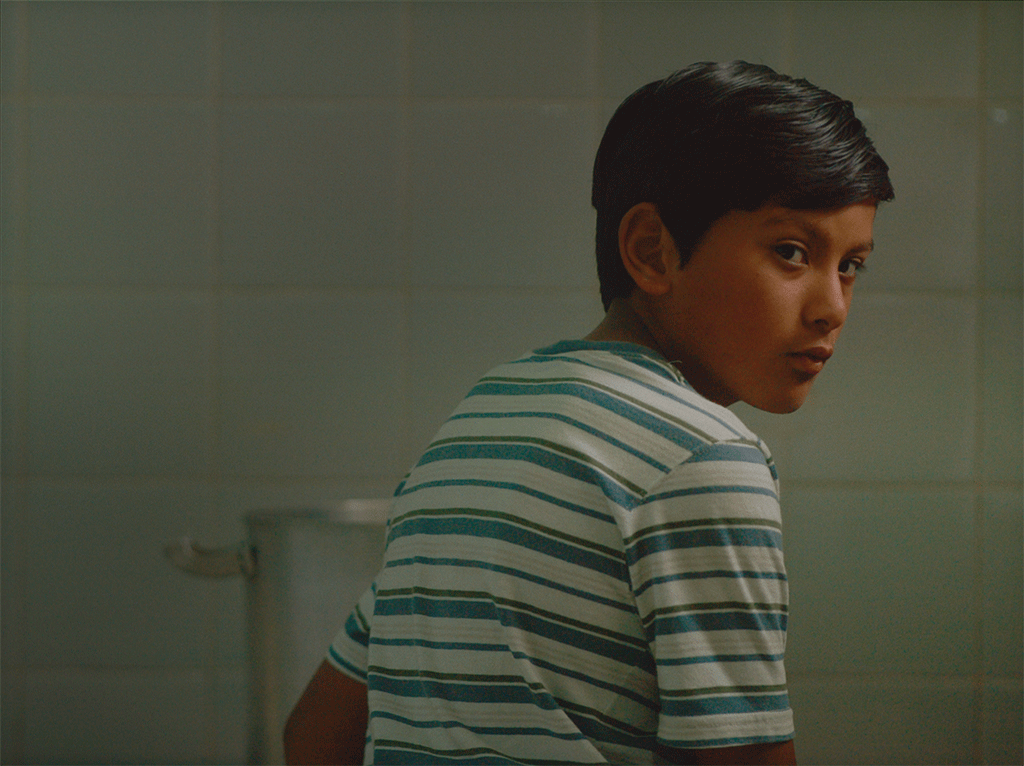
Distinctive openings that keep their auspicious promise throughout the entire course of a film are rare, therefore memorable. At the shouted cue “Don’t think, speak!”, 9-year-old Milo (Milo Barría) utters words—“Gaucho! Arrow! Smoke! Patience! Boldness!”—seemingly with no meaning except to bolster him, in an equally idiosyncratic way, for the stunning malambo dance he is about to perform. By the time he appears on stage, together with three fellow child dancers clacking and stomping their cowboy boots, mystery has given way to wonder. It’s a traditional dance contest somewhere in rural Argentina, a piece of observational realism that yet retains the miraculous energy of folk practices.
But Milo, just as The River Train (2026), shies away from any literal or one-dimensional views of the surrounding world. Curiosity sparks in how things are seen, not in what they are. “We stole a lot, everywhere,” said directors Lorenzo Ferro and Lucas A. Vignale while presenting their work at Berlinale’s “Perspectives.” The cast, excluding a sort of wicked Blue Fairy figure (Rita Pauls) who Milo encounters later in his journey, is mostly constituted of first-time actors shot during rehearsals. Hence, a rhythm that feels informal instead of studiedly authentic, and playfully arranged instead of staged. It is Milo’s real father (Mariano Barría) who gives us first a magnetic young De Niro/Harry Dean Stanton stare from below his cap, and then, revealing a bald patch and a protruding belly, more ordinary, tedious vibes. Boredom is the main threat in the life of a happy child, and so Milo leaves his family behind in the pampa to board the title’s phantasmagoric train to Buenos Aires.
If the mischievous trick by which he succeeds in fleeing wasn’t enough of a tribute, the nights spent alone in the bustling metropolis recall the tender, energizing adventures of an Antoine Doinel of sorts. As the plot thickens, Milo is persuaded to attend a children’s theater casting call by two enigmatic men he shares his hotel room with. Making it in the big city on the strength of one’s looks is a hope that’s easy to forgive. Milo’s naïve audacity recalls another smalltown dreamer, Joe Buck from Midnight Cowboy (1969). Luckily for him, the camera’s fascination with his pensive and soft-looking face, often portrayed in close-ups, is shared by the young woman auditioning actors for the play (Pauls). The dialogue between the two, like many other characters’ conversations, as well as the development of the storyline, follows its own logic, absurd and full of child-like jests.
From its very beginning—which features a sequence parodying telenovelas’ pathos, driven by an unforgettable tune from Colombian producer ONIRIA that voices Milo’s desire to escape—The River Train establishes a language that is neither overly fantastical nor trivial. Instead, the film is refreshingly poetic and unceremonious, in a way that some viewers might recognize as a contribution to the noble tradition of the Argentine weird (which is making a comeback not only in literature, but also on the silver screen; consider, for instance, Amalia Ulman’s Magic Farm, Federico Luis’s works, Rodrigo Moreno’s The Delinquents, or Benjamín Naishtat’s upcoming remake of the classic Los Sietes Locos). In the notes I took down during my screening, I also wrote: “Slomo Marty Supreme.” But, if the narrative of the cunning boy on the loose in the big city might indeed recall recent frantic views, ultimately The River Train feels more like a dream, a vision much more original and invigorating than the sum of its deliberate, or casual, references.
The River Train screens this evening, April 13, at Film at Lincoln Center, and tomorrow, April 14, at the Museum of Modern Art as part of “New Directors/New Films 2026.” Directors Lorenzo Ferro and Lucas A. Vignale will be in attendance for a series of Q&As.