This week’s impressive multi-venue retrospective “Why? Because… with Jean-Pierre Gorin” is one of those series that is at once divinely inspired and something of a no-brainer, long overdue in this movie-crazed city. Now 83, the French-born, California-based filmmaker and theorist is most frequently aligned with Jean-Luc Godard, with whom he co-founded the Dziga Vertov Group in 1969, co-directing towering provocations such as Wind From the East (1970), Struggle in Italy (1971) and Tout va Bien (1972). After splitting off from JLG, Gorin accepted a teaching job at the University of California, San Diego (where he is still professor emeritus.)
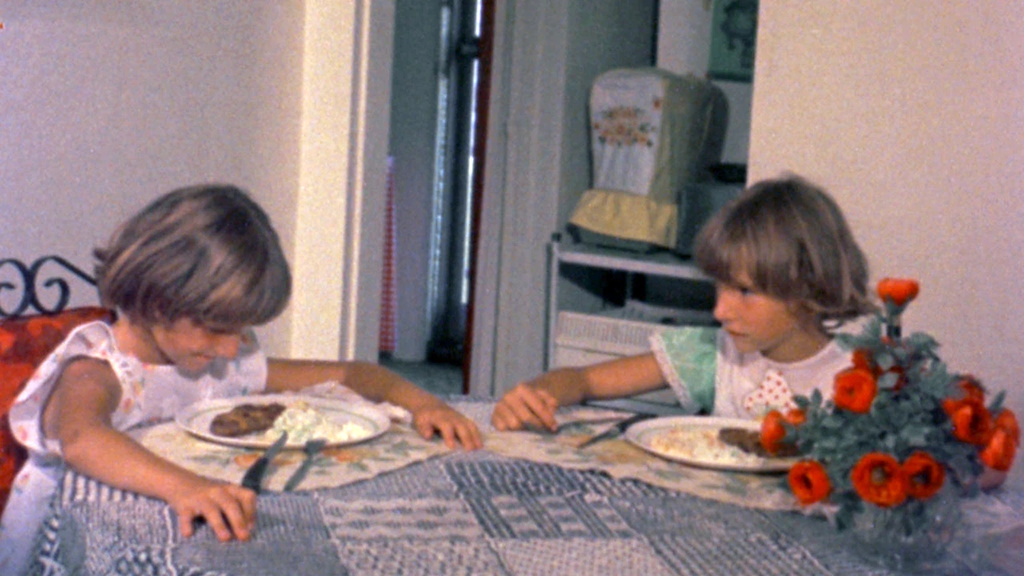
Next came his sequence of anti-documentaries focusing on his chosen second home: Poto and Cabengo (1976) is a portrait of the Kennedy twins, two San Diego six-year-olds who attracted media attention for sharing a bizarre made-up language exclusively between them, which Gorin and others identified without too much difficulty as being heavily influenced by their grandmother’s German. Routine Pleasures (1986) juxtaposed the art and criticism practices of Gorin’s friend Manny Farber with a group of miniature train enthusiasts in Del Mar, giving visual relief to Farber’s concept of “buglike immersion in a small area without point or aim.” Here, working with fellow UCSD professor Babette Mangolte as cinematographer, Gorin found a funhouse mirror of Reagan-era myopia and a reflection of a uniquely American romance with recapturing the past.
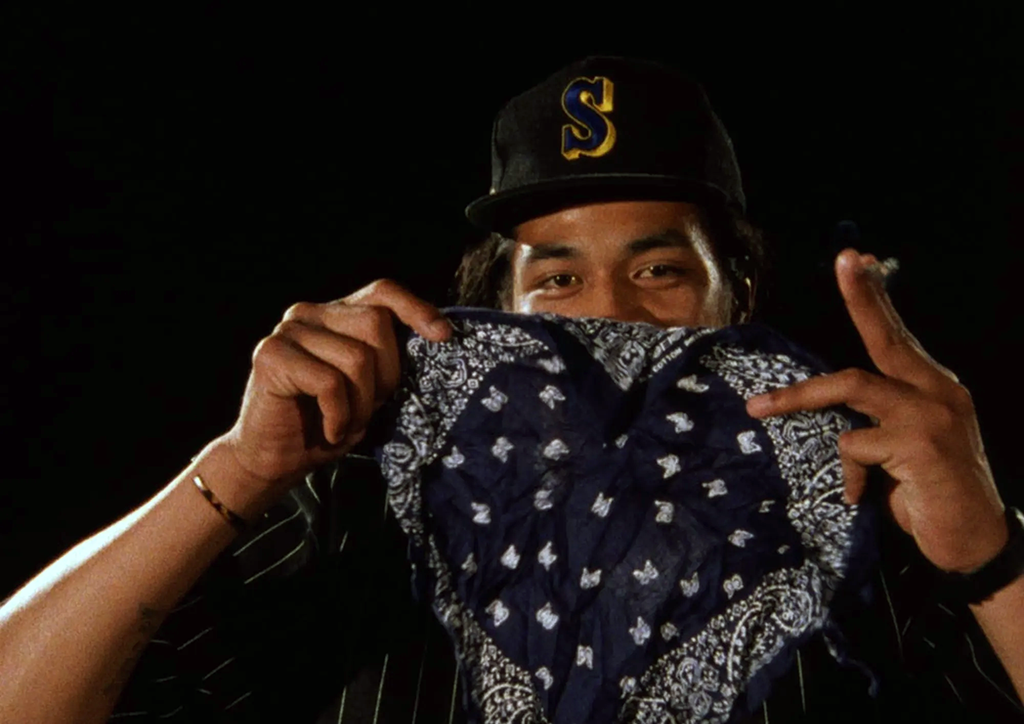
My personal favorite of his films is My Crasy Life (1991), a portrait of the Sons of Samoa gang operating in Long Beach, California. Working this time with cinematographer Maryse Alberti, My Crasy Life sees Gorin continue to explode the documentary form, intercutting his sessions with these young Samoan men with a stagier voice-over that he worked out with the screenwriter Howard Rodman (of the short-lived HBO noir series Fallen Angels) in which a HAL-9000-like dashboard computer ruminates on the future of human activity as re-encoded into data points. While Gorin built My Crasy Life on the research of USC anthropologist Daniel Marks, his mischievous energy is immediately apparent; when a gang member yells “Fuck Margaret Mead! Fuck National Geographic!” in the film’s opening minutes, it confirms the filmmaker’s disinterest in feigning objectivity. (No surprise that such uncommercial portraits of Americana as these were only made possible with European arts funding.)
Speaking via video-conference from his SoCal home, Gorin was generous and hilarious, openly conceded he liked to talk and referring to himself on multiple occasions as “an old rat.” Our discussion hopefully serves as a primer on the philosophy of Gorin’s singular, reliably brilliant and endlessly fascinating body of work.

Steve Macfarlane: The program at L’Alliance begins with Jean Renoir’s masterpiece Toni [1935]. Your reasons for watching it as a movie lover are compelling, but how do you put it into dialogue with your own films?
Jean-Pierre Gorin: I’ve always been fascinated by the fluidity of Renoir. He never talks down to people, nor to his subjects. What you get is a glimpse at the world of the immigrant worker, circa 1931, and not the typical liberal problem. How do you get inside the imaginary of the immigrant worker, in a way that doesn’t begin from an entirely exterior point of view? For this, it was a direct inspiration for My Crasy Life. Toni spells out the hopes and the pathos of the 1930s, and does so in an un-selfconscious way. But, I also included Lumière d'été [1943] by [Jean] Grémillon. It’s more interesting when you have two filmmakers from the same period and only one is well known. They are both well known in France, but unfortunately we are here, in the land of milk and honey.
SM: Your program notes also specify that “anyone not thinking about the 1930s right now is a fool.”
JG: Because it’s interesting to talk about fear of the past in relationship to the present. For me, it’s less about the second coming of Adolf Hitler than about what happens when the left loses its terrain to a right-wing system. We’re seeing this happen everywhere today, it seems.
SM: I went back and listened to a 2006 UC Berkeley lecture you delivered on the history of cinema. Talking about the Dziga Vertov Group, you make specific references to the impetus of that moment to reject Eisenstein.
JG: Cinema has two tribes: the people of the idiom and the people of grammar. The former accept the rules and within those rules you can do amazing things, like, I don’t know, Lubitsch. Anyone who tells you Lubitsch wasn’t a great filmmaker is an idiot! And, because Eisenstein’s montage had been accepted as the closest we could get to reality, Vertov was a good starting point. He was always interested in the relationship to documentary material, whereas Eisenstein was a sophist.
Calling this up will make me sound like an asshole, but there’s a bit in Plato’s Dialogues where one of Socrates’s minions asks him: “How do you deal with a Sophist?” Socrates spends about five seconds on it and basically replies, “With a 2x4”.
My generation was interested in a question that had already been opened up in literature and criticism: What does it mean to construct a narrative? Or an image? It didn’t seem so obvious you could make a film without interrogating yourself on the function and the nature of image-making. It’s a reaction against narrative. How do you fight a certain idiotic tradition in narrative filmmaking? Because if you didn’t ask those questions, it meant everything would slide back to the idiom.
I love this quote Fritz Lang told Peter Bogdanovich: “When I make a picture of today—especially if it’s a crime picture—I always tell my cameraman, ‘I don’t want fancy photography—nothing ‘artistic’—I want to have newsreel photography.’ Because I think every serious picture of today should be a kind of documentary of its time. Only then, in my opinion, do you get a quality of truth into a picture.”
SM: A perfect segue for your California trilogy.
JG: I always react violently when people describe those as “documentaries.” If they’re about the drama of documentation then they’re essay films, and the essay is an old tradition, going back to Montaigne, et cetera…
SM: You’ve spoken about your hatred of the piety of documentarians.
JG: When Jean-Luc put himself in front of the camera in Far From Vietnam [1967], it was to examine the validity of going to Vietnam to film the war from the side of the North Vietnamese. Onscreen, he says he wanted to bring Vietnam into his practice. People on the left were furious. But, to me, it was more contemptuous for a filmmaker to hide himself behind the grandiosity, or the importance, of his subject—the historical omniscience of Ken Burns or Herzog functioning as a Germanic guru. “Look how much I dominate the material, and look how interesting the material is that I dominate.” As a viewer, I may not be interested in what interests you, but how you maneuver to show your interest in it. That became essential to me. The only thing that matters is how you express to viewers that this is of importance to you and why.
SM: “Write what you know” is good advice, except I fear most filmmakers are already narcissists and so their films end up being about that.
JG: There’s an old Leninist principle that says to be more polite to your adversaries than your comrades, because you must always be learning from your enemies, questioning your own parameters.
SM: You hired Les Blank as DP for Poto and Cabengo, and have spoken about working to rein in his Les Blank-ian style of filming or punctuating a given scene.
JG: The film has a certain energy that I got from him, I think, about, “How do you talk about poverty in California?” It’s difficult to be a punk in California, because the sun is there. Even if your head is shaved, you’ll end up with a perfect tan. Anyway: Les would have a beer, lay on his back, and go to sleep. There were no real discussions about theory or technique or cinematography. I think he was determined to let me fall on my face, but filmmaking is not about wine and roses.
SM: Press junkets typically suggest everybody was joyfully collaborating with everybody else. I always cite Singin’ in the Rain [1952] as the counterexample, with Debbie Reynolds and Gene Kelly positively despising one another, yet successfully working together toward a bigger goal.
JG: My real collaboration was with the twin six-year-olds. Shooting a sequence of them at the zoo, I realized I had never dealt with kids. But, to me, there was no difference between talking with those twins and talking with the train enthusiasts of Routine Pleasures. The question in either case was: “How are we gonna handle this situation we’ve put ourselves in?” By the way, the imaginary of the Routine Pleasures guys was just as important to me as that of the immigrant workers or the twins. These were blue-collar guys obsessed with model trains. How do I talk to them without talking down to them?
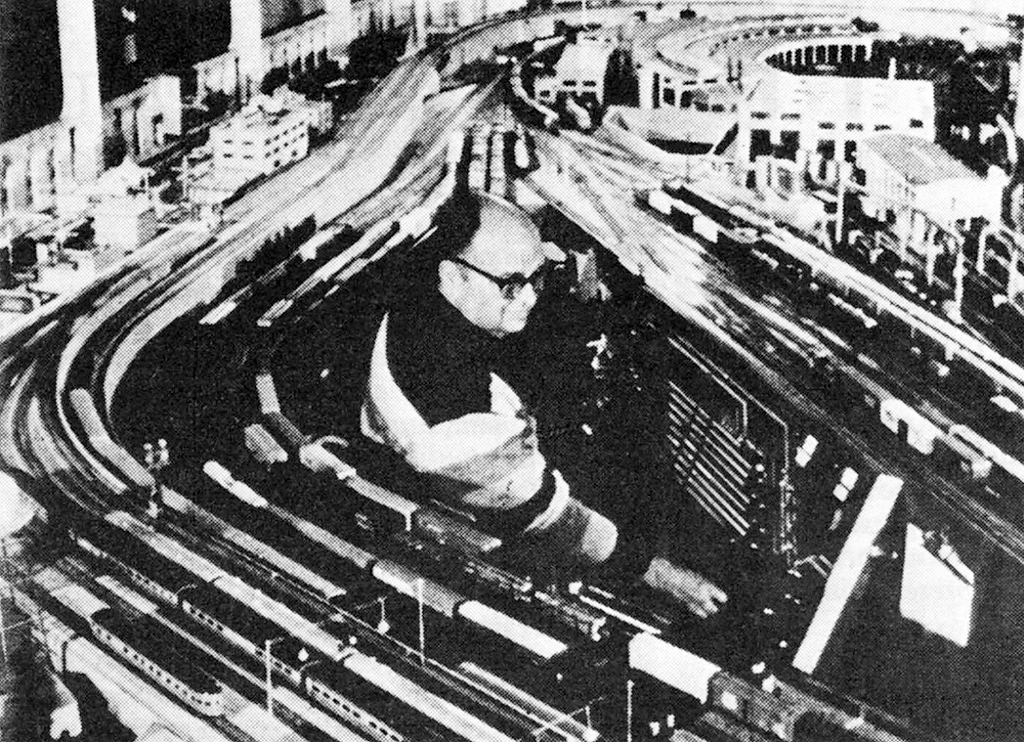
SM: The train set is an old-school analogy of studio filmmaking, but also a perennial symbol of arrested development here. Walt Disney was obsessed with them, laying an elaborate track in his backyard, wearing a full conductor uniform when guests came over.
JG: Del Mar Fairgrounds is also where the ponies used to run. One of the racetrack’s biggest fans was J. Edgar Hoover. If the “bargain” of capitalism is growing up in order to contribute to the increased circulation of goods in the social field, what is the role of childhood enthusiasm? I was fascinated by how far these guys went into these tiny landscapes. I wanted to talk about conservatism, but without the contemptuousness and dismissiveness of the new left. More like: how do you keep a tradition alive? You’re escaping reality by keeping a tradition alive. It becomes like a shrunken head.
When Europeans come to the U.S. we’re confronted by space: not the people who live in that space, but the complexity of its layers of time. We’re not used to the horizontal, but rather the vertical. A lot of Europeans wanted to make the road movie: Paris, Texas [1984], Stroszek [1977], whatever. Those people had the means to travel and I didn’t! So I said, “I’m going to put my camera on five millimeters of road and watch the traffic of the cockroaches.” I thought I was making the great American epic at the time, but most people reacted quite negatively.
SM: There’s a scene in My Crasy Life where a white dude walks up to the Samoan gangbangers to buy drugs and gets his wallet stolen, driving off in a panic. The first time I saw it, I was like… “What the hell?” Because of the blocking and framing, it’s like you’ve lapsed into a scene from an old Cagney movie. But there’s awkwardness there, too.
JG: All the more interesting that guy was one of our production assistants and we hadn’t told him what was going to happen. The gangster was the one to suggest: “We gotta jack him!”
SM: Bigger-picture, I’m just like, “How did this middle-aged Frenchman ingratiate himself with a bunch of Samoan crips?”
JG: People asked, “Oh my God, how did you do that? How could it be?” The answer is, it’s fucking easy. Maybe you don’t approach them with the camera in hand, but people love to be filmed. When you’re making a fiction film, everyone has a very hard job. With documentary, it’s playtime.
For me, the point was to get lost in the subject and find my way through it. The gangsters loved that they were invited to interview each other: “What is a question that only a gangster can ask another gangster?” When that happens, the smart thing to do is to pull back and let it reveal itself, like a flower. We were building a glossary of gangster sayings. They rap at the end.
SM: I recall gangsta rap driving white suburbanites absolutely insane in those years. I’m thinking of my parents’ generation. There was this whole culture-war thing of, “Those young men need to pull up their pants and get a job.” Nevermind the history of segregation, Jim Crow, mass-incarceration, displacement, all of it. Or, the fact that this music was hugely popular and made a lot of white record label executives filthy rich.
JG: What is this demonization about, really? There is an idea that the gangster will destroy the social order by wearing this or by wearing that. My question becomes, “What are you talking about? You really think they can take on the American police apparatus?” No. They’re confined. Their isolation makes them much more violent against each other than anything else. Of course they committed crimes, but the stakes were clear for them.
Everything I’ve done has been about the moment when image-making became problematic unto itself. In 1968, 1969, people started asking questions about the ability of cinema, or photography, to capture what was really happening. Ultimately, where ‘68 lead was a massive return of the narrative after its questioning. In the Dziga Vertov Group, we wanted to really surprise people, not just with the contents of the films but how they functioned. With all the naivete and optimism that is linked to those years, we believed the world was going to change, and that surprising people in this way would help. Today, I feel that has radically changed.
SM: You’re talking about the triumph of capitalism. I think some people are confused to see it breeding illiberalism.
JG: Maybe that ‘60s optimism will return and I won’t be here to witness it, but it’s important to avoid the condemnation of the present, just like it’s important to avoid nostalgia when talking about the past. I don’t want to get stuck feeling sorry for myself.
SM: Movies are changing too. A mainstream studio release from 20 years ago looks like an arthouse film compared to a lot of what gets financed today. It’s hard to resist the siren song of merely telling your audience how much everything sucks now.
JG: Teaching is like Golgotha, but with no resurrection. You cannot face a room full of people in their early twenties and nicely explain to them that the world in which they live is an absolute horror. You have to figure out a way to tell them, “The purpose of culture is to produce an enormous amount of crap, but certain things are great.”
GM: In the run-up to this series, a couple UCSD alumni have told me how much they enjoyed your classes.
JG: It started as a lark. I needed a job and Manny Farber put in a good word for me. What I found was these kids seemed to belong to a culture absolutely determined to erase its own history, its own practice. To me this was political work, but of course I also got pleasure out of being aggressive with them. First day of class I’d ask, “Who has seen Pulp Fiction?” They’d all hoot and holler and applaud, “Yes, yes, great film!” I’d say, “Well, if this class has any interest in achieving its goal, that goal will be to prove to you by the end of the quarter that Pulp Fiction is crap.” And, to offer alternatives.
SM: So much of cinephilia is about clinging to the past or somebody’s idea of it. When I rewatch a film that was important to me in childhood, I’m almost relieved if my opinion changes. It could be Teenage Mutant Ninja Turtles [1990], Bambi [1942], or Persona [1966]; if my experience is identical to the one I had 10, 20, or 30 years ago, that feels… Reactionary? Desperate?
JG: A film changes in front of you, though. If you love it at one moment, you may hate it at another in your life. To me this kind of constant rethinking, or rewriting, of a film is very exciting. A good film is one you want, or need, to see more than once.
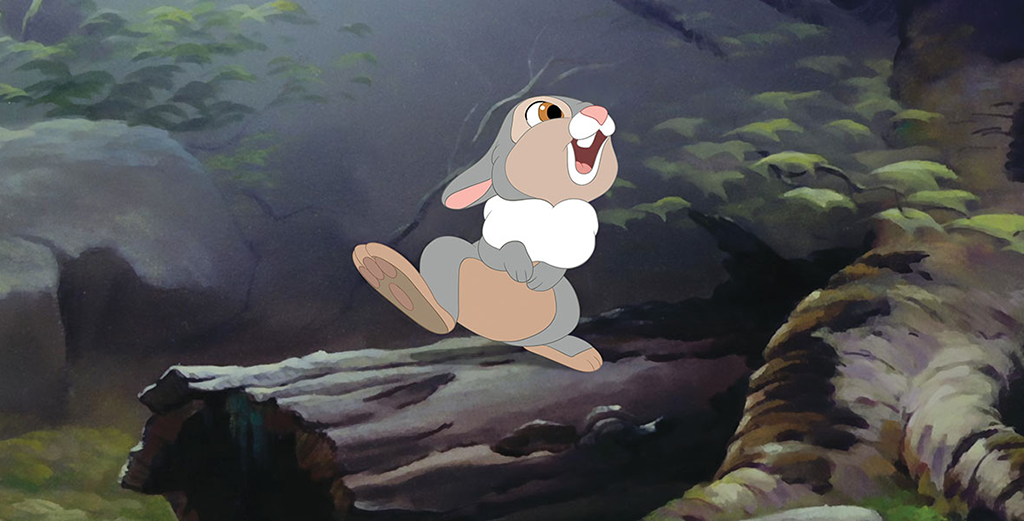
Since you mentioned Bambi—this film was essential to me, because my father and I arrived in the middle of the screening and I saw this giant rabbit onscreen, banging his foot against a tree trunk. What was essential there was the scale. In a world too big for me to understand, I was baffled that things could exist at that scale. But if you asked me about scale coming out of the theater, I could not have told you any of this. I wouldn’t have known this thing would completely change my life.
SM: Do you spend a lot of time with your own films?
JG: Not really. I rewatch certain films because I want to persuade myself that they’re well-constructed, honest little films. Sometimes I look at them and say, “I should have pushed this further.” Sometimes I say, “Well, this is pretty good.” They piss me off and they’re hilarious. Generally, I get pissed off that I haven’t done as many films as I wish I had, but I’m not the nostalgic type.
SM: You’ve made multiple references to cartoons across your career. The L’Alliance program notes for Tout va Bien read “That’s all, Folks!” Who is your favorite Looney Tunes character and why?
JG: I prefer Tex Avery, actually.
SM: You mean his MGM characters, like Droopy, The Wolf, or Red Hot Riding Hood?
JG: All of them. I learned a lot about acting from those characters. Creating a whole narrative with a single gesture. This was my introduction to filmmaking, somehow. That language is also in Weekend [1967]. Whether it’s getting a piano up a flight of stairs, or tightrope-walking from one tower to the other… Those movies only exist because of the tasks. You find this in Laurel and Hardy too—the only real Marxists of cinema. What makes a film exciting for me is when you see a filmmaker get himself into a predicament, and then you see them solving it. You need a task. My task is to look at how difficult it is to think about all those things. It came to me in school, way back when I was a kid. At the end of each writing assignment, I would end my composition the same way: “But now my mother is calling me for dinner, and so I must finish.”
“Why? Because… with Jean-Pierre Gorin” runs June 2-11 at L’Alliance New York, Roxy, and e-flux screening room.