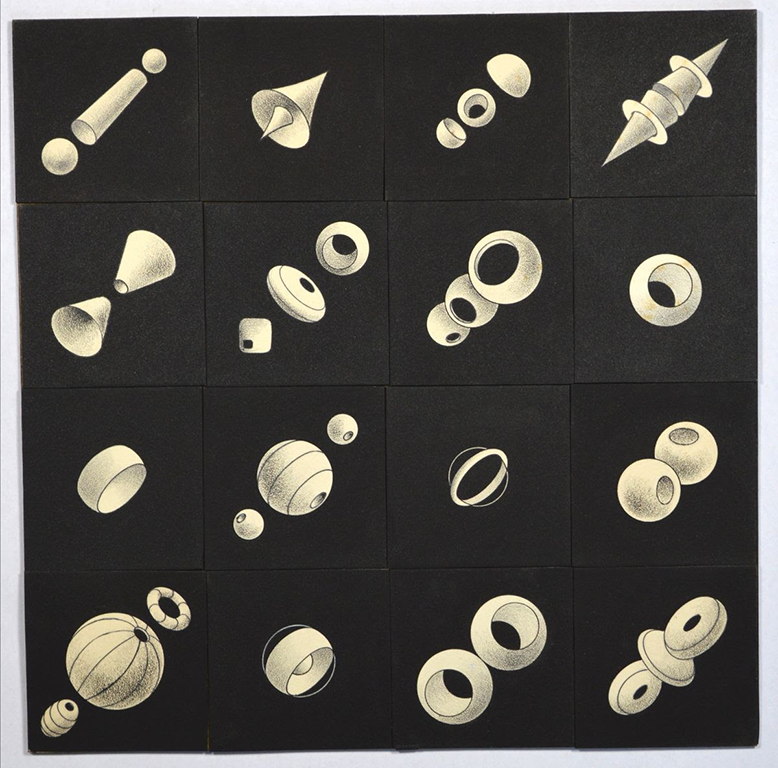
Jordan Belson began his career in painting, not filmmaking. One of his earliest exhibitions was at the Museum of Non-Objective Painting, now known as the Solomon R. Guggenheim Museum. Both the exhibition and the museum’s abstract art collection were curated by fellow abstract artist Hilla Rebay, the museum’s first director, who awarded Belson multiple grants on recommendation from abstract animator Oskar Fischinger. As Belson’s creative focus shifted toward filmmaking, he continued to explore other mediums, quietly developing a large body of multidisciplinary work.
In 1952, Belson withdrew himself from the contemporary art world and stopped exhibiting in institutional spaces. Freed from commercial and critical pressures, his self-imposed exile allowed him to cultivate a private mythology shaped by meditation and psychedelics. A move from New York to the Bay Area a few years later accelerated this shift as he worked alongside other West Coast experimental filmmakers.
Belson’s work exists at the crossroads of private inner visions and spiritual exploration. His goal was to make inward voyages visible to eyes accustomed to simply seeing the external, and to translate incommunicable experiences into pure visual energy. Though often labeled an abstract artist, there is a structural throughline in Belson’s work that is felt before all else. His films often harness the framework of Eastern philosophical and religious traditions, such as the order of the seven chakras, to induce meditative states in his audiences and encourage new ways of seeing.
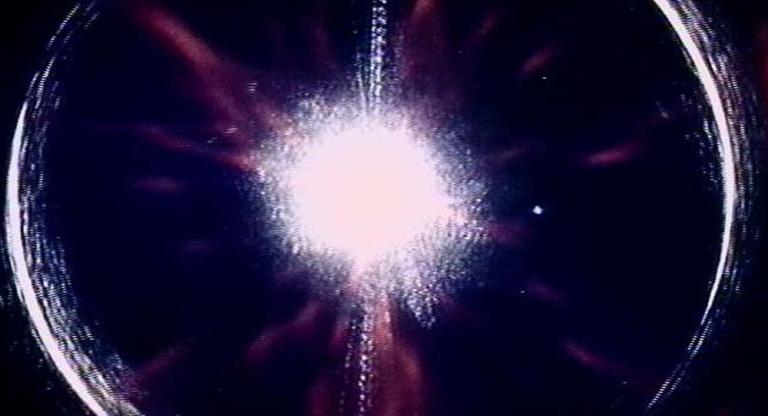
Although Belson’s films are short, they are profoundly labor-intensive and exacting. He took an alchemical approach to the medium, blending his spiritual beliefs with highly technical skills. He experimented with oscilloscopes, optical printing, color organs, and more in order to examine light as a physical phenomena and its corresponding states of consciousness. In Light (1973), the order of the electromagnetic spectrum provides the film’s rigid narrative structure. But, this work is more focused on feeling rather than thinking. As the film unfolds through entrancing patterns of color and illumination, it shifts into a fiery cosmic eruption where light becomes a rush of movement.
Infinity (1979) takes a different yet complementary path. Set to music by the pioneering New Age musician and repeat Belson collaborator, Iasos, it begins with a psychedelic sunset over the ocean. Unusual for Belson, Infinity features landscape footage: a creek, a forest, some trees. His reverence for the natural world grounds this cosmic journey. Belson asks us to consider the infinite not as a distant concept, but as a constant stream of movement unfurling in all directions, everywhere, at all times. In his hands, the infinite is not linear nor a loop, but a multidimensional constant.
By the early 1980s, Belson had begun to live as a recluse. A rare selection from his extensive archive—including visuals, 78 rpm records, VHS work tapes, and other artifacts—will be presented at this evening’s screening. Regardless of medium, Belson was constantly in pursuit of the same goal: to make the invisible tangible. In every medium he touched, he left behind a map for those willing to close their eyes and look inward.
“Raymond Foye Presents… Jordan Belson Rarities” takes place this evening, June 4, at Anthology Film Archives.
See Also