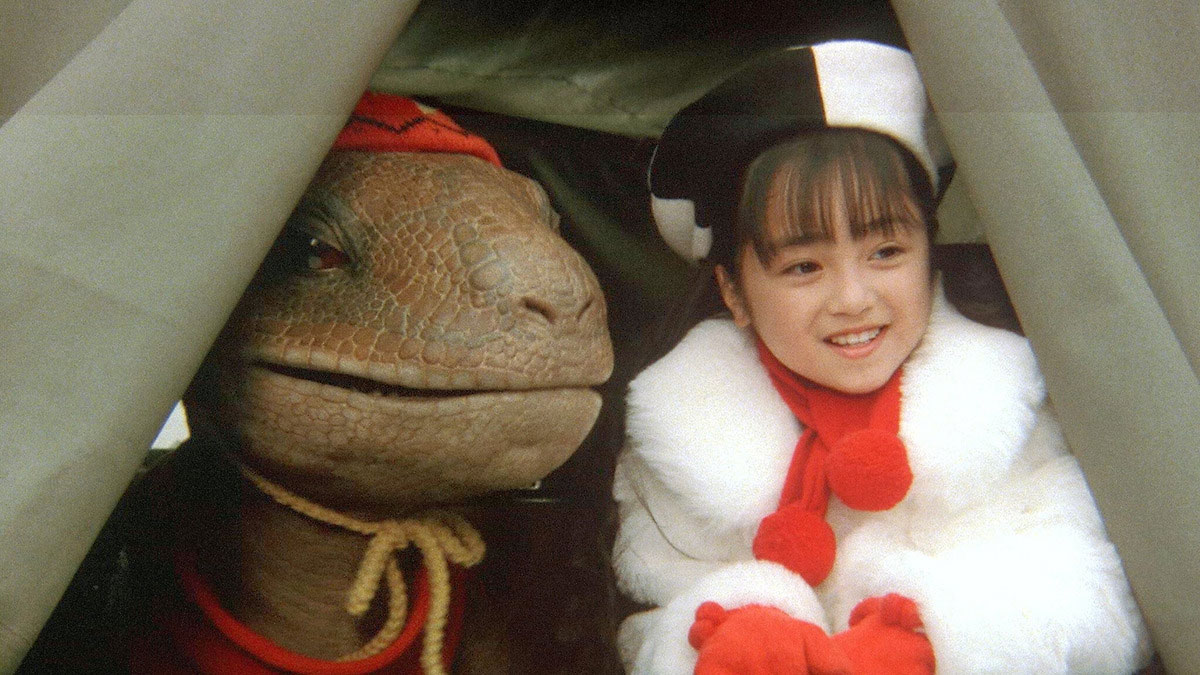
Rex: A Dinosaur’s Story (1993) could become a new Christmas movie tradition. Released in Japan shortly after Jurassic Park premiered, it’s a far more innocent depiction of human-dinosaur relations. If it may attract an audience looking for a new cult movie, it wasn’t made to lure them in despite its strange images and concepts. The film was made to please Japanese children and works on their terms. But, in an ironic twist of fate for a family film, its original release was botched when director Haruki Kadokawa was arrested for his involvement in a scheme to smuggle cocaine. As a result, the industry shunned the film, destroying its commercial prospects.
Chie (Yuri Adachi) feels lonely after her parents’ divorce. Her father Akira (Tsunheiko Watanabe), who works as a paleontologist, has just discovered a fossilized dinosaur egg and believes it holds a live Tyrannosaurus Rex. Taking her to a cave inside a national forest, Akira and Chie tumble into a space created to protect the dinosaur’s egg that lies beneath a crystal pyramid. As Chie plays an ocarina before the egg, a baby dinosaur, nicknamed Rex, emerges. Rex takes after her, and she takes on the role of his mother. However, a museum director, who used to work for Akira, exploits Rex, forcing the dinosaur to appear in commercials. Chie decides to save him and the two go on the run.
When Rex was shot, its only option was relying on practical effects. The dinosaur was created by Carlo Rambaldi, who worked on Alien (1979), Possession (1981), and E.T. (1982). It’s a puppet animated in stop motion. These pre-CGI techniques give the film great charm, such that the visibility of the fantasy enhances its appeal. Kadokawa films nature and constructed sets alike with genuine wonder. The cave’s underground passageways and hidden temple are a marvel of production design. Just before the title drops, the camera swoops excitedly from inside a helicopter over patches of fog, mountain vistas and vertiginous drops. A climactic chase scene is made even more exuberant by adopting the perspective of a person racing a motorbike through snow. Kadokawa’s direction is always dynamic. Rex’s storytelling errs on the side of sexist sentimentality, blaming Chie’s problems on her mother’s pursuit of her career. (It suggests the young girl’s actually better at the maternal role.) However, this flaw doesn’t dominate the film. Rex retains a beating heart, never condescending to its intended audience of children while likely to please adults.
Rex: A Dinosaur’s Story screens tonight, July 10, at Japan Society as part of “Japan Cuts 2026.”