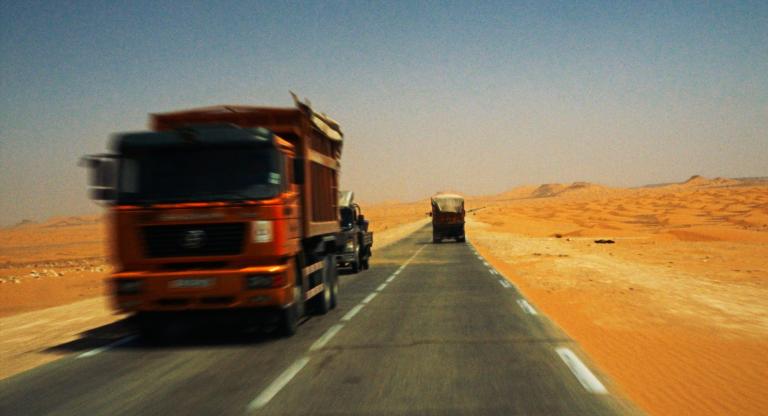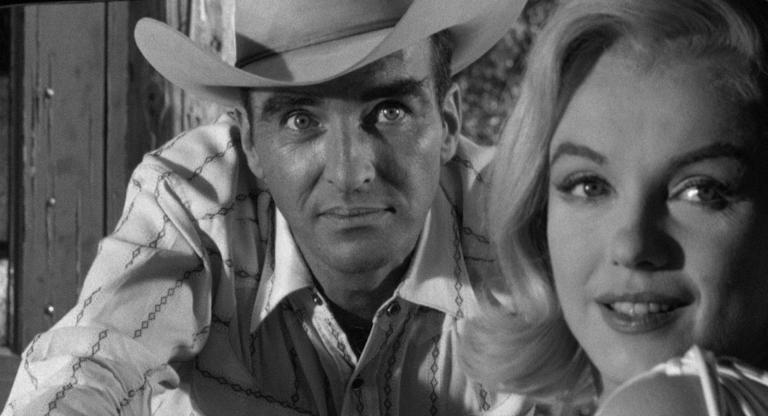
Jocelyne Saab (1948-2019) documented Lebanon in a way that complicates the idea of documentation even being possible. At the level of footage, Saab filmed historically valuable scenes in her “Beirut trilogy”—Beirut, Never Again (1976), Letter from Beirut (1978), and Beirut, My City (1982)—that were only available elsewhere in television news broadcasts now lost to time. In Beirut, Never Again, Saab captured children sifting through the remains of a civil war. Later, in 1982, during the ongoing Israeli invasion, she went into buildings that had been shelled and filmed similar children, stiff with rigor mortis. (In 2013, she told Olivier Hadouchi that the Palestinian resistance had arranged for Saab to work as a journalist in contested areas. “They knew who was who, and we were essential to them,” Saab said.)
None of this was approached as journalism alone. When she began the trilogy, in 1976, she knew other journalists were “on it anyway.” She later recalled saying, more than once, “I need to tell what is in the heart of the people; I don't feel like just showing what is going on anymore.” Her clarification was that “a work that evokes war without sincerity” is “not the truth.” Her process was not exactly the run of show for the seven o’clock news: “When you’ve gone that far, with such sincerity, you’re in need of urgency in art or journalism.” Her collaborator, the great poet and painter, Etel Adnan, said of the trilogy that “[n]o document on that war ever rivalled the three films Jocelyne made about Lebanon.”
These three films are in fact largely montages set to poetry, with some interventions of sync sound. Adnan wrote the voiceover text for both Beirut, Never Again and Letter from Beirut. She told Saab that, while writing, "she was very sensitive to the children who understood, before any of us, that nothing and nobody could be a precedent for what was happening.” She called her text an “homage to their lucidity.” Saab pulls off a real feat, an eye that is neither detached nor prurient. In Beirut, Never Again, she walks through both streets bustling and destroyed hand in hand with Adnan. She does not overvalue the moral heft of the rubble nor cast the Lebanese as some kind of benighted mass. Everyone continues doing what they can. In one sequence, she captures five children peering around the corner in the rubble, each of them wearing yellow rubber dishwashing gloves pulled from a pack they’ve just found. They look like a small Dada army as Adnan’s voiceover is read aloud by Jörg Stoecklin, Saab’s partner and collaborator. (He reads in French; the following are the current English subtitles. There is also an English version narrated by Saab herself.) “This wonder, disinherited children, are discovering it. They loot with a kind of contemplation. All of the elements of a forbidden world are suddenly with their reach.” A girl, who seems equally 80 and 10, sifts quickly through striped blankets being thrown out a window stories above her. “It took the worst catastrophe of the century for these children and adolescents to take into their hands the luxurious objects that Beirutis used to import carelessly.” A boy carefully lowers an office chair down the side of a building while the girls gather clothing into bags and look about, both lost and overly present. “These children are the kings and queens of one day that poets refer to.” Less often celebrated but absolutely Adnan’s equal is the narration written for Beirut, My City, by Lebanese playwright Roger Assaf. As free with language as Adnan, he also had a knack for the epigram: “Time has taken its time, or rather, war has taken our time.” These collaborations recall Chris Marker’s narrative scripts for Alain Resnais (and himself).
In the late ‘60s, after she had completed a college course in economics, Saab began moving through various phases of journalism. In 1970, she hosted a show called The Marsupilamis Have Blue Eyes (Les Marsupilamis ont les yeux bleus) on national Lebanese radio where she played “pop, rock, international music, and the weirdest news she could find in the dailies,” as Saab scholar Mathilde Rouxel described the programming to me. A few years later, she was an intern at Al-Safa newspaper, where Adnan was an editor. Saab wrote music reviews and though one of Adnan’s colleagues thought it was “not serious” that she sent Adnan unfinished drafts, Adnan said it didn’t matter. “What she was saying was interesting,” Adnan later explained.
At no point did she take a traditional view to any of her assignments, much of them done for French and Lebanese TV. (Saab eventually moved permanently from Beirut to Paris in 1975, though she returned to Lebanon constantly.) For Lebanon In Turmoil (1975), Saab allowed all the various parties to have their say. Even Pierre Gemayel, all alone at a massive conference table, explains the position of the Christian right-wing Phalangists, sounding every bit the proto-Trump he was. Their “militia” (he seems agonized to have to use the word) only arose because young Lebanese had to “defend themselves” against the foreign elements who had taken advantage of Lebanese hospitality and freedom. (Parsing what “foreign” means here would take an entire second film.) French TV wouldn’t broadcast the film because, Saab said, “they considered it too critical of the Christian and fascistic right.”
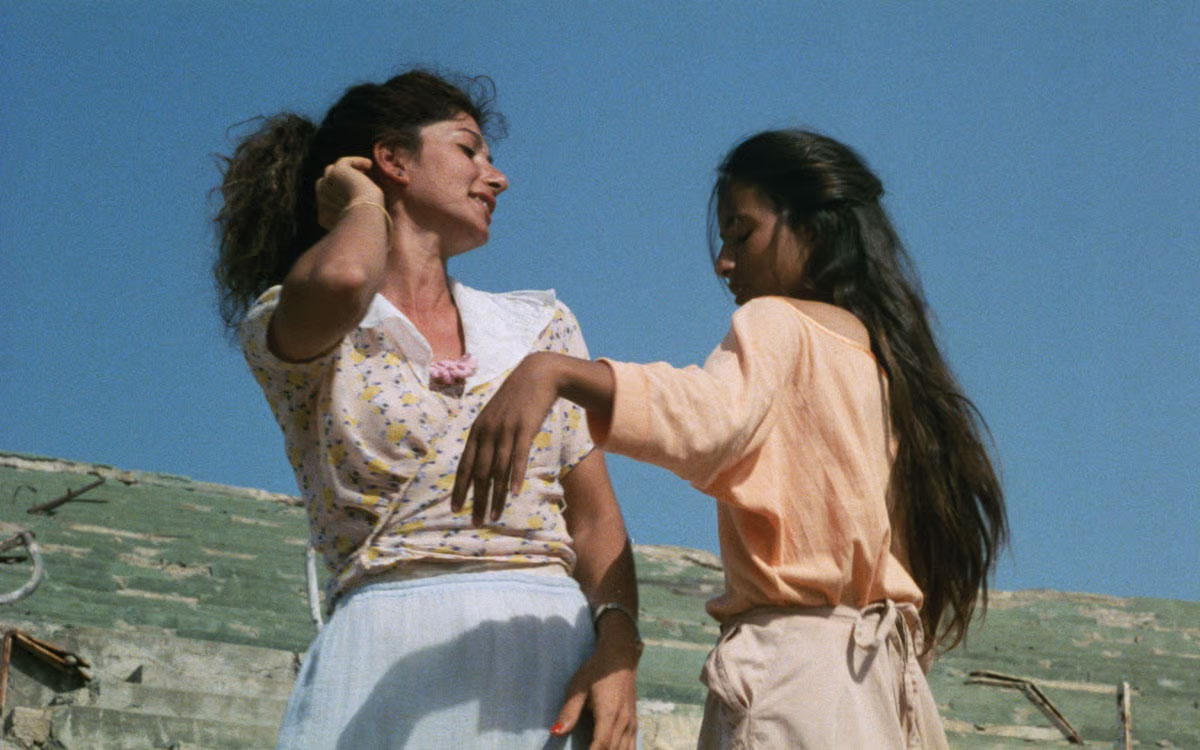
Her first feature is a wild reimagining of how fiction could convey the realities of war, in big and small ways. Amidst the rubble and huge abandoned houses resettled by squatters, a teenager named Samar falls in love with Karim, a much older painter. Karim begins the film in a cemetery, picking wild flowers. After he leaves, a small band of resistance fighters spot him and call him by name to offer him coffee. They are sitting in once-fancy upholstered chairs inside a small perimeter made of sandbags. “You’re the first person I’ve seen coming out of a cemetery with flowers,” one says to him. What is and isn’t a flower is what The Razor’s Edge (also known as A Suspended Life) is about, more broadly. Or even more broadly, as Rouxel wrote, “from beginning to end, Jocelyne Saab’s work is permeated by the Palestinian struggle.”
Jocelyne Saab: Letters from Lebanon runs July 10-12 at Metrograph.