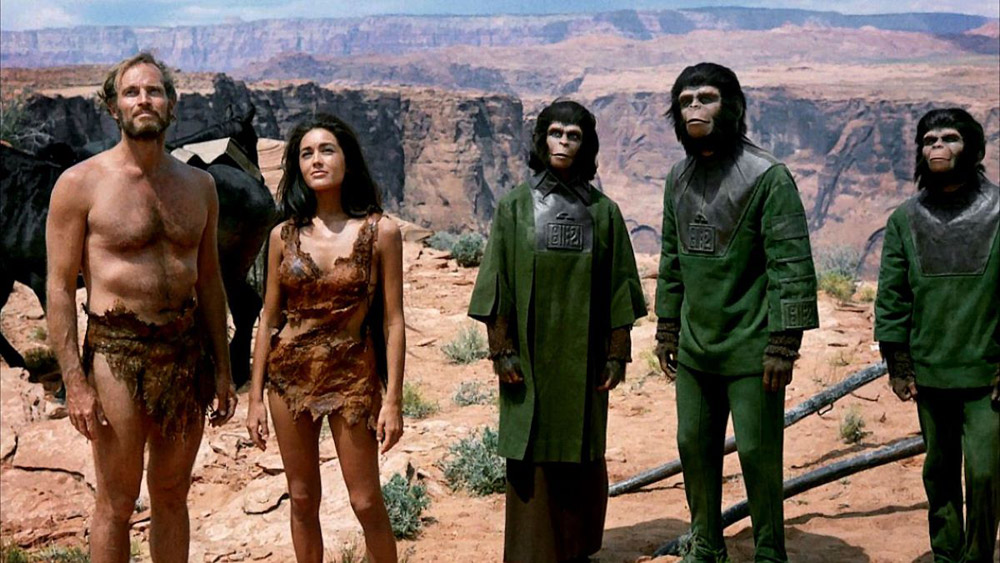
In Franklin J. Schaffner’s compulsively entertaining Planet of the Apes (1968), American astronauts crashland on a forbidding desert planet in search of life, only to find the place is run by humanoid apes oppressing a class of enslaved, nonverbal humans. (Orangutans are ruling elites; chimpanzees are thinkers and provocateurs; gorillas are enforcers and laborers.) The lead astronaut, George Taylor (Charlton Heston), hides among these loincloth-wearing neanderthals as long as he can, but his higher intelligence and rebellious spirit gain him the attention of a bleeding-heart anthropologist chimpanzee named Zira (Kim Hunter) and her fiancée Cornelius (Roddy McDowell). By serving as proof of human intelligence, Taylor’s existence threatens to upend ape civilization and casts doubt on its founding narratives. Zira and Cornelius answer to an orangutan named Dr. Zaius (Maurice Evans), who puts Taylor on trial before the insurgent human escapes on horseback to the area known as the “Forbidden Zone” where, it’s revealed, a prior civilization once existed.
The apes in Pierre Boulle’s 1963 Planet of the Apes novel drove cars, operated telex machines, enjoyed radio and television, et cetera, but Schaffner and producer Arthur P. Jacobs’s adaptation leans into a prehistoric Californian aesthetic, largely for budgetary reasons. And whatever the pulpy genesis of Boulle’s idea, it has always invited different levels of subtextual analysis: depending on where you stand, the apes are a crude metaphor for the subjects of colonialism persecuted by Boulle’s native France, or an uneasy mirror for man’s inhumanity to man. The film’s cautionary satire is that the apes are just as naive about their assumptions of superiority as the humans on Earth who made (or paid to see) the movie.
By transferring human tried-and-trues onto simian overlords, Schaffner’s film calls out human folly (the atomic bomb being the tantamount example) while also deploying explicit racial imagery: the Apes’ first appearance onscreen, on horseback, hunting humans within stalks of leafy greens, unambiguously evokes the horrors of antebellum slavery. The use of firehoses on unruly human captives recalls the mass-spraying of Civil Rights protesters in Birmingham. When Taylor encounters one of his former teammates taxidermied in a history museum, it’s shocking, but also feels like a satire on the exploitative and extractive processes of anthropological study. The film’s long second act becomes a discourse on free will, played out in the halls of ape power. However well-intentioned the messaging, it’s surreal to realize you’re watching a blue-eyed, blonde-haired figure shackled and abused: a treatise on racism that plays out on the body of Charlton Heston.
The first Planet was such a hit it engendered four theatrical sequels in rapid succession, all of varying repute. 1970’s half-budget Beneath the Planet of the Apes doubled down on the original’s atomic-age anxiety while James Franciscus starred as a dubious Heston knockoff named “Brent.” 1971’s Escape From the Planet of the Apes cast a surprisingly somber eye toward Cornelius and Zira’s exodus to the United States, foreshadowing the pessimism of its follow-up, Conquest of the Planet of the Apes (1972). That film tapped into the political discontent of the Nixon years to tell the tale of Cornelius and Zira’s son Caesar (again played by MacDowell) leading the simians in insurgent revolution against their human overlords in a futuristic city-state shot entirely at the University of California’s brand-new brutalist campus in Irvine. After the stunned public response to Conquest’s radical despair, 1973’s Battle for the Planet of the Apes closed things out with a kid-friendlier plea for tolerance, understanding and world peace (although, a syndicated TV series came shortly thereafter.)
Tim Burton’s 2001 remake with Mark Wahlberg boasted stunning ape prosthetics via Rick Baker, but was fundamentally sabotaged by a rushed production schedule and studio-sabotaged script, such that Burton joked about killing himself while doing press interviews. Rise of the Planet of the Apes (2010) initiated a more successful reboot franchise, which strained to avoid camp while replacing the traditional ape prosthetics with motion-capture CGI; while impressive, to me this approach betrays the look and feel of the original Apes cycle.
This wide range of cash-ins has kept Boulle’s rough idea alive, but the original remains essential viewing. Given Rod Serling’s screenplay credit and the closing twist to end all plot twists, it’s tempting to posit Planet of the Apes as the ultimate Twilight Zone movie. But the script was thoroughly reworked by blacklisted scribe Michael Wilson (Salt of the Earth, A Place in the Sun) and tweaked on-set by Schaffner and his ensemble. In aggregate, especially thanks to the prosthetic ape makeup of John Chambers and the magnificent score by Jerry Goldsmith, Planet represents a high watermark for Hollywood science fiction yet looks inevitably hokey compared to Stanley Kubrick’s 2001, which came out the same year. It’s a socially conscious (if confused) blockbuster, a ripping yarn, a pop masterpiece, and cultural touchstone such that it’s not hard to understand why it continues to inspire so many ripoffs and parodies.
Planet of the Apes screens tonight, April 7, at The Paris as part of the series “AMPAS Branch Selects.”