Boris Barnet was a hitmaker in the Soviet Union, but in the afterlife of film studies, he’s been something of an also-ran—a buoyant pulpmaster forever in the historical shadow of the Soviet moment’s four horsemen of Marxist agitprop (Sergei Eisenstein, Vsevolod Pudovkin, Oleksandr Dovzhenko and Dziga Vertov). It’s not that Barnet didn’t hosannah the motherland or couldn’t montage up a storm when he wanted to, but his sensibility was always more irreverent. So, it makes sense that today his merrier, less dogmatic films wear a good deal better than the dialectical mastodons of his contemporaries.
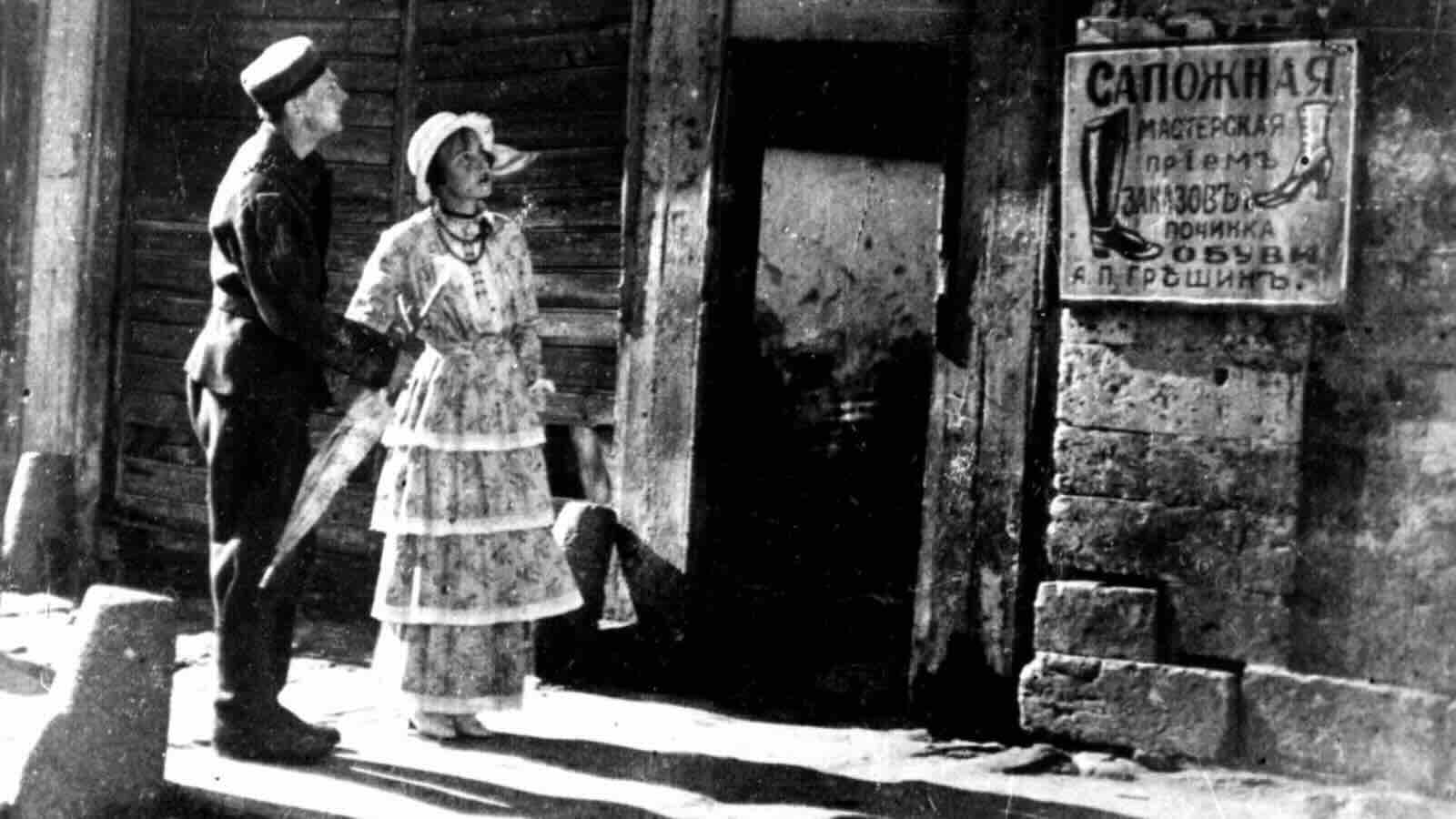
His pacifist early-talkie Outskirts (1933) could have been dull or patronizing in another filmmaker’s hands, but Barnet attacks the early Soviet village life facing WWI and the Revolution with both elbows out. It might be the first sound Soviet film that took on the war, thieving and joybuzzing riffs from both All Quiet on the Western Front (1931) and Dovshenko’s Arsenal (1929), but it begins with a shoemakers’ strike that essentially reinvents Eisenstein’s Strike (1925) as cornpone slapstick. In the movie, shoes, on workshop benches or on dead soldiers’ feet, persist as a leitmotif for an ordinary Russian life struggling to truck through the trials of Czarist oppression, world war, civil war, and the first provisional governments.
Even trench warfare, that iconically claustrophobic staple of WWI movies, is treated like pratfall farce (until eventually, craftily, trauma, dementia and the stillness of corpses finds its way in). Just as suddenly, it’s 1917, as the new Soviets try to pull out of the war (the Czarist officers are the primary obstacles) and the village is contending with an influx of German POWs—hired as workers, routinely abused, and even wooed by the lonely local girls. (Considering Germans as fellow empire-pawns, to be perhaps Communized, was a world-workers sentiment even in 1933, but not for long after.)
Barnet saves his satiric opprobrium for the shoemaking war profiteers, and as with a lot of early Communist culture that dishes on the damage done by capitalist greed, it’s easy to agree. Throughout, Barnet hones in on idiosyncratic character details in a lovable way Eisenstein & Co. never did, playing with the early-talkie capabilities like it’s an arcade game, even free-associating sound effects across scenes (bullet noise = shoe hammers, and so on). Back in the day, it even impressed Variety’s reviewer, who called it a “milestone” that “at last” restored “human beings to the Soviet screen.”
Outskirts screens this afternoon, March 28, at Metrograph as part of the series “Boris Barnet: A Soviet Poet.”