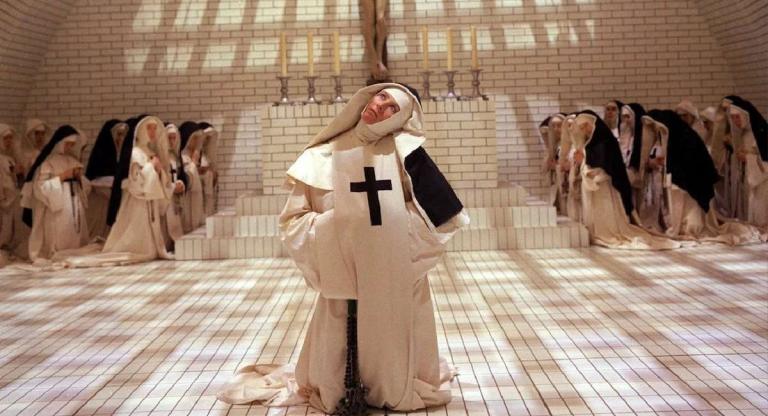
Claude Chabrol is perhaps the phantom of the Nouvelle Vague—or at least of its Cahiers du cinéma cohort. Unlike his fellow critics-turned-filmmakers—Jean-Luc Godard, François Truffaut, Éric Rohmer, and Jacques Rivette—Chabrol has long fallen out of circulation, both discursively and in repertory exhibition. The former is likely due to the dependable, prolific consistency of his oeuvre: sexually charged mysteries set within the French bourgeois milieu. Compared to the movie-mad modernism of his colleagues, Chabrol can appear a mere genre director, more specifically a genre director in pursuit of a Hitchcockian style (it should be noted that Chabrol, in collaboration with Rohmer, wrote the first major book on Hitchcock’s films). The paucity of retrospectives devoted to Chabrol’s films is due in no small part to his countless co-productions with long-defunct European companies, making the search for prints a route littered with dead ends. One hopes that the recent restorations of seven of his finest films from the late 1960s and early 1970s, which are screening in L’Alliance New York’s “Chabrol! Suspense! Restored!” series, will not only (re)introduce Chabrol to contemporary audiences, but also reveal that his films constitute a genre unto themselves: a distinctly Gallic strain of pulp cinema that modulates between absurdity and intrigue.
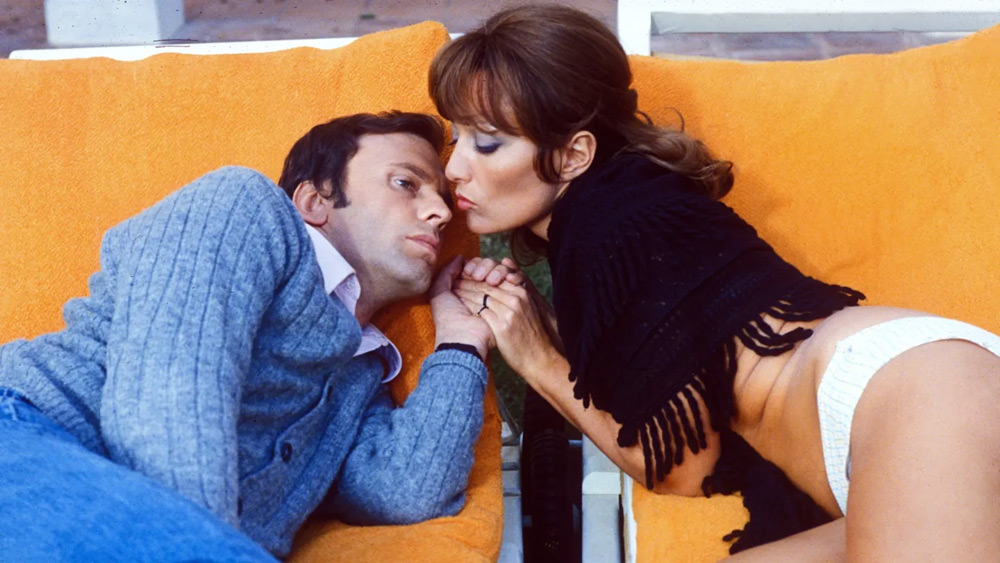
Les Biches was Chabrol’s fifteenth feature in 10 years—his eighteenth overall, if we count short films as well—and it launched a run of films, nearly all starring the incomparable Stéphane Audran, that display “a new simplicity,” in the words of the film critic Robin Wood, and cemented the director’s legacy as an auteur of suspense. The film opens with Audran slinking her way into an impromptu (or is it?) meet-cute with a chalk street artist (Jacqueline Sassard) on a wintry Paris day. An uncertain seduction ensues, thick with sapphic undertones—Audran the unflappable sophisticate, Sassard the rough-edged innocent—and the pair soon decamp, via Audran’s white convertible Benz, to her villa on the French Riviera. There they encounter architect Jean-Louis Trintignant over a card game and a tense romantic triangle snaps into place.
A duo of gratingly unfunny hangers-on—Henri Attal and Dominique Zardi—aside, Les Biches unfolds as a sinuous danse macabre between Audran, Sassard, and Trintignant. Chabrol’s camera stalks and circles his characters with weightless precision, and Audran—acting opposite her ex-husband (Trintignant) in a film co-written and directed by her then current husband (Chabrol)—is the very image of languor. A recurring image in the film shows the couple sharing a kiss, though it is partially obscured: one face is almost entirely swallowed by darkness, as if the other were kissing a shadow—an apt metaphor, since few people in Chabrol’s world are quite what they seem.
Les Biches screens this evening, January 11, at L'Alliance New York as part of the series “Chabrol! Suspense! Restored!”
See Also