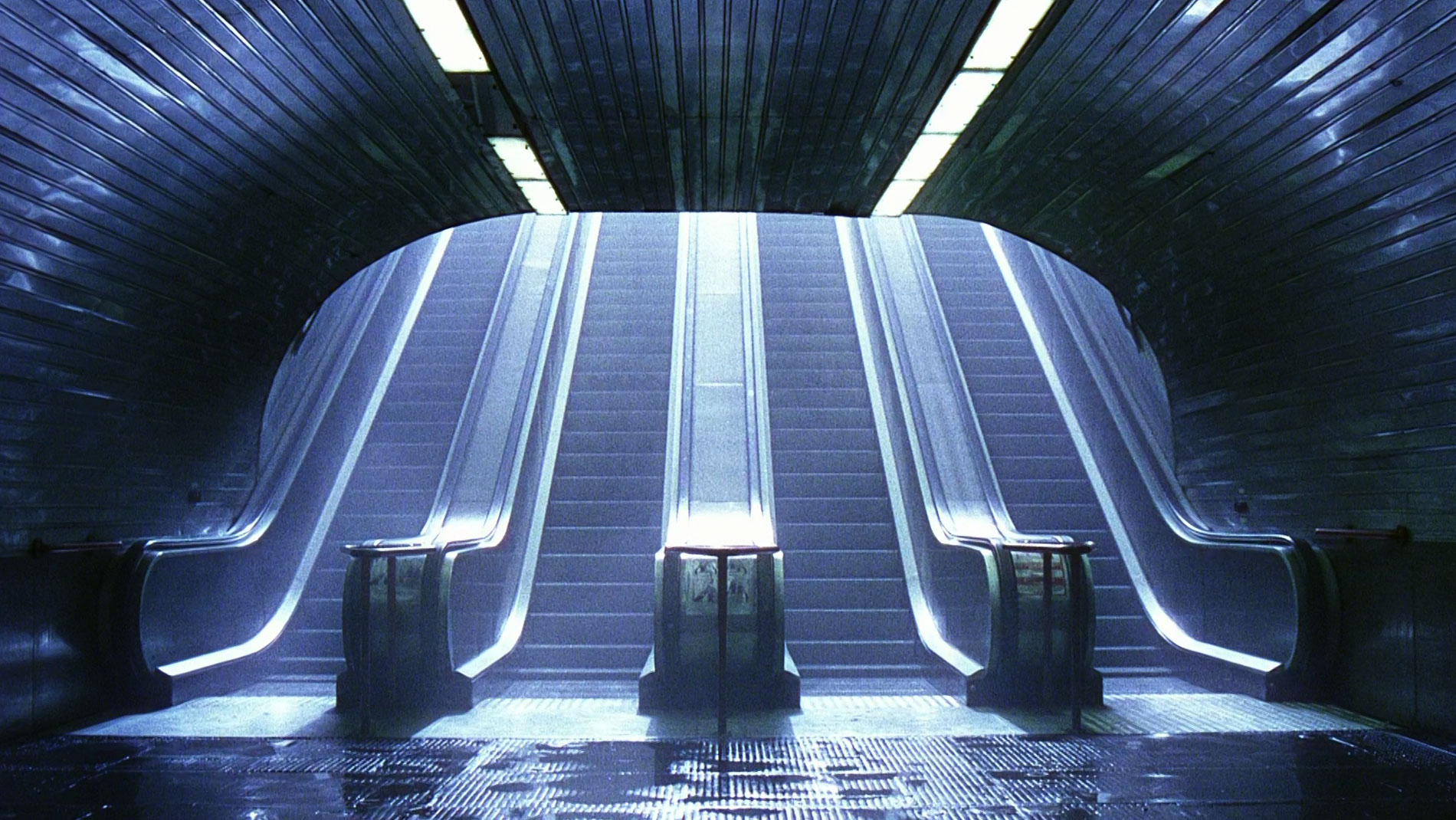
Nimród Antal's Kontroll (2003) has an unusual beginning: an austere man dressed in white reads from a tablet. This man—Asa Botund, then the actual CEO for the public transit company in Budapest—explains that the film you are about to see is, per the director's words, about the “struggle between good and evil,” and while filmed in the Budapest Metro, the film is entirely fictional and should not be understood as representative of the Metro system. While I have never been to Budapest, I found Antal's version more thrilling than any real Metro could ever be. In Kontroll, the Metro is a domain of bloodshed and inertia, painted in shades of cool grim and despair. The film is swaggering, moody, and ridiculous, hewed to an original electronic score by the Hungarian band Neo that sits in comical contrast to the surreal grays of Kontroll’s world. Indeed, Kontroll is a film about good and evil, where the “good” are the misunderstood, wildly harangued ticket inspectors of the Metro, and the “evil” are, well, nearly everyone else.
Bulcsú (Sándor Csányi) is a sullen man who leads a ragtag crew of ticket inspectors in the Budapest Metro. Their jobs are to ask passengers on the train for their tickets, a remit that invites ritualized misery—Bulcsú and his lackeys experience routine harassment, retaliation, and occasional violence from passengers who either do not have tickets or want to deal with the inconvenience of an inspector hounding them for theirs. Either from his work or his suffering, Bulcsú's face is always inexplicably bleeding. Kontroll, like Bulcsú himself, never leaves the underground. Bulcsú simply sleeps on the train platform when he needs—that is, if he needs to. There are allusions to time, but time doesn't materially appear to exist in this version of the Metro; after all, there is no sky in Hell. Either from boredom or the nihilistic absence of stakes, Bulcsú races other ticket inspectors on the train tracks for leisure. In this game, the winner successfully outruns the midnight freight train and makes it to the next platform; the loser dies. The monotony of Bulcsú's life is punctured by the increasing number of homicides in the Metro committed by a mysterious hooded man dressed in black and the presence of a strange woman (Eszter Balla), as uncommonly beautiful as her uncommon choice of attire: a teddy bear onesie. She is often riding the train alone, and no, she does not have a ticket. She lets Bulcsú know this fact coolly, raising her assured face close to his stunned one before exiting the train.
Kontroll screened in Un Certain Regard at Cannes in 2004 and paved Antal's path to Hollywood. After Kontroll, Antal would direct the horror film Vacancy (2007), starring Kate Beckinsale and Luke Wilson, and continue the Predator franchise with Predators (2010). That Hollywood would find Antal intriguing makes sense given the dimensionality, technical prowess, and hysterical heights of Kontroll; Antal really could not have delivered a more impressive first feature film. Yet what I find mystical about Kontroll is its deeply ethical core: the film is really about the indignities of labor. One of Bulcsú's coworkers, Muki, eventually snaps from all the vitriol he is forced to endure in his work and commits the unthinkable: murdering a stubborn passenger. A coworker from a former job bumps into Bulcsú on the train and reminds him that he once had dreams and talent—maybe not here, but in the world above this one, past the Metro's escalators. “I never thought there were jobs worse than ours,” Bulcsú remarks as he watches a man's corpse be lifted from the train tracks by paramedics, bloody clump by clump. In a moment of battered angst, Bulcsú asks the older, docile train conductor, Béla, how to leave. Does Bulcsú mean his unhappiness, his job, the unceasing death around him, or the underground? Béla looks at him, choosing not to pry, instead responding earnestly: “There are many ways out of here, Bulcsú.”
Kontroll screens this evening, July 12, at BAM as part of the series “Electronica.”