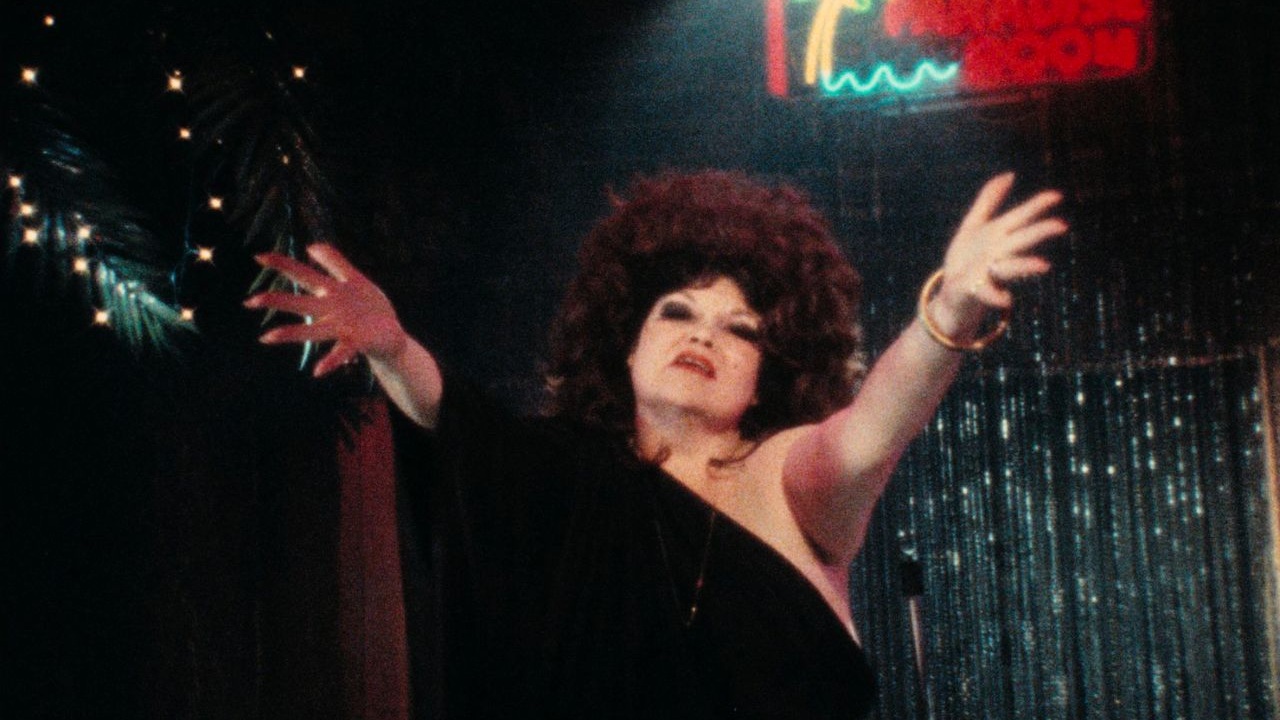
Rosa von Praunheim’s documentary Tally Brown, New York (1979) opens with a pair of unbroken long takes. The first is a cacophonous roving panorama of Times Square, and the second a long, slow zoom in on Tally Brown—the squat, stout cabaret star whom Leonard Bernstein once described as being “a white Billie Holliday”—as she performs a bilingual cover of David Bowie’s “Heroes” alone on stage, her voice booming at the peak of the song’s emotional crescendo despite her initially appearing so small in the frame. For Praunheim, the grime of the city and the glamour of Brown were inextricable. Though he’d previously explored a variety of New York arts and cultural scenes across the series of wide-ranging panoramic documentaries he’d made about the American gay liberation movement (Army of Lovers or Revolt of the Perverts, 1979), experimental theater (Underground + Emigrants, 1976), underground cinema (George and Mike Kuchar, 1977), and, well, death (Death Magazine, or: How to Be a Flowerpot, 1979), these projects were all narrow in scope and without much crossover. In Brown, he found a singular subject who existed at the center of his own personal Venn diagram of interests and obsessions. And in Praunheim, Brown found a collaborator willing to at last put her in the spotlight instead of merely relegating her to yet another supporting role. It was a perfect match.
Coming from a filmmaker who frequently courted controversy throughout his career—like when he attempted to “demystify gay sex” by having his San Francisco Art Institute class film him fucking a gay porno star in Army of Lovers or Revolt of the Perverts—the most shocking thing about Tally Brown, New York is its warmth and its intimacy. Eschewing any sort of traditional documentary structure, the film consists of little more than a tape-recorded conversation between the filmmaker and his subject intercut with live performances filmed at the long-gone Village cabaret Reno Sweeney and a series of testimonials from some of Brown’s friends (including Divine, Holly Woodlawn and Taylor Mead). Accompanying Praunheim’s conversations with Brown is an assemblage of what can only be described as footage—or what J. Hoberman described in his Village Voice review as “barely edited rushes.” (The film later made his “Best of 1979” list). He’s not wrong, but it’s the roughness of the film’s images that makes them feel so vividly alive. Rather than the languid, thoughtfully composed shots of urban landscapes found in News from Home (1976) and Massillon (1991), Tally Brown feels like a memory rush from a long night of location hopping carried out in a flurry of taxicabs and near-missed trains guided by the most interesting person you’ve ever met.
In transposing Brown’s recollections of her past onto contemporary locations (the decadent Continental Baths of the early ‘70s is represented here by the sleazy Broadway Arms Baths of the late ‘70s, and so on), Praunheim links the mainstream and underground arts scenes that Brown came up through with the present moment. In a way, Tally Brown, New York challenges two truisms: that every queer person always wants to think they were the first person to do something and that New York was always much more interesting before you got there. Yes, there has always been someone there before you, but, though the fashions and locations change with age, there always will be people here who aren’t the most famous just doing the thing while also managing to find a way to get by because it’s in their blood.
Tally Brown, New York screens this afternoon, July 19, and throughout July 23, at IFC Center.