Talking about painting can bring to mind Bob Ross memes or John Berger’s Ways of Seeing. But talking about painting using the language of artists’ moving images is a different conversation altogether, one imbued with calculated chance and the purposeful riddles of visual interpretation. Inaugurating a new ongoing collaboration between SFMOMA and San Francisco Cinematheque, tonight’s program, “A Thing Brilliant and Powerful: Films on Gesture, Paint and Painting,” screens six short 16mm films and videos contesting what it is to paint or be painted. Screening in conversation with SFMOMA’s exhibit, “Matisse’s Femme au chapeau: A Modern Scandal,” the films range from abstract to personal to cheeky across three decades.
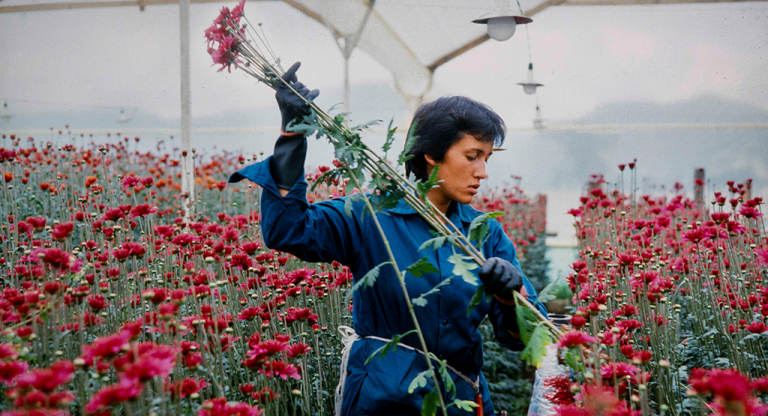
Between six epistolary missives to famed painters—Johannes Vermeer to Diego Vélazquez, Giovanna Garzoni to Charles Ethan Porter—Cauleen Smith’s Entitled (2008) shares the artist’s quiet take on modern life with these long-gone artists, set against the grainy oversaturation of digitally shot still-life compositions. Wryly addressing this subject, Stephanie Barber’s 16mm film 3 Peonies (2017) places her tableau vivant into a literal memento mori of dizzying red and blue primary colors, a smothering of painters tape, and a somber fade-out to a cover of The Beatles’ “A Day in the Life.” Dismissing the use of a painted subject altogether, John Smith memorializes his late father’s history of painting (which he did on the side from his day job) in Dad’s Stick (2012), a short video essay focusing on the changes in color schemes his father used, saved in petrified strata on his decades-old stirring stick.
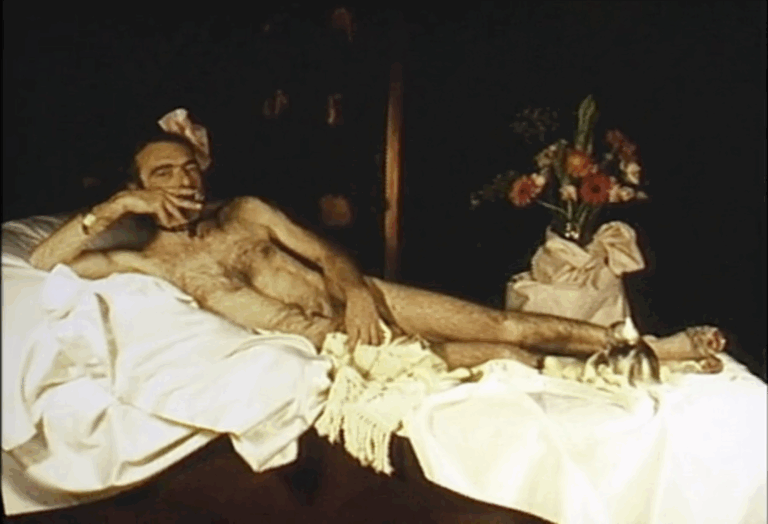
Turning the painting and its subject inside out, Pelle Lowe’s Work (1994-1995) stars her collaborator Saul Levine attempting to become the Olympia of Édouard Manet’s notorious 1863 painting, which shocked Parisian salons with its dignified portrayal of a prostitute and her servant (who were actually frequent Manet models Victorine Meuret and Laure). Levine, at times replaced by Alya Romeos (credited as “The real Victorine”), frequently rambles through monologues or partial conversations on gender and personal history while lying in the fully nude Olympia pose.
Dedicated to the late Fred Worden (1946-2025), the program includes his silent 16mm film The Or Cloud (2001). “I believe there is a current which runs at the core of all beings, call it the life force,” Worden had said of the piece, quoting Rainer Maria Rilke’s idea of a vibration meant to “enrapture and console us.” “I like to think this vibration can be detected streaming out of The Or Cloud.” Seeing a filmmaker’s creation—one that he believed portrayed a “life force” in rapid bursts of black and white—after he has passed is an especially powerful way to commemorate his work: this is what coming alive, in film, looked like to him.
Ending the program is a masterful film directly incorporating painting into the moving image’s medium: Phil Solomon and Stan Brakhage’s first collaboration, Elementary Phrases (1994). With colored paints applied directly onto the 16mm printed film, the result is over half an hour of the filmmakers’ signature styles in silent abstract compositions, appearing like backlit stained glass, or visceral body parts, in a rapidly shifting fantasia of colors. In this cameraless stop-motion, Solomon and Brakhage each create image ideals in a natural dialogue with each other, presenting a visual conversation of unexpected highs, lows, pauses, and explosive exclamations.
“A Thing Brilliant and Powerful: Films on Gesture, Paint and Painting” screens Thursday, July 23, presented by SF Cinematheque at SFMOMA.