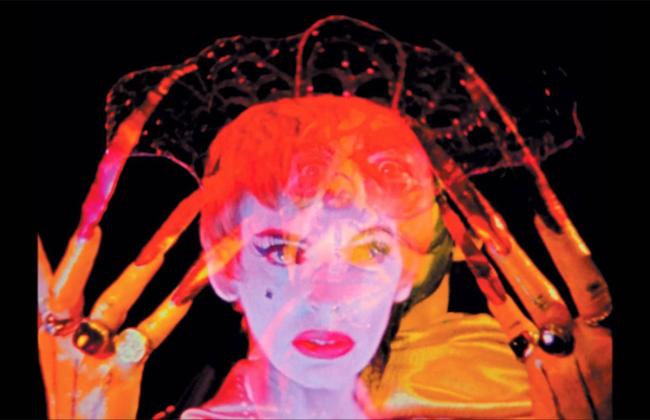
Kenneth Anger's Inauguration of the Pleasure Dome (1954) is a spell preserved in cinema that lavishly presents the occult currents that fascinated the filmmaker throughout his life. A devotee of Thelema (an esoteric philosophy developed by the occultist Aleister Crowley), Anger uses the film as a place of ritual, drenching each frame in dense symbolism.
At the center of this ritual is Marjorie Cameron, an American artist and occultist with a magnetism so strong that she nearly burns through the screen. Her casting as Babalon, the Thelemic goddess of sexually liberated women, is a reflection of a lived belief. She was the widow of Jack Parsons, one of the founders of Jet Propulsion Laboratory, and a dedicated follower of Crowley. One of the main reasons Parsons had married her was because he believed she was the earthly avatar of Babalon, known as the Scarlet Woman. After her husband's death by explosion at his home lab in 1952, Cameron devoted her life to the beliefs that brought them together. She's joined here on screen by a pantheon of Thelemic co-conspirators: Curtis Harringinton as Cesare, the sleepwalker; Renate Druks as Lilith; and Anger himself as Hecate. Filmed in the infamous 'Hollywood warlock' Samson De Brier's (who has multiple roles in the film, including a depiction of Crowley) opulent fever dream of a Los Angeles bungalow, Inauguration of the Pleasure Dome lacks both dialogue and a linear plot. It depicts a meeting and collision of the Gods, who are shown coming together for a group ritual that rapidly deteriorates into conflict. As their magicks clash and tensions rise, a divine tug-of-war pulls them into the depths of Hell.
Anger bathes each scene in hypersaturated neon pinks, oranges, and yellows punctuated by electric greens and blues. His lighting is rich yet minimalistic, casting deep, velvety shadows that give the proceedings a dreamlike, hazy texture. Anger's genius lies in his playfulness: his clever overlays and multi-exposures allow the imagery to interact and merge with one another, deepening their symbolic weight to develop a visual feast in which each image is constantly dissolving into the next.
Nearly a decade before the counterculture explosion of the late 1960s, Anger was planting its seeds. His exploration of then-taboo queer sexuality and an unapologetic embrace of esoteric ritual flew in the face of the repressive traditional America of the 1950s. The film's radical sense of freedom and celebration of a magickal, individualistic Thelemic Will would echo through generations of future artists, influencing now-legendary filmmakers like Dario Argento, Brian De Palma, and David Lynch. During an era that was fearful of the unknown, Anger was busy building its mythology. The results remain as potent and unsettling as any invocation.
Inauguration of the Pleasure Dome screens this Saturday, March 14, at BAMPFA on 16mm as part of the series 'Psychedelia & Cinema.' It will be paired with Steven Arnold's Luminous Procuress. This screening will be introduced by artist and scholar Maria Silk.