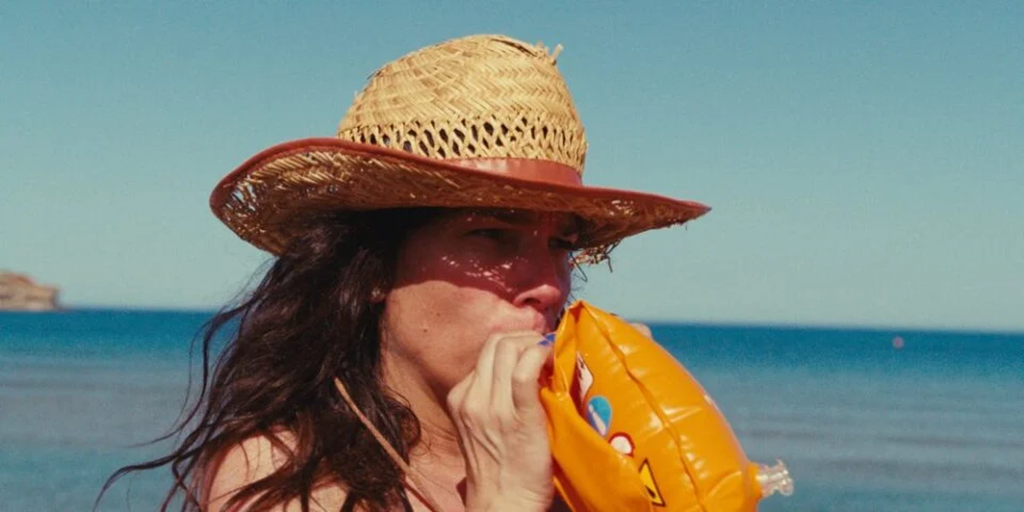
Sophie Letourneur, with a film career spanning the best part of two decades, has received her fair share of accolades in her native France, including the Prix Jean Vigo in 2022 for her witty and self-reflexive style of filmmaking, which deftly balances humor, tenderness and a striking commitment to a formal radicality. Unfortunately for us Americans, Letourneur still remains somewhat of an unknown figure in US film circles. But, this might all be about to change thanks to the first US retrospective of her feature-length works at L’Alliance New York this Spring.
The retrospective kicks off today, April 21, with the US premiere of L’Aventura (2025), the second installment of ‘the Italian trilogy,’ which will conclude with the release of Divorce à l'italienne later this year. In an interview that took place over the phone in mid-March, Letourneur spoke with me about her background in visual art, her tactile creative process, her desire to épater le bourgeois, and her love of the American spirit.
Helen Fortescue: I wanted to ask you about your somewhat atypical trajectory into cinema. Do you think your training and education in the visual arts influenced how you approach your work as a director, and in what way?
Sophie Letourneur: Yes, totally. I consider myself a visual artist before anything else. I started off with painting. I think there’s a relationship to that practice that shows up in the way my films are made; in how the writing process is linked to auditory materials and the way that [the films] are constructed, woven, and glued together. I think [my films] are more comparable to the art of collage and weaving than to storytelling and narrative in the classical, literary sense.
HF: When did you transition to filmmaking?
SL: When my art practice was painting, I had a lot of trouble painting faces. I started to make films on Super-8 and to film “portraits” on Super-8, with one three-minute Super-8 film roll dedicated to each person. I created sound montages out of what these people had said, or sounds that resembled them, things like that, to accompany the images. My first films were a type of portraiture.
Afterwards, I also did a lot of screen-printing. I set up installations with the screen-prints, video and sound pieces. Step by step, I started to make experimental videos at Arts Deco [The École nationale supérieure des Arts Décoratifs] and became a film editor with respect to the video art I was making then. One day, they asked me to make a short film, but I hadn’t decided in the slightest to write fiction or work in cinema. I was approaching it as a visual artist.
HF: Your interest in autobiography and autofiction is very manifest in your films. Where does this interest come from?
SL: I frequently write from concrete material and not material [I come up with] in my head. This existing material frequently makes up the base of my films. This could look like the recordings I make, or maybe other “archives.” I once made a film that was about the private diary of my best friend when I was in college. She had lent me her journal. I really like to start from something very concrete that I can analyze, dissect, play with, modify… That becomes the base from which I work on the script. Consequently, it turns out the most simple thing for me is to use my own archives. So [the interest in autofiction] comes from there! It’s simpler if these archives are my own, especially as it's such an intimate sphere.
HF: I wanted to ask you about the role of improvisation in your filmmaking considering the lack of traditional, literary script-writing?
SL: There’s no improvisation at all at the moment of shooting. By that point, there’s a very specific script, and there’s a very specific rhythm to the script that must be learned [by the actors] very well. This is because [the rhythms of speech] have to match the recordings, the sound tapes, and the audio montages that make up the basis from which I write that were made before shooting.
When I’m writing a film, I frequently go back and forth and re-transcribe or rewrite things, whether from the archives [of materials made in advance] that I use, or from recordings of improvisations that I made especially for the film. But [improvisation] never happens during filming. There are things that help me write and which make up the content of what I write about. I write after having elicited certain situations, which I then record and sometimes film. Then afterwards, I restage all of that. Sometimes I even make a “model” of the film before filming it.
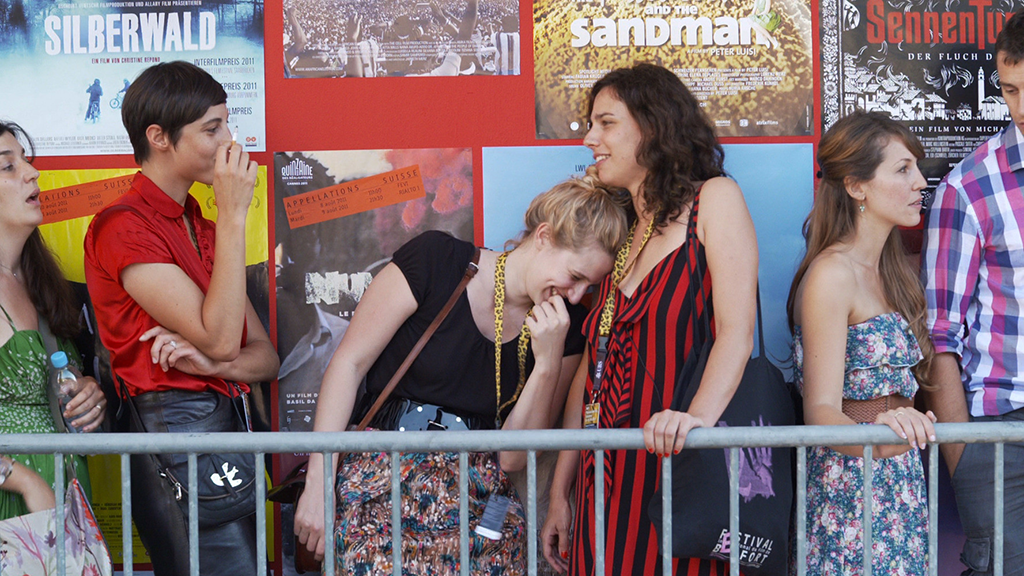
HF: What is it like to act and play a version of yourself in your films compared to directing from behind the camera? I wanted to ask if you had a preference with respect to being an actor versus a director, and what led you to decide to act, as a version of yourself, in your own films.
SL: I had already acted in my first short film, La Tête Dans Le Vide [2004], and then in Les Coquillettes [2012]. What was funny about Les Coquillettes was the setting of the film; the action takes place at the Locarno Film Festival, where I came to present another film that I had made, Le Marin Masqué [2011], in which I had also acted. So it’s there in the idea of the film; it could only have been me who acted in it. Besides that, I acted in Le Marin Masqué because of Laetitia Goffi. She is my assistant director, but I wanted to make her act. She would only act if I acted with her. So, that’s how it went; it was logical that we would do it together.
To be frank, I quite like acting. It’s more precise when I have to tell myself to do things. After that, for my two most recent films, it’s true that we all had earphones in and we were listening to recordings. I knew these recordings extremely well. I had been working on them for years. Acting also allows me to direct from within. This was really important in Les Coquillettes, because the entire film is dubbed. And, as soon as I wasn’t in a shot, I could give directions without being seen. So, frankly [acting, and using the recordings] allows you to “cheat” on a number of things when you’re on set.
HF: You gently mock and undermine the pretension of certain aspects of cinema culture in a few of your films. I’m thinking about Les Coquillettes, wherein the Locarno Film Festival is somewhat “debased” into a hook-up hunting site, but we also see this “anti-cinema” stance in the La Vie Au Ranch and Voyage en Italie. Where does this impulse to mock the world of cinema and make fun of yourself in the process come from?
SL: Yes, it’s true! Even to have chosen, for the first two installments of the Italian trilogy, [the titles] Voyage en Italie and L’Aventura. It’s a means of estrangement and desacralizing, and I enjoy making art that isn’t part of bourgeois culture. I don’t situate myself or my work in bourgeois cinema or literary cinema, or these bourgeois conventions or codes. In fact, I really like a mix of triviality and poetry, comedy and melancholy. Above all, I really don’t want to make snobbish cinema.
HF: You once spoke about how your work is situated in an in-between space, between comedy and drama, with this mixture of laughter, melancholy, and pathos. These elements are all accompanied by a real formal radicality, especially in the first two parts of the Italian trilogy. I wondered if we could talk about your comic influences and what makes comedy in particular an attractive mode for you?
SL: I have a natural disposition toward it. [It begins] when I take the material with which I’ll be working and begin sculpting it and remolding it, and making it into a different form. I think the comic vision, or at any rate the offbeat tone [of my films], is something that comes pretty naturally to me. At the same time, it’s something that moves me very much: observing people by means of making fun of them, or seeing them in their weaker moments. All [those things] move me enormously. I’m very moved by my characters and their situations, as much as I find them comic.
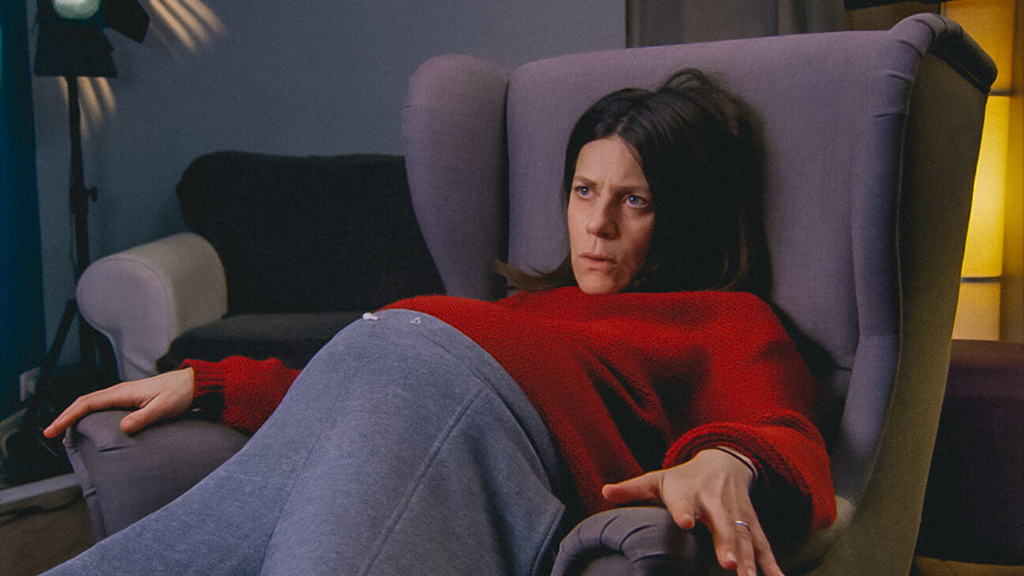
HF: Énorme [2019] was a great success, which led to you being awarded the Prix Jean Vigo. It’s a film that seems to me to mark something of a “turn” in your career and seems to embody a proper “comedy” film in terms of its genre with its focus on excess, the body, the play, and the inversion of gender. How did you come to make Énorme and then, a little while after, to a more intimate, or “lofi,” or autofictional style of cinema.
SL: I’d say that Énorme also came from a very intimate place. I wanted to talk about pregnancy, especially childbirth. That was really the basis of it. I’d already had two children at the time. I wanted to film a birth and I wanted to make a film that was comedic, but one in which we see a little bit of all the facets of pregnancy.
Pregnancy can be everything all at once; it can be beautiful, it can be monstrous, it can be unbearable, it can be perhaps that most beautiful moment of someone’s life, all at the same time. It’s a subject that is so taboo that I realized that in order to do everything I wanted to do, I would have to make things even stranger. Although, of course, I wouldn’t consider my other films to be examples of naturalism or realism; even in Le Marin Masqué and Les Coquillettes, everything is exaggerated. There is always a doubt about the [narrative’s] plausibility.
What’s true about Énorme is that in order to feel that I could be free to say what I wanted to say, I intuited that it was necessary to really break away from realism. I didn’t want what I wanted to say to be enclosed in reductive phrases or thoughts. It was a film we made with very few people in the end. I made it in the same way as the other films, like the Italian trilogy. It’s part of my work [to switch things up]. Right now, I’m working on a film that’s pretty much an action film. Again, a different genre. In any case, I think I enjoy experimentation in every form. Énorme was also about experimentation in a sense. In principle, the use of shot-reverse-shot, and using images which were not made at the same time to construct a film with gaps in it, and mixing documentary and fictional shots [is part of this experimentation]. It’s true that for me, at each turn, there is a question of tone, and of finding a new tone and a new distance from reality. To find a new formal challenge each time. That’s what drives me.
HF: Speaking of pregnancy and birth, what was it like to work with your children in L’aventura? I saw they received writing credits.
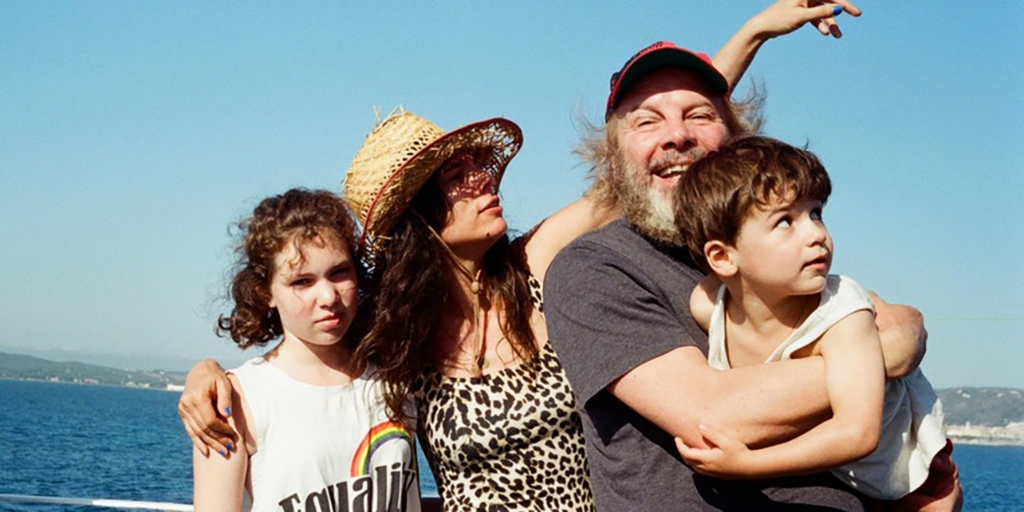
SL: It’s not my own children who act in the film. My daughter is 20 now! My children are credited because I was drawing on recordings, made in 2016, from which we constructed the film. It was Claudine’s idea; she wanted to record all of that. A lot of the dialogues were “made” by them. Then, in 2021, we went to make a first version with the children… They must have been 9 and 15, something like that… We went to make this first version with the script that I’d written. We shot all the scenes and we also made some more improvisations wherein they had to play around pretending to be 3 and 10 years old again. After that, I also consulted them both during the editing process. So, it made sense that they should have writing credits, as it’s really their characters.
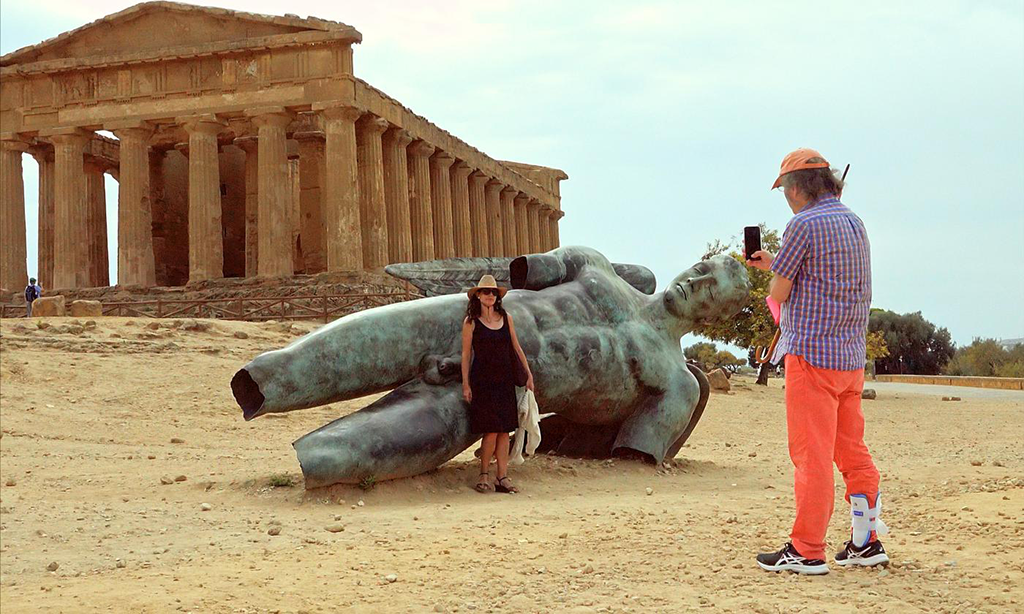
HF: Was “The Italian trilogy” conceived as a trilogy from the start? Also, how did you end up evoking these famous, canonical Italian titles.
SL: I think I found it funny. It started with Voyages en Italie. When we were really on holiday, with the father of my son, he said to me “You haven’t seen Voyage en Italie [by Rosselini]?” It’s the same scene that takes place in the film. He, by the way, is a total cinephile, an intellectual… I’m more of a manual worker! I had actually seen it, but I acted as though I hadn’t because I was jealous of Ingrid Bergman. I said to him that I’m convinced that cinephiles are just sexually frustrated men who are cinephiles just for the actresses. That’s how the film's title came about in the film.
After that, I said to myself, “Well, maybe it would be interesting [as a title], as [the film is] about a couple. Not an exceptional couple, or a bourgeois couple on vacation who always behave really snobbishly. It’s just a middle class couple who have taken their guidebook and they are tourists. Well, it’s romantic tourism. And, their holidays are ruined by the fact they've put too much pressure on these four days to be able to find each other again.
For me, it’s always the question of what deserves to be filmed, what is “noble”, and what isn’t. It’s a political point of view. I don’t want to film privileged people, so [the title] is also a form of provocation. I thought it would be funny to continue along those lines with L’aventura. The challenge of L’aventura, beyond succeeding at filming the children, was to make a film with as few twists and turns as possible. It’s interesting for that reason, with the movement back and forth in time and all that.
L’aventura was at Cannes and they really criticized it for not having a plot. But there is a plot. It’s a story about someone who wants to disappear, who wants to flee. The character Jean-Phi [played by Philippe Katerine] is someone who disappears, not literally, but he is a man who disappears within the couple.
The third part of the trilogy will be called Divorce à l’itallienne. By the way, it’s a film I think I want to make in French and without a doubt with American actors. I think it would be very fun to make a film in two languages with us being interpreted by American actors. It would be “overfiction,” “surfiction.” But it’s also very complicated at the level of production; a Franco-American co-production is complicated. But that would be the final installment of the Italian trilogy!
HF: I love that you call it “the Italian trilogy,” because in my head I’ve taken to calling this trilogy “the summer trilogy.” The first two films really remind me, in some respects, of other emblematic French “summer films,” like Jacques Tati’s Les Vacances de Monsieur Hulot [1953] or the works of Jacques Rozier, or Guillaume Brac’s shorts (and I believe your short works were screened alongside his at a festival once). Elsewhere you’ve mentioned this influence of Éric Rohmer, who of course made many films about summer, summer holidays, and summer romances. I wanted to ask you if you considered these films as part of a larger genealogy, or a sub-genre of French cinema that concerns itself with the depiction of summer?
SL: I’ve made quite a few films that take place during a journey. Les Coquillettes is about a journey; Le Marin Masqué is about a journey. Perhaps because they’re not films that are “written” in the classical sense, the fact that a “summer holiday” offers a departure and a return, and a beginning and an end… It's stupid, but a journey is limited temporally. It functions kind of like parentheses. But they’re parentheses that contain everything else that belongs to everyday life.
Guillaume [Brach] also, and maybe Rohmer too, make “minor” films, films about the small things. Maybe it’s necessary that these small things are contained with a beginning and an end, marked in time and space. It’s for that reason that holidays or travelling are important. For me, this type of filmmaking is also linked to money. Films that are made in and about summer are filmed with natural light, outside. They offer different conditions of space as well.
HF: Something that has played a central part in your film career since its beginning has been your desire to place narrative construction at the forefront of your filmmaking. This ends up complicating the relationship between “the real” and the “narrative” in your films; we see this in Les Coquillettes and Le Marin Masqué, but this desire to render visible the construction and deconstruction of filmmaking reaches its apotheosis in Voyages en Italie, and even more so in L’aventura, in which filmmaking really becomes the subject of the film as much as the family is. Why does filmmaking occupy such a central place in your work?
SL: It feels like throwing a wink to include the film and the necessity of making the film in the story itself. I think it’s a means of justifying the existence of the film in some way. In Les Coquillettes and Le Marin Masqué, there isn’t a question about a film that is being made, but in the Italian trilogy filmmaking itself is one of the themes that elaborates on itself more and more intensely. And, it will be a very strong theme in the third installment. The third film will begin with a scene with the producers, who don’t understand the film at all, who think it’s a financial catastrophe, and [say that] the films don’t sell either in France because the actors are unknown, nor abroad because there’s too much dialogue.
This is why we thought about getting American actors working in English to embody this in some way, and to fictionalize it and dramatize it even more. The whole episode about the divorce will have two different narratives, one that is the narrative about our characters, because we will still act in it, and next to this there will be the American adaptation of our characters. So, little by little, it’s true that the “film within the film” becomes more and more prominent.
I also think that this trilogy is also a means by which I can move on to other things.I think I need to get to the heart of the matter, which is what I did with L’aventura. L’aventura is really the sum total of all of the other films I’ve made before. I employed and experimented with all of the formal mechanisms I had used before. I've gone as far as I can, I think—in terms of the narrative, the direction, the actors, and everything else—and I feel like something is coming to a close in my work, with respect to this trilogy and with respect to the question of fiction and autofiction.
HF: You’ve already shared a lot with us about the third film, but is there anything else you would like to add, or about what’s next for you after this project?
SL: Well, with my way of making films, non-academic films, and the types of scripts and the stories I propose, it’s very complicated to get money to make them. L’aventura cost €300,000 to make, so really very little, and I had a lot of trouble getting French financial backing. I rely on my own company to fund making the films I want to make.
The French system is very “literary” and funding revolves around the script. So, I’m always looking for other means of financing, but it’s getting more and more difficult even though my films cost so little to make. I know in the US it can function a little differently and that there is more funding. My films aren’t well known abroad, including in the US. I had a couple of screenings at MoMA and things like that, but I’d really like to work with the US industry, in particular on Divorce à l’italienne, but also on an adaptation.
I’d like to adapt, for example, Les Coquiellettes [but have it take place] at South by Southwest. I’d like to do these sorts of projects, especially as I feel myself to be quite close to a type of “American spirit,” especially as it relates to what I was saying about bourgeois-ism and snobbishness and all of that. I love American art-house comedy in particular, so I’d really like to make films with American actors, who I often find pretty genius.
HF: Even with the possibility of using American actors, would the third part of the trilogy still be filmed in Italy?
SL: Not necessarily, but there are a lot of Americans who go to Italy! Although they tend to go to Capri. We’ll have to think about it, but I already have ideas… I was thinking about Brad Pitt! I think having [Philippe Katerine as] Jean-Phi and Brad Pitt side by side could be very funny.
“The Films of Sophie Letourneur” runs April 21-May 26 at L’Alliance New York. Director Sophie Letourneur will be in attendance for a Q&A tonight and an introduction on April 28.