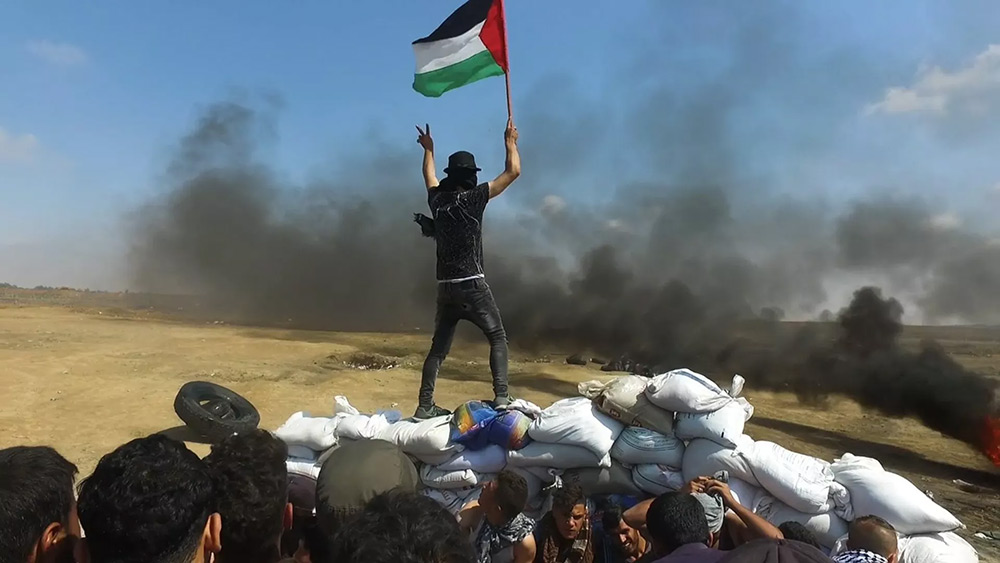
In Gaza Fights for Freedom (2019), Abby Martin documents dispossession as a structure, not an event. Land is taken, then water, electricity, food, and finally speech itself; what remains is a condition of spectral survival, a life reduced to endurance under permanent siege rather than episodic crisis, where even visibility feels provisional. “We look alive, but we’re not,” says a father struggling to feed his kids. This is the logic the Israeli state enforces, made brutally visible during the Great March of Return in 2018, when Palestinians in Gaza gathered week after week along the militarized border. Presented as part of “History as Hashtag: Revolution in the Age of Social Media,” the film resonates as an ongoing record of how images circulate, distort, and resist. It insists on something both simple and radical: that to live in Gaza is to resist. From children playing in the shallows, splashing in water that is as much ruin as refuge, to paramedics running toward gunfire with little more than stretchers and resolve, political struggle here appears diffuse, collective, and inexhaustible.
Formally, the film is classical—voiceover, interviews, graphic reconstructions, chapter headings in all caps—and deliberately so. Martin leans on the evidentiary grammar of documentary to build a case that is less interpretive than cumulative. Official United Nations texts appear onscreen, only to be immediately countered by images of their violation: body-cam footage, phone videos, archival clips, even fragments of Israeli propaganda repurposed as proof. The method is blunt, even repetitive, and that repetition becomes the argument, with the accumulation taking on the force of a counter-history that resists both erasure and abstraction. The occasional use of slow-motion risks redundancy, but rarely lapses into aestheticized misery; instead, it holds the viewer in a sustained act of looking, insisting on the individual lives of each body seen, which statistics so often eclipse. Seven years on, as the machinery of destruction continues, the film’s insistence on historical and witness records feels less like retrospection than a way of historicizing the present, using the friction between official texts and lived images to reveal a pattern of systematic violence.
The film’s strongest impact comes from a sustained layering of archival television images. For several minutes, clips from American news broadcasts follow one another in quick succession, spreading misinformation—interviews cut mid-sentence, statements stripped of context—and feeding a narrative that recasts every Palestinian as a terrorist, collapsing lived experience into a ready-made script for Western consumption. The effect is cumulative and difficult to shake, and the film becomes as much a document of Gaza’s struggle as of the discourse imposed upon it by imperial powers. The making of history and the fight over who gets to tell it, of who gets to define truth and therefore justice, sit at the core of Gaza Fights for Freedom.
Gaza Fights for Freedom screens this evening, May 3, at BAM as part of the series “History as Hashtag: Revolution in the Age of Social Media.”