During the April 8, 2024 solar eclipse, the city of Buffalo, New York experienced 100% totality. This celestial spectacle is captured in one absorbing long take in Humboldt USA (2026) from the Kensington Expressway, the former site of Humboldt Parkway—one of myriad places across the United States named after the 19th century scientific explorer and natural philosopher Alexander von Humboldt. In voiceover, director G. Anthony Svatek speaks to Humboldt: “Today, something strange happened. The sky quickened, a portal opened, and I stepped through.” In the defamiliarizing darkness of the eclipse, the highway vanishes and he communes with Humboldt through their shared awe at natural phenomena—a feeling of wonder which underpinned Humboldt’s radical conception of life on Earth as profoundly interconnected.
Despite having more species and places named after him than any other human being, Humboldt is not a well-known figure in the United States. The 19th century naturalist we remember better is Charles Darwin, due to the notoriety of his ideas of natural selection. By contrast, Humboldt’s legacy appears relegated to a decontextualized, if ubiquitous name. In a telling shot, his face graces a lonely poster on a wall in the Buffalo Museum of Science, ignored by its few visitors. But Svatek treats Humboldt’s geographic namesakes as a map of stories hidden in plain sight. By visiting them, he assembles a poetic portrait of ecology as it is differently practiced and understood today: by hunter-conservationists, by technologists and park rangers, by environmentalists and activists.
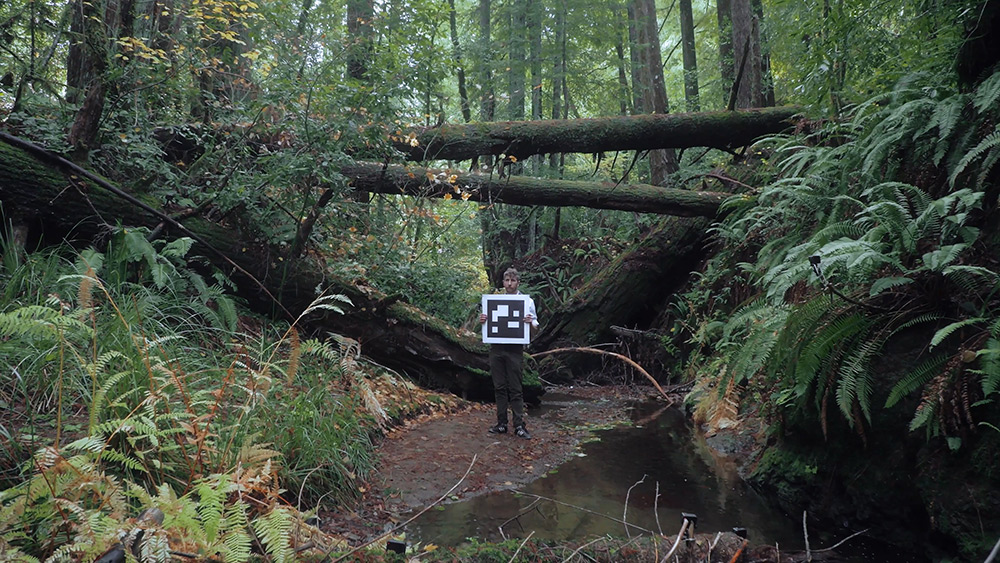
For Humboldt, the study of nature was a romantic, feeling science, a veneration of the joy and artistry involved in measuring the complexity of the world. And, it was done at a much slower pace. In our hyper-networked society, the environmental sciences hinge on advanced computation, digital models, massive datasets, and remote sensing. As someone trained in restoration ecology, I was struck by how well Svatek observed the contradictions and tensions that exist in the field today. Does this increased connection engender a kind of disconnect? In Humboldt County, Nevada, hunters reintroduce bighorn sheep to the hills and mountains where they once roamed. On a computer screen, the sheep are neatly shown as points on a GIS map. This is an abstraction, as seen later, of the messy work of physically transporting large, stubborn animals across the landscape. In Humboldt Redwoods State Park, California, the landscape is itself broken down into a point cloud by researchers photographing and creating a digital twin of the forest. This is data that they will feed to machine learning models in hopes of generating novel insights. Elsewhere in the park, a charismatic ranger makes TikToks for children unable (or perhaps unwilling) to touch grass.
Svatek also explores the promises and perils of technology in his wryly humorous short film .TV (2017), in which a Tuvaluan man recounts, from a not-so-distant future, the disappearance of his island due to sea level rise. The low-lying Pacific island nation of Tuvalu owns the country domain name .tv, which bolsters its economy due to its widespread usage. Since the .tv domain will exist long after Tuvalu is gone (Tuvalu is only represented in the film through videos posted online by a French tourist), its leaders, says the man, decide to migrate the country by uploading it to the internet—this is, in fact, a real proposal. Our obsession with virtualizing and simulating reality fascinates Svatek, because it exposes how scientific measurement not only describes and quantifies the world, but remakes it in our own image.
Back in Buffalo, Svatek hones in on long-time residents who are fighting a simulation of their own. The New York State Department of Transportation, through flashy renderings, proposes the construction of a park elevated above the Kensington Expressway—a meager imitation of the former Olmsted-designed parkway that activists living along the expressway oppose in favor of removing the expressway altogether. One of them, Terry Robinson, points out that the new (and outrageously expensive) park does little to reduce the air pollution and traffic hazards that were heaped onto the community by the construction of the expressway. In the efforts of these activists, Svatek finds a challenge to the forces that warp Humboldt’s rhetoric to serve the flow of capital. When the NYSDOT holds a community meeting at the Buffalo Museum of Science, its halls swell with concerned citizens. Suddenly, Humboldt doesn’t feel alone there anymore. His legacy is carried forward in struggle.
Near the expressway, Svatek films a billboard with a strange haiku written on it: “Paying dues to the / Carbon fixation death cult / Lights on for safety!” These and other poems (by artists Jason Livingston, Phoebe A. Cohen, and Squeaky Wheel’s youth and adult education students) were commissioned by the Buffalo art center Squeaky Wheel and displayed on billboards around the city in commemoration of the eclipse. The poem, in casting the eclipse as an unveiling of our dependence on the natural world, would probably please Humboldt, who saw art and poetry as a way of speaking “truth to nature.” This is precisely what Humboldt USA accomplishes.
Humboldt USA screens this afternoon, May 2, at the Museum of the Moving Image as part of “First Look 2026.” Director G. Anthony Svatek, producer Elijah Stevens, and other crew and subjects of the film will be in attendance.