Art history is easier to learn when artists and artworks are siloed into genres and movements: the chance happenings of Fluxus, the cultural appropriation of Pop Art, the postwar middle finger to tradition found in Abstract Expressionism. But these taxonomies are often applied in hindsight, and many, if not most, artists work across styles, mediums, and messages throughout their lifetime. After finishing his architecture studies at Cornell in 1968, Gordon Matta-Clark became involved with Land Art. (He’d been invited to work as an art handler for pieces by Robert Smithson, Walter De Maria, Michael Heizer, and others in Willoughby Sharp's landmark “Earth Art” exhibition in Ithaca, New York.) Soon after, Matta-Clark moved back to his birth city of Manhattan and became involved with groups and communities that were an extension of his arts practice: FOOD, an artist-run restaurant and venue he co-founded; and The Anarchitecture Group, which he led in criticizing modern architecture from an anarchist perspective. Like his contemporaries, Matta-Clark documented his social commentary and roving multidisciplinary artworks through performances, writings, and photography. But, he remains best known for his "building cuts," some of which he filmed.
With “Constructions / Destructions / Instructions: The Films of Gordon Matta-Clark,” the SF Cinematheque will present a third of the 18 films Matta-Clark made before his untimely death from cancer in 1978 on 16mm. These works prove Matta-Clark’s critical eye was unrelenting when it came to challenging society's use of architecture and its excessive consumerism. Fire Child (1971) documents the assemblage of a trash wall under the Brooklyn Bridge that’s set aflame. This opener sets Matta-Clark's themes clearly, establishing the tension between building something and destroying it, as well as the debate over whether nothing (for example, useless rubbish) can become something (such as a wall, or art), or if nothing will remain just that (a temporary pile of ash). In Fresh Kill (1972), destruction is filmed with a perversely thrilling pleasure as Matta-Clark annihilates his red truck at a dump by driving it against a bulldozer. The experience of watching Fresh Kill is like that of watching a nature doc on an animal hunting its prey, with the bulldozer sloppily and clumsily moving to crush the blood-red metal truck. Captured from several angles, the camera oscillates between the calm nature visible on the dump's outskirts and the 13-minute kill as the screaming of countless seagulls on site accompanies the sounds of crushing metal.
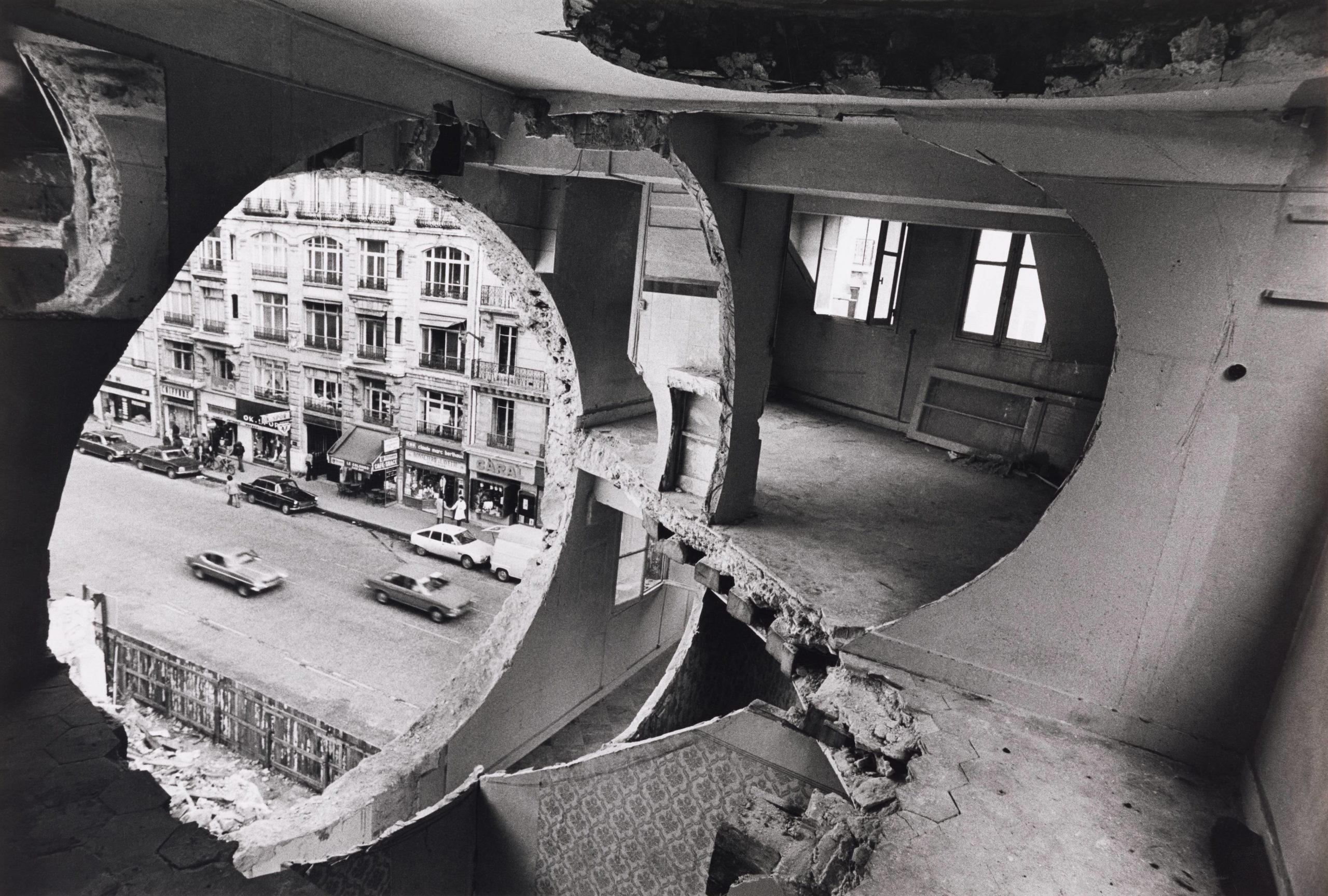
There are then two building cuts: Bingo/Ninths (1974) and Splitting (1974). The first documents how Matta-Clark uses the side of a building in Niagara Falls, NY, marked for demolition as an experimental surface. The second depicts Matta-Clark’s four-month splicing of a house in Englewood, NJ. Conical Intersect, which was made for the 1975 Paris Biennale, expands upon these practices and raises awareness about the controversial erection of the Centre Pompidou, which required the tearing down of centuries-old buildings so that an assuredly contemporary structure could replace them.
Closing the program is Matta-Clark's most formal experimentation, City Slivers (1978). With a shrunken field of vision, the film (shot and edited with help from Betsy Sussler, founder of BOMB Magazine) is disorienting. It’s as if it was shot through several squinting vertical eyelids, an effect Matta-Clark achieved with strips of film that were exposed during filming and then covered before the other strips were exposed. Silent, like many of the preceding titles, Slivers is more photographic than filmic—like a camera obscura that doesn’t flip the image. Matta-Clark's juxtaposition of different city scenes, simultaneously onscreen together, confuses perspective but is also dizzyingly delightful to watch. As the only non-destructive film in the program, Slivers paints a silent portrait of the endless and nameless people who inhabit, and will eventually corrupt, the "nature" we now call New York City. Matta-Clark doesn't have to wield a sledgehammer (a favorite in his building cuts) here; as he already knows and we've already seen, buildings have their own natural cycles, and will be destroyed or break down on their own, with or without an artist's intervention.
"Constructions/Destructions/Instructions: The Films of Gordon Matta-Clark" screens Tuesday, April 21, presented by SF Cinematheque at Gray Area. The program will be introduced by Jessamyn Fiore, Director of the Estate of Gordon Matta-Clark, and Dylan Adamson, collections manager at Vtape (Toronto).