“They had made James Dean, and they wouldn’t let him go,” recounts the narrator of Robert Altman’s documentary The James Dean Story (1957) with Yeatsian solemnity. Onscreen, a slow montage of photographs shows fans screaming in rapture at the premiere and first run for Giant (1956). For years after the actor’s death at the age of 24, Dean devotees in denial latched onto conspiracy theories that his death was a hoax, coveted car parts from the crash of sometimes dubious authenticity, or wrote desperate letters to the deceased star. These eccentric mourning rites brought to surface the paradoxical intimacy of parasocial celebrity relationships: they are inherently built from fictional narratives but rooted in authentic emotions.
Sympathetic to the meaningful complexities of fan culture, Robert Altman’s adaptation of Ed Gracyck’s play Come Back to the 5 & Dime, Jimmy Dean, Jimmy Dean (1982)—a passion project of the filmmaker developed for stage and screen within the same year—returned to the macrocosmic mythos of James Dean to magnify the microcosmic experiences of six women characters from a tiny town near Marfa, Texas.
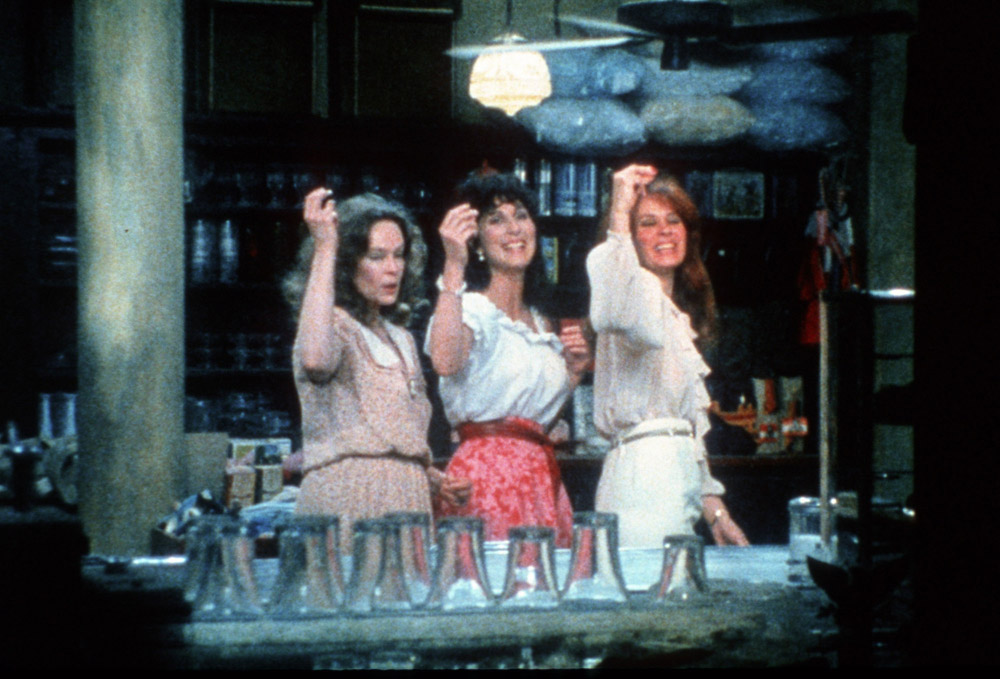
Following the commercial failure of Popeye (1980), Come Back to the 5 & Dime kickstarted a decade in which Altman primarily adapted plays. Featuring a smaller ensemble than much of his quintessential work, the film nonetheless retains his signature reliance on the interpersonal dynamics of a group, with the original theatrical cast reprising their roles. At an anachronistic Woolworth’s five-and-dime, the Disciples of James Dean gather for their fan club’s twentieth reunion. The group includes religious shopowner Juanita (Sudie Bond); her assertive, salacious employee Sissy (Cher); and, the erratic Mona (Sandy Dennis), who claims her son Jimmy Dean is the offspring of the late star. Out-of-towners arriving for the occasion include the bombastic Stella Mae (Kathy Bates), the painfully subdued Edna Louise (Marta Heflin), and Joanne (Karen Black), a glamorous stranger who arrives in a yellow sports car.
Cher, for whom this was only her second major acting role, struts onto the scene with prodigious confidence, letting audiences know that “it’s 118 degrees in the shade, which there ain’t none of. Same as it was yesterday and the day before and last week and last month.” Though this comment sets up a pathetic fallacy indicating that repressed tensions will come to a boil over the proceeding runtime, it also captures the stagnancy of the film’s environment. It’s implied that life has come slowly for those who have stayed in town, changing as infrequently as the weather.
Furthering this atmospheric inertia is a narrative structure that uncannily toggles between past and present, imbuing the film with the disquieting rhythm of a skipping record. Its opening scene nearly repeats itself (to the extent that audiences might briefly wonder if their viewing device is broken) while Mona, Juanita, and Sissy all wear almost identical costuming in both sequences. Some characters who managed to leave town regress to decades old dynamics when they return. Stella Mae deflects her insecurities as cruel snark toward Edna Louise, who can’t manage to escape her own watery meekness (this said, they might have the most functional friendship in the film). Even Joanne—who seems to have moved forward the most, disclosing she is a trans woman who grew up with the group as their friend Joe—finds that the past has seeped into her present, more cosmopolitan life in Kansas City. “I laid back staring at the cracks in the ceiling, like a road map, tracing the route that led me to where I was in that moment,” she recounts of a chance encounter with a familiar face, before breaking out into a pained, hysterical laughter that captures the immensity of her travel.
In true Altmanesque fashion, it’s hard to pick one performance as the thespian MVP of Come Back to the 5 & Dime. Though Cher was nominated for a Golden Globe, each actor has moments of transcendent delivery and reaction. A serious care for the material shared by both filmmaker (Altman ensured an independent distributor) and cast is palpable, and is possibly the reason Gracyck’s play endured despite the limited success of its initial runs.
Intermingling with the film’s deliberately muddled temporality is the claustrophobic coziness of its single setting. Though characters enter and exit from the front or back of the shop, the Woolworth’s serves as a container for the entirety of the film’s action. Beneath a painting of Christ bordered by hot pink neon, a photograph of James Dean is given its own iconic treatment using fairy lights. Amongst brimming shelves of unbought inventory is a plethora of Dean paraphernalia: framed headshots, red, white, and blue streamers, letter bunting, a subtly macabre ceramic bust broken at the neck, and a diorama of the Reata mansion from Giant. “Believing is so funny when what you believe in doesn’t even know you exist,” muses Juanita, speaking equally of her Biblical God and James Dean; both elusive and unknowable, but given life through worship and brought closer to their adorers by repeated stories.
A good five-and-dime might have all the essentials, but where do we stock our grief, shame, and disappointment in places where there’s nowhere to go but out?
In some moments, Come Back to the 5 & Dime showcases powerful sentimental exchanges that point to the importance of dialogue in healing old wounds. Ultimately, the film is restrained in granting catharsis to its characters, preferring to land on a tone of strained ambiguity, impermanence, and the inevitability of suffering. The gobsmacking imagery of its final credits indicates that while sometimes circling back to our past can set us free, it’s halfway between a liberatory unburdening and a storm that passes through but doesn’t break. We carry our lives with us, tracing lines on the ceiling while trying to figure out the logic of an always dated map.
This piece was commissioned to coincide with a screening that was recently cancelled without notice. We'll blast it back out the next time the film screens...