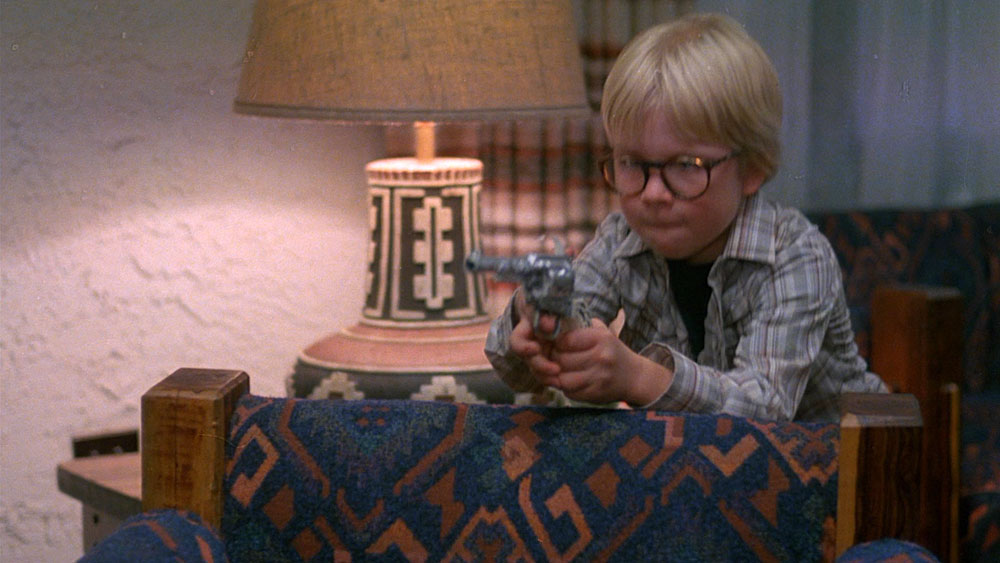
Death Valley (1981) exemplifies the kind of undisciplined, genre-fluid commercial cinema that once filled American screens, first-run houses, and drive-ins alike. It also offers a cross-section of talent, both behind and in front of the camera, that's sure to stimulate trivia heads. The film was produced by Elliott Kastner early in a wild ‘80s run that culminated in the category-defying fever dreams Angel Heart (Alan Parker) and White of the Eye (Donald Cammell)—both from 1987. Death Valley's screenwriter, Richard Rothstein, went on to co-create the cult classic Jean-Claude Van Damme sci-fi franchise Universal Soldier (1992), and Death Valley director Dick Richards helmed everything from a hippiefied revisionist Western (The Culpepper Cattle Co., 1972) to an Oscar-nominated adaptation of a Raymond Chandler noir (Farewell, My Lovely, 1975). Most improbably, the film's ostensible lead is none other than the same flaxen-haired, bespectacled scamp (Peter Billingsley) who ended up starring in Bob Clark's A Christmas Story (1983).
Death Valley opens far from the Martian wastes of the Southwest. Billingsley and an adult are eating hot dogs against a postcard-worthy vista of the Brooklyn and Manhattan bridges. In scarves and long coats, the duo trek through the city, visiting art galleries, browsing bookstores and playing chess in Washington Square Park. One could mistake this opening for the introduction to a Sydney Pollack drama (curiously, Death Valley's director went on to produce Pollack's Tootsie). An admission by Billingsley's father (Edward Herrmann) that a divorce is afoot sends the young boy on a Southwestern journey with his mother (Catherine Hicks) to her home state of Arizona, where an old flame has been rekindled (Paul Le Mat). As Billingsley tries to navigate the dual alien landscapes of the Sonoran Desert—captured in crisp widescreen by cinematographer and future De Palma regular Stephen Burum—and post-divorce pre-adolescence, a sinister figure enters the film. Behind the wheel of a Dagmar-bumpered Cadillac, he materializes on the blacktop and ends up leaving three bodies and the scorched remains of an RV in his wake. As this villain begins hunting Billingsley down over a piece of evidence, the film careens between dread and oddity.
Wilford Brimley plays a clueless sheriff, kitsch cowboy culture abounds and character actor Stephen McHattie turns in one of the most underrated performances of a forbidding eccentric in a decade full of them. Veering into (un?)intentional comedy of awkwardness, climaxing with a low-budget, Zabriskie Point eruption in reverse, and concluding with a stark freeze-frame of a family newly blended and fully traumatized, Death Valley is closer to a late New Hollywood crash-out than a tightly constructed genre piece.
Death Valley screens tonight, August 13, at Nitehawk Cinema Williamsburg on 35mm as part of the series “The Deuce.”