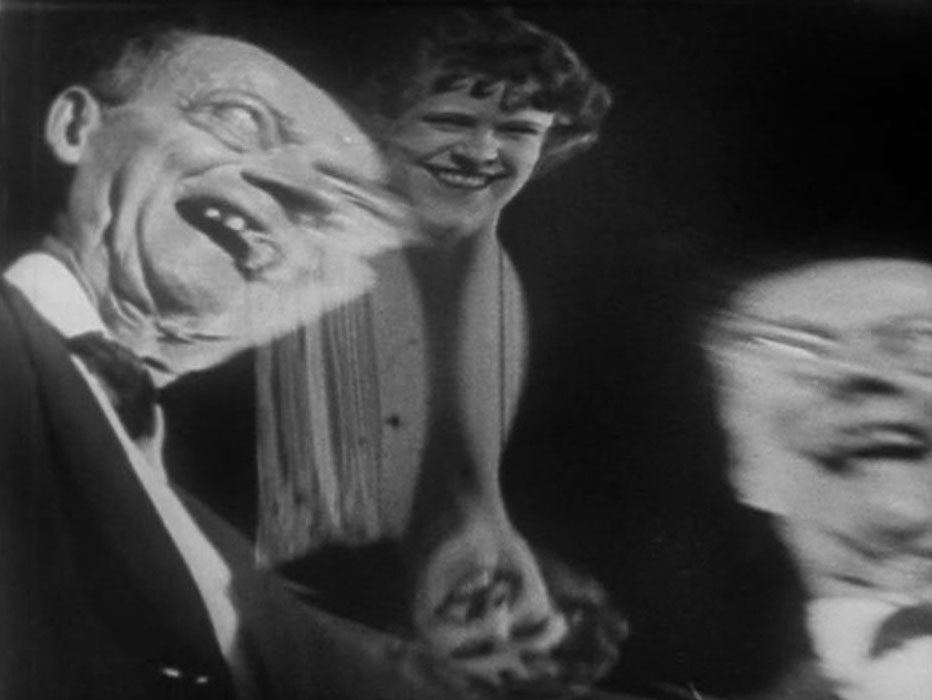
I’ve always disliked the way film historians sometimes simplify the stylistic tendencies of the silent era by making German filmmaking epitomize developments in mise en scène, on the one hand, and Soviet filmmaking developments in montage, on the other. This framing always struck me as reductive, if only because it downplays, if not outright denies, the extent of the cross-pollination between German and Soviet filmmakers at the time. Unlike in France, where it was banned, Sergei Eisenstein’s Battleship Potemkin (1925) received a heavily-celebrated release in Germany in 1926, during which time the director visited the Ufa studio in Berlin and met with directors like F.W. Murnau and Fritz Lang. The influence of this trip, and of German filmmaking in general, on Eisenstein can be felt all the way through his final films of the 1940s. The twisting faces and chiaroscuro lighting of a film like Ivan the Terrible, Part II: The Boyar’s Plot (1945), for instance, is inconceivable in the absence of the profound effect German film would have on him.
Conversely, one can trace the influence of Soviet films, and Potemkin in particular, on plenty of German films at the time. One such example is Werner Hochbaum’s Brothers (1929), a film that is quite open about its debt to Eisenstein. Its opening sequence, cutting from images of police to statues exemplifying the authority of the Kaiserreich, is an explicit homage to the Soviet director’s theories of intellectual montage. Like Potemkin, Brothers revives an episode from the history of the labor movement—the 11-week dockworkers strike in Hamburg in 1896-7—as a rallying point for the contemporary working class. Both films end with the raising of the red flag. The year Brothers came out marks the high point of German proletarian cinema at the end of the Weimar Era. Its release was followed not long after by other landmarks of the tradition, such as Phil Jutzi’s Mother Krause's Journey to Happiness and Marie Harder’s The Proletarian’s Way. All three were produced as part of the cultural front to support the left-wing parties vying to contest the rise of the far right. Each struck some balance between fictional and documentary elements, weaving them together for the sake of open political agitation. Brothers went the furthest of any German film of the time in that all the performers were actual dockworkers without any acting experience.
Hochbaum’s film, which plays this evening at Light Industry in a double-bill with Ernö Metzner’s short film Überfall (1928), is a cavalcade of close-ups of faces, shot at strange angles and edited in symbolically suggestive ways. Überfall, for its part, draws less on Soviet film: its use of mirrors and other optical effects more readily place it alongside Impressionist films, such as those made in France by Germaine Dulac. Together, this pairing goes a long way to show the variety of formal styles in German cinema toward the end of Weimar.
Brothers screens this evening, August 11, at Light Industry. It will be preceded by Ernö Metzner's Polizeibericht Überfall.